Cooking Tips · Techniques

High Altitude Baking

This Cooking Tip is Part 2 about the problems of being in a high-altitude kitchen. The first Tip was about the difficulties of cooking at high altitude. In this one, I want to tackle baking, something that can be even more challenging than cooking at high altitude. If you live above 3000 feet, I’m sure you have suffered your share of fallen cakes or cupcakes, under-done interiors, a dry texture and more. I often speak to people who have given up on baking when they move to our area. In this Cooking Tip, I want to encourage you to try again. You do not have to cease baking if you have a bit of knowledge about what is happening and what can be done about it.

Overcoming the problems of high-altitude baking starts with understanding the source of those problems. As you go up in altitude, air pressure decreases and, as noted in last week’s Tip, water boils at a lower temperature. Consequently, the liquids inside your baked item (or around it if using a water bath) do not get as hot and the baking time may need to be extended. The decreased air pressure also means quicker rising in items that contain leavening agents as the gases rapidly expand. Therefore, your cake rises very quickly – before the batter has had time to set. Once you take it out of the oven, that underdone middle collapses and you have a gummy crater in the middle of your beautiful cake. Another problem is that there is quicker evaporation of liquids, resulting in dry baked items.

If those are the problems, what are the solutions? The first thing to note is that not all recipes fail at high altitude. I encourage you to try the recipe as written the first time you make it. You may be surprised as it turns out wonderful. If not, there are a number of steps you can take. Do not do all the changes at once. Start with making just one or two adjustments and taking notes about the results. If the item still does not turn out as you wish, try more adjustments. In my experience, some recipes just need a slight tweaking while others need more. I have even had one recipe that I just discarded because nothing seemed to work.

Here is a list of adjustments for high altitude baking.

  • Oven temperature – Increase by 15-25 degrees. Monitor the cooking time as, with the increased temperature, you may need to shorten the baking time by about 5 minutes per 30 minutes of cooking time. If you are above 7000 feet, it may be better to leave the temperature alone and increase baking time. The increased temperature at this altitude can lead to over-crusting.

  • Flour – increase the amount by 1 tablespoon per cup of flour. It is also preferable to use all-purpose rather than cake or pastry flour.

  • Liquid — Increase by 2-4 tablespoons per cup of flour.

  • Leavening – decrease baking soda/powder by 25-40% depending on altitude.

  • Eggs – add an additional egg.

  • Sugar – reduce by 1-4 tablespoons per cup of flour. Do not remove more than ¼ cup.

  • Acid – because acidic batters tend to set more quickly as well as holding moisture in batter, substituting buttermilk, sour milk, yogurt, or sour cream (all high in acidity) for regular milk (which is lower in acidity) often leads to an improved result.

Another question you might have is which type of baked goods can be affected by altitude. To some extent, all baked goods could be affected if only by the lack of moisture. Baked goods that rise in the oven are the most affected – cakes, cupcakes, etc. They are likely the ones to give you the most difficulty. Although less of a problem, even muffins and quick breads may need slight adjustments. Some people have concerns with their cookie recipes although many cookie problems are not necessarily related to altitude. I wrote an earlier Cooking tip on Cookie Success. If you have not read this and want to, just email me.

Pies do not rise but may need some extra liquid in the crust as well as a longer baking time.

Making yeast breads at altitude is interesting in that they, too, will rise faster. Some may like this as the waiting time for the dough to double in size is decreased. This, though, is not a total positive. The slower yeast breads rise, the more flavor develops. If you like the resulting product, there is no need to change anything. However, to maximize flavor, you may want to decrease the yeast by about 25% or punch the dough down and allow a second rise to occur. Allowing your dough to rise very slowly in the refrigerator overnight is also something that can enhance flavor – whether or not you live at high altitude.

If you are saying, “This is all too much trouble!”, don’t despair. A quick look on Amazon showed not less than 20 cookbooks written with recipes that have already been adjusted for altitude. Grab one of those and get back in the kitchen. Delightful baked goods are just around the corner!

Cooking Tips · Techniques

The Woes of Cooking at High Altitude

I was at a neighborhood gathering the other night and some of the people (especially those new to our area) were complaining about problems they have with cooking & baking at our altitude of 6000 feet. Some of the things they were saying were a bit inaccurate and everyone had their own solutions. I figured those concerns & misconceptions were probably more wide-spread and thus, I decided to write about this topic. This week’s Cooking Tip will be about problems with cooking at high altitude. Next week’s will deal with baking. Earlier I wrote an entire tip on Candy Making at altitude. If you did not get that one and wish to, just email me and I will forward it to you.

These two tips are mostly for those of us that live at what is called High Altitude. What is high altitude? It depends on the topic for which you are concerned. In baking/cooking, some say 3000 feet and others say 5000 feet. Because of my husband’s job, I have lived in many different states and other countries. As I moved from place to place, I did not personally notice a problem until I moved to an area where the altitude was about 5000 feet. The problem exacerbated when we lived in an area of 7000 feet. Now that we are settled at about 6000 feet, I deal with the altitude problems on a regular basis.

You might ask why altitude matters in cooking. Much of it has to do with the boiling temperature of water. At sea level, water boils at 212°. For every 500 feet that you go up in altitude, the temperature at which water boils drops by 1 degree. If you do the math, you will see that water boils at about 200° at my house. No matter how much I turn up the heat on my stovetop, the temperature of the water in my pot will not get above 200°. The only way I am going to get my water hotter is by using a pressure cooker. The lower air pressure also means the water will evaporate faster. Think about how many recipes call for you to cook something in boiling/simmering water. I would suspect that most of those recipes are written by someone who is used to their boiling point being close to 212°. If you are cooking in water that is significantly lower in temperature, it will take longer to cook. This is especially true with food items such as beans and rice but also applies to pasta, meat, stews and other foods.

What can you do about this problem? The simplest answer is to cook your food longer. However, because of increased evaporation, you may also need more water to ensure it doesn’t dry out. As you near the time you would expect the item to be done, check it. For example, taste your rice and beans to see if they are tender. If not, cook longer and add liquid as needed. I have found my white rice cooks just fine in my rice cooker. I have more problems cooking brown rice. For that, I tend to use the “pasta method” of cooking. Instead of using a water-to-rice ratio, I cook my brown rice in enough water to cover the rice by at least an inch – just as you do with pasta. Check periodically to see if the rice is done and, if not, cook longer but check to see if you need to add liquid. When the rice is done, you may need to drain off excess water. If so, do that, replace the lid and allow it to rest and steam for a few minutes before serving.

For beans, you may consider pre-soaking your beans although your cooking time will still probably be longer than you might expect and you will also need to watch the liquid level. A side problem of this is that with the extended cooking time, the skins sometimes disintegrate. To help with this, lower the temperature so the beans are cooking at a gentle simmer, not a rolling boil. Others recommend adding an acid, sugar or calcium. Acid makes the bean’s cell wall more stable. Sugar reinforces cell wall structure and slows the swelling of the starches. Calcium reinforces cell walls. One expert states that molasses is a good source of all three if the flavor would be compatible with your recipe. She also recommends adding tomatoes (which are acidic) or cooking beans with hearty greens (which add calcium). Another answer is to use your pressure cooker or Instant Pot.

As I mentioned, you may notice similar problems with potatoes, pasta and stews. If you recognize this, plan for a longer cooking time and ensure your liquid does not evaporate, you should be just fine.

If you want to read more, here is a link to discussions on high altitude cooking on the FDA site as well as the Colorado State Extension office.

Happy High Altitude Cooking and stay tuned for High Altitude Baking.

Cooking Tips · Ingredients · Techniques

Custards and the miracle of eggs

When we lived in England, my husband loved some little custard tarts that we would buy from a Portuguese bakery in the town in which we lived. Since then, I have been attempting to re-create them to his satisfaction. Recently, I was testing a recipe from Emeril Lagasse and it turned out to be a winner. Hurray! This testing caused me to think about custard and what a wonderful creation it is. It is something all cooks should know how to do and this is why I am writing this Cooking Tip.

A custard is nothing more than a mixture of milk, eggs and often sugar that is cooked into a thickened product. It forms the filling for these little Portuguese tartlets but a custard is also the basis of crème brûlée, flan, ice cream, quiche and more. It is not difficult to make a custard but there are some hints that I hope you find helpful.

Many custards start by having you beat/whisk the eggs (whole or just yolks) together with the sugar until it has thickened and turned light yellow. Some will recommend you continue to the “ribbon” stage, which means the mixture will form a ribbon as you lift up your spoon and allow the mixture to fall back into the bowl. These instructions are meant to help you ensure that the sugar has mostly dissolved. You do not necessarily need to go all the way to ribbon stage but a good mixing until the color and consistency changes is a good idea.

Some recipes will have you heat the dairy (milk, cream) before adding it to the egg/sugar mixture. This is not necessary unless you want to infuse flavor into the dairy. For example, my tartlet recipe had me infuse vanilla seeds and orange zest into the milk. This was achieved by bringing the cream to a boil, adding those two ingredients, covering it, taking it off the heat and allowing to steep for 30 minutes. I then whisked that steeped dairy into my egg mixture. If I did not want to infuse any flavors, I could have added everything together and then heated it on the stovetop.

If you are told to add hot milk/cream to the egg mixture, the danger is that the eggs will start to cook and you will end up with a scrambled egg mixture. To avoid this, you should “temper” the hot liquid into the eggs. This simply means adding some of the hot liquid very slowly into the eggs while whisking. Once the eggs have been diluted with the dairy, you can put it all back into the pot and continue with the recipe.

If your egg/dairy mixture is started cold, the recipe will instruct you to heat it so as to cook the eggs and thicken the mixture. This heating should be done very gently. Resist the temptation to turn up the heat to speed the process. I love how Harold McGee puts it in his book, On Food and Cooking.

“Turning up the heat is like accelerating on a wet road while you’re looking for an unfamiliar driveway. You get to your destination faster, but you may not be able to brake in time to avoid skidding past it.”

As he goes on to explain, the chemical reactions that cause the thickening of the custard don’t stop just because you take it off the heat. So, if you try to hurry this step, you may easily get to the point of curdling or overcooking.

Some custards are meant to be very soft and creamy while others (such as those that need to be turned out of the container before serving) are firmer. This can be adjusted by changing the proportion of the egg content. If you use more whole eggs or egg whites, the custard will turn out firmer and glossier. More egg yolks (or even yolks alone) produces a softer, creamier custard.

Some recipes will have you add a starch such as flour or cornstarch. These ingredients help with thickening while also protecting against curdling. The recommended amount is one tablespoon of flour or two teaspoons cornstarch (or arrowroot) for every cup of liquid. Whereas this does help guard against curdling, it can also turn a smooth, creamy dish into a thicker and coarser one. Whether your custard is made totally on the stovetop or ends up in the oven, if there is no starch in it, it requires gentle heating. On a stovetop, this generally means using the double boiler method with constant stirring. If in the oven, a water bath should be used. On the other hand, if you do add a starch to the mixture, the custard can be cooked over direct heat on the stovetop or without a water bath in the oven.

A water bath just means putting the custard dishes in a larger pan (such as a roasting pan) that has enough hot water in it to go up about half-way the height of the custard dishes. Even though your oven temperature may be set at 350°F, the water in the pan won’t exceed 212°F (or even less if you live at altitude). This means the custards are exposed to a gentler & more even heat. Some recommend putting a rack in the bottom upon which you place the custard dishes so that they are not directly exposed to the hot bottom of the pan. Without a water bath, the outside of your custard could overcook before the center is done. With a water bath, you are more likely to catch them at the perfect degree of doneness.

All this talk of custards has me salivating over those little Portuguese custard tartlets that I made. I have a few left and those will definitely be dessert tonight! How about you? Is a custard in your near future? Let me know!

Cooking Tips · Techniques

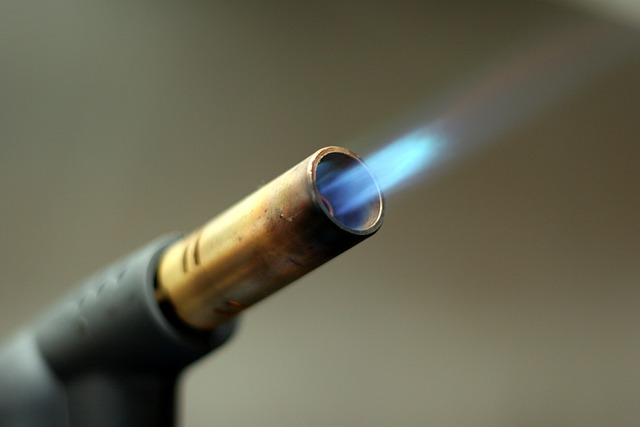
Do you need a kitchen torch?

There are certain kitchen tools that might be considered “essential” to a well-stocked kitchen and then there are others that are “nice to have”. A kitchen torch would, for most of us, be in the latter category. In this Cooking Tip, I want to discuss the uses for this tool as well as some shopping suggestions.

One of the main purposes for a kitchen torch is to apply a brûléed top to certain dishes. Another way of saying this is to caramelize the top. The most classic example is as in a crème brûlée. To make this dish, you make a type of custard, sprinkle sugar over the top and, with a flame, melt the sugar and turn it into a crunchy, caramelized top. Although some recipes will recommend using a broiler for this, a kitchen torch is an easier method with more control over the amount and depth of caramelization.

Custards are not the only dishes which benefit from a small amount of torching. Other dishes that you can brûlée are oatmeal, grapefruit, fresh figs, apples, bananas, goat cheese, cheesecake and so much more.

There are more uses to a kitchen torch than just making a brûléed topping. They are an easy way of getting that wonderful melted and brown cheesy topping on a bowl of French onion soup. Those browned tips on your meringue pie are a cinch with a kitchen torch. Another great idea is to torch your mac & cheese topping in lieu of putting it in the oven if you are impatient for that wonderful cheesy dish.

Have you got the makings for s’mores but no campfire? With a kitchen torch, you can enjoy these in a just a few minutes. I have never tried this but some cooks use their kitchen torches for charring the skin of tomatoes and peppers. This will give you a nice smoky taste and make it easier to peel the item. Some even use it to apply a quick final browning to a piece of meat.

Are you convinced that you need to get a kitchen torch? If so, the next question is which one to buy. I have one made by Kitchen Craft but certainly would not recommend that one. It is much too wimpy to be of much good. On the other side of the spectrum is just using a large propane torch that you would buy at a hardware store. That will certainly do the job, but if you are faint of heart (as I am), it might be a bit intimidating.

There are a few things you should look for when shopping for a kitchen torch. First, you don’t want it too heavy to use easily and it should feel comfortable in your hand. The flame should be adjustable so you can use it for many different tasks. For safety purposes, it is nice to have a lock to prevent it from activating when you don’t want it to do so. Although not necessary, a fuel gauge so you can see how much fuel you have is very useful. Take a look at the warranty, too, in case you have problem after purchasing it.

Different sources recommend different torches but there are some that come up repeatedly in reviews. First is the Iwatani Cooking Torch. Rösle is another brand that comes highly rated. A third quality company is Messermeister. Another brand to take a look at is BonJour. They have a few different models.

Do you have a kitchen torch that you love? Let me know which one it is. Do you have any special ways in which you use it? Please share your favorites!

Happy Bruleeing and Happy Torching!

Cooking Tips · Techniques

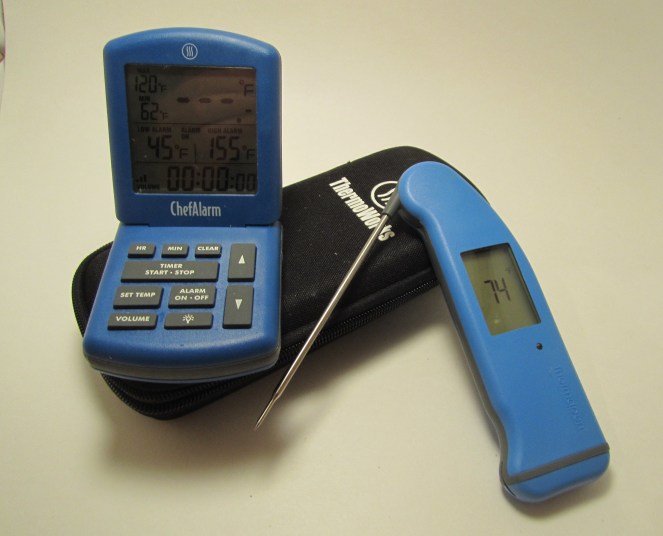
Instant Read Thermometers

All of us have many different tools in our kitchen. One tool all of us should seriously consider adding to our tool chests is a good instant-read thermometer. It has so many uses to improve your cooking from ensuring meats are safe to eat but not overcooked to monitoring critical temperatures in candy making to helping to achieve a wonderful custard. I was recently asked how to know which thermometer to buy and which ones are accurate. That is the subject of this Cooking Tip. This post contains affiliate links and I may earn a commission if you decide to purchase.

I have my favorite instant-read thermometer – the Thermapen from Thermoworks. As these are more expensive than many other thermometers, I also want to tell you how to ensure whatever thermometer you use is giving you accurate readings.

Whatever thermometer you use should be checked for accuracy, preferably by the use of an ice water bath. To be useful, though, this has to be a properly made ice bath. To achieve this, fill a container with ice all the way to the top. If possible, use crushed ice as there will be fewer gaps between the ice. Add water to this container so that it reaches to about ½ inch below the top of the ice. If the ice is floating off the bottom, pour off some water and add more ice. If you have water below the level of ice, it will not be accurate. Insert your thermometer probe and stir in the center. Allow enough time for the reading to stabilize. If you keep stirring, the probe will not rest against an ice cube, which may give an inaccurate reading. Similarly, do not allow the probe to rest against the sides or bottom of the container. Now, your thermometer should read 32°F. If it does not, you should first check the documentation that came with the thermometer to determine whether the reading is within the manufacturer’s accuracy specifications. If it is within that range, do not try to adjust it. If the reading is outside that range, refer to your instruction manual to adjust the thermometer. If you would like a printable chart that details these steps, email me.

Some ask if they can instead use a pot of boiling water to check the accuracy of the thermometer. One of the problems with this is that the temperature at which water boils varies by your elevation. At sea level it is 212°F but this drops approximately 2°F for every 1000 feet you rise in elevation. You need to know what the boiling point is at your location to use this method. For an easy-to-use online calculator, see this link.

Once you know your boiling point, you can use the following method. Fill a saucepan at least four inches deep with water. Place the pot on the stovetop and allow the water to come to a rolling boil. When it comes to a boil, insert your thermometer probe a few inches into the water and wait until the reading stabilizes. Do not let the probe touch the sides or bottom of the pot. Keep it suspended in the water in the middle of the pot. Take this reading and compare it to your locale’s boiling point.

Another theoretical problem with using this method is that impurities or salt in the water can affect the boiling temperature of water. Therefore, ensure your water is as clean as possible.

Once you have an accurately-reading thermometer, your next step is to use it properly. To do this, the tip of the probe should be used and it should be placed in the center of the thickest portion of the food. If the food item is large, be sure to take readings in several places. Insert the probe into the food and push past the center, watching how the temperature reading changes. Then, withdraw the probe, again watching the readings. Typically, the center will have the lowest reading and, therefore, is the best place to gauge doneness.

We are so blessed in our world today to have such great technological advancements that can enhance the results of our cooking endeavors. The food thermometer is just one of those advancements that I encourage all of you to consider.

Cooking Tips · Techniques

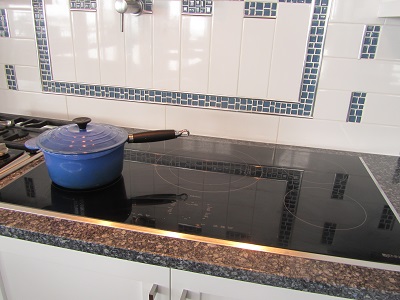
Induction versus gas cooktops

For all of my married life (32 years this May), we have moved from house to house every 2-3 years. Almost all were rental houses and, thus, I had no say about the kitchen or the kitchen appliances. When my husband reached mandatory retirement from that job, we moved here to Colorado and began building our retirement home. Finally, I could have the kitchen I wanted! As I planned that kitchen, I just assumed I would have a gas cooktop. Afterall, doesn’t every avid cook use gas?

About that same time, I began to hear and read about induction cooking. After much research, I finally decided to put in an induction cooktop. Because of a bit of concern, though, I also installed a small two-burner gas cooktop next to my main induction cooktop. Now, three years later, I can tell you that I LOVE my induction. The only time I use my little gas cooktop is if I need more space than I have on my induction or if I want a real flame for something like quickly roasting a pepper. In this Cooking Tip, I would like to explain why you need to consider induction the next time you have a choice about your cooktop.

I love the way Consumer Reports describes induction cooking. “The power and precision of the technology comes from an electromagnetic field below the glass cooktop surface that transfers current directly to magnetic cookware, causing it to heat up. Essentially, induction cuts out the intermediate step of heating up a burner and then transferring the heat to the pot.”

What is so great about induction? It heats much faster than gas/electric but you also have infinitely more control. If you want to turn down the heat, it responds immediately. Compare that to an electric cooktop where you may need to take the pot off the heat until the burner responds. Even with gas, the grate remains hot for quite a while. I can take a large pot of water to a rolling boil in a short time and when I turn off the heat, the boiling ceases within a second or two.

Depending on the cooktop model, you can achieve & maintain very low heat for as long as you want. Most experts will tell you that you should not melt chocolate over direct heat due to the risk of overheating and/or burning. On the induction, this low heat level allows you to safely melt your chocolate and hold it in that melted state. I also often use the lowest settings to keep food warm without overcooking.

These cooktops are very easy to clean. In fact, since the cooktops themselves don’t heat up (although they will be warm from being in contact with the hot pan), you can quickly wipe up spills or splatters as soon as they happen.

So, why not go with induction? Firstly, you do need the proper pots/pans. If a magnet will not stick to the bottom of your pan, it will not work on induction. I have seen an accessory you can supposedly put between a regular pot and the induction cooktop to allow your regular pot to work. I have not tried this but, if it does work, it would not be nearly as efficient or effective.

A minor disadvantage is that most induction cooktops do emit a buzzing and/or a clicking noise. This doesn’t bother me but I did know someone for whom this was a major problem.

Another problem is one that I was not aware of until very recently but, as I think back, I can testify that this is true. I am a big proponent of using digital thermometers for everything from cooking meat to custards and more. The magnetic field of an induction cooktop can interfere with those digital thermometers. Removing the pan from the cooktop is necessary to get an accurate reading. Alternatively, you can use an analog thermometer.

When I decided on this cooktop, I was pretty nervous. Afterall, it is a big purchase and not one you are going to easily change after it is installed. Now, three years later, I can tell you that I am so happy I purchased my induction cooktop. It is wonderful! And, I have never heard the opposite from anyone else who also installed this type of appliance. That says a lot.

Cooking Tips · Techniques

Cast Iron Cookery

I love my cast iron cookware. I have both enameled and unenameled items. Many people shy away from regular, unenameled cookware because they think the care of it is a hassle. In this Cooking Tip, let’s look at what is true and what is not about unenameled cast iron.

Why consider unenameled cast iron? It is extremely durable and will last for years as well as it is affordable. You will never get a better sear on a piece of meat than you will in a hot cast iron pan. It is also great for making a great crust on a dish such as hash or cornbread. It is oven-safe and so, you can go from the cooktop to oven and back again with ease – just beware the handle will get very hot and you must use an oven mitt or pot holder. It can also tolerate very high heat levels, even more than stainless steel.

Many people say a well-seasoned cast iron skillet is as nonstick as a regular nonstick skillet. Whereas it will get very nonstick the more you use it and the more seasoning it acquires, it will never be as nonstick as a modern coated nonstick skillet.

Most new cast iron pans are sold pre-seasoned. Ones you buy at a flea market or an estate sale may or may not be seasoned. Even with a new pre-seasoned pan, you may want to put it through a round or two of seasoning. The nonstick properties will only improve with more seasoning. Of course, just using your cast iron pan on a regular basis improves the seasoning.

Many posts claim one of the advantages is that a cast iron pan will heat evenly, meaning there will be no hot spots. Therefore, your food will cook evenly. In reality, a cast iron pan will develop definite hot spots. Also, cast iron is a relatively poor heat conductor. This means that it is hard to get an even heat distribution across the surface of the pan. The best way to evenly heat a cast iron pan is in the oven.

Those new to cast iron cookery need to realize that a cast iron pan will take longer to heat up than non-cast iron pans. It will also hold on to that heat much longer. Therefore, just because you take it off the heat does not mean the cooking will stop. You must remove the food item from the pan to really stop the cooking process quickly.

Your cast iron pan may be the most durable pan in your kitchen. It is actually sort of difficult to hurt a cast iron pan. And, the more you use it and the more the seasoning builds up, the more durable it becomes. You may have read to never use soap on your cast iron pan. Most experts disagree with this and say that today’s gentle soaps will not harm your pan. Once the seasoning has built up, you may also use gentle scrubbing along with the soap. It is not recommended, though, that you allow your cast iron pan to soak in water. Make it the last thing you clean. Thoroughly dry it and heat on the stovetop until hot. Follow this by rubbing the pan very lightly all over with an unsaturated cooking fat, like canola, vegetable, or corn oil. Buff it well to remove any visible oil. Repeat this process after every use and cleaning. One caveat, do not put it in the dishwasher.

Another care tip you may have read is that you should never use metal implements. According to Dave Arnold, a cast iron expert, it is good to use metal implements as “gentle scraping of metal along the bottom of the pan while cooking helps to even out the surface of the seasoning and make it more durable, not less.”

There are many brands of cast iron cookware on the market. One of the most highly recommended is the Lodge cast iron skillet. I have one and use it on my small gas cooktop. My major cooktop is an induction and I do not like to use it on that due to imprinting of the logo from the bottom of the skillet. Because of that problem, I bought a second skillet without that type of logo, an Analon Vesta. It was more expensive than the Lodge but it was worth it as I can use it on my induction cooktop without worry and – it came in a pretty cobalt blue to match my kitchen!

If you have cast iron pans, I hope this article encourages you to use them more than you currently do. If you don’t have one, I hope you consider adding one to your pots/pans inventory. I do not think you will regret it!

Cooking Tips · Techniques

Meringues — French, Swiss & Italian

Last week’s Cooking Tip talked about different styles of mousse and how some styles used a meringue as part of the dish. In this week’s Tip, I would to spend more time discussing the different types of meringue – French, Swiss and Italian.

In the simplest terms, a meringue is a mixture of beaten egg whites and sugar. It can be used to fold into cake or cookie batters, as a filling, topping or a stand-alone cookie that melts in your mouth when you eat it. Since the basis of a meringue is beaten egg whites, you may want to review the prior Cooking Tip on egg white foams before attempting these different types of meringues.

French meringue is the most basic of the meringues. It is made by beating egg whites to the foamy stage (45-60 seconds) and then slowly adding sugar and continuing to beat into a soft, airy and light mixture. Adding the sugar too early or too late can lead to disappointing results. Adding it after about a minute of beating when the whites have reached the foamy stage but before they begin to form peaks is ideal. This type of meringue is the easiest to make but is also the least stable. Therefore, it is usually used when it is going to be baked – either in a cake batter, meringue cookies or a meringue shell that is then topped with fruit, whipped cream or a type of mousse.

Swiss meringue is prepared differently. Egg whites and sugar are put into a bowl that sits above boiling water – a type of bain marie. When the mixture reaches the temperature of about 120° to 140°F, the mixture is removed from the heat and then beaten to stiff peaks. This method results in a meringue that is less fluffy than French and less stable then Italian. The recipe testers at Serious Eats, though, claim to have found a technique that will make your Swiss meringue as light as a French meringue but as stable as Italian. They do this by cooking it to a higher temperature – up to 175°F. They also whip it vigorously at high speed for about 5 minutes, until it is very glossy, thick & stiff. This type of meringue is often used as the base for buttercream frosting.

Italian meringue starts by putting the egg whites into your mixer bowl and beating to soft peaks. Then, a sugar syrup that has been heated to 240°F is slowly drizzled in while you continue to whip until the meringue is very voluminous and reaches the desired peak. Because this sugar syrup is very hot, one must be very careful when using this method to prevent burns. It is the most stable of the meringues but is also heavy and thick. It is what is used to make nougat and is also the best one for topping meringue pies.

Watching egg whites transform into a beautiful fluffy meringue is almost miraculous. Using this meringue to then top your pie, to lighten your cake batter or to bake into a pavlova or meringue cookie is further evidence of the wonderfulness of eggs!

Cooking Tips · Techniques

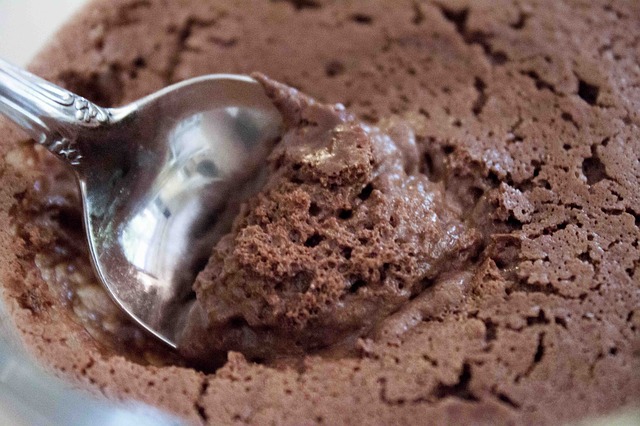
Making chocolate mousse

I am preparing to teach a class on French cooking. One of the desserts I will be doing is a classic chocolate mousse. It really is a wonderful dish to have in your repertoire for entertaining friends and family. There are a myriad of recipes out there but, in this Cooking Tip, I would like to explain the different styles of mousse so you can decide what would be best for you. These are general categories and you will find many variations on them. However, this will give you a solid start on understanding mousse.

A mousse always has two components. There is the base, which is the flavor, such as chocolate. Then, there is the lightener, which is something added to the base to make it airier, such as whipped cream or whipped egg whites.

The first style is called a Quick Mousse and that is just what it is. Start with melted chocolate and fold whipped cream into it. Mousse done!

A second style is Anglaise style. An additional step of making a crème anglaise is required. Crème anglaise is a custard sauce made from egg yolks, sugar, vanilla and dairy such as cream and/or milk. It is often the starting point for making ice cream. This warm anglaise sauce may be used to melt the chocolate. Alternatively, the chocolate may be melted on its own and then combined with the anglaise. After thoroughly incorporating the two, whipped cream is then folded into the mixture.

If you want to make a mousse without dairy, there is the Meringue-style mousse. In this case, you need to make a meringue with egg whites & sugar and then use that to lighten your chocolate base. The meringue can be either an Italian or Swiss meringue. I will discuss the different types of meringues in an upcoming Cooking Tip.

Pâte à bombe is similar to a meringue but is made from cooked sugar syrup and egg yolks (rather than whites), which are then whipped up into a light, creamy consistency. Add to melted chocolate and then fold in whipped cream.

A Pastry Cream mousse starts by making a pastry cream, which is a thick custard made with milk, eggs, sugar, cornstarch (or a mixture of flour and cornstarch) and flavoring. The resulting pastry cream can be used to melt the chocolate and then lightened with either whipped cream or whipped egg whites. This type of mousse works wonderfully as a filling for cakes, tarts or pastries.

A Bavarian mousse is great when you want to make decorative shapes. Because it is set with gelatin, you can unmold it and it will retain its shape.

Although you can make chocolate mousse from any of the above methods, the resulting taste and texture will be different. Which would be your favorite? You may just have to try them all before you can decide! If you do, be sure to let me know your thoughts.


Cooking Tips · Techniques

Is sous vide cooking for you?

A friend of mine decided to give her husband a sous vide machine for Christmas. She knew I had one and asked me how I liked mine. That sparked me to write this Cooking Tip for those of you who might be getting one yourself for Christmas or just want to know more about it.

Let’s start with basics – what is sous vide cooking? “Sous vide” is French for “under vacuum”. It refers to the method of cooking food in a sealed plastic bag (traditionally vacuum-sealed) in a water bath with very precise temperature control. Many high-end restaurants have long used this technique for producing perfectly-cooked and delicious food, especially steaks. With the advent of affordable home kitchen sous vide machines, this is now something that we can all use.

Why would you want to consider investing in one of these machines?

  1. No over-cooking – since the food is normally cooked at the temperature at which you will be serving that food, there is almost no risk of overcooking your food and ruining your dinner.
  2. Even cooking – since the food is surrounded by water at a precise temperature, the food cooks evenly without over-done or under-done spots.
  3. Hands-off – just like your slow cooker, most of the cooking time is “hands-off”. Great results with little effort!
  4. Less moisture loss – when cooking meat in a skillet, the outer layers get much hotter in a quicker time and this leads to moisture loss. It is why we rest meat after cooking to allow the meat to reabsorb this moisture. When cooking sous vide, there are no such “hot spots” and due to cooking at a lower and steady temperature, there is much less moisture loss and no need for a rest after cooking.

Tenderizing tough cuts – with sous vide cooking, you can hold tough cuts of meat at lower temperatures for longer periods of time, which leads to more tenderizing.

Are there any downsides to sous vide cooking?

  1. You need to purchase a sous vide machine. If you have a small kitchen with little storage, you need to consider if you would use it enough to justify the cost and the storage space.
  2. It is not quick cooking. Since the food is cooked in a gentle manner, it takes longer for the item to be cooked thoroughly. It is usually a matter of hours, not minutes. However, it is mostly hands-off time. Yes, you need to plan ahead but that is no different than if you were using a slow cooker.
  3. Sous vide cooking does not result in a nicely browned and crispy exterior. You will need to add a step – that of a quick, high-heat sear to obtain this result.
  4. Cooking sous vide precludes making a good pan sauce since very little fond develops when doing a quick sear. For a prior Cooking Tip on the importance of fond to sauce making, email me and I will send it to you.

If you are looking to get into sous vide cooking, some of the most highly rated machines for home cooking are the Joule, the Anova, and the Sansaire. Mine is made by Kitchen Gizmo and I have been very happy with it.

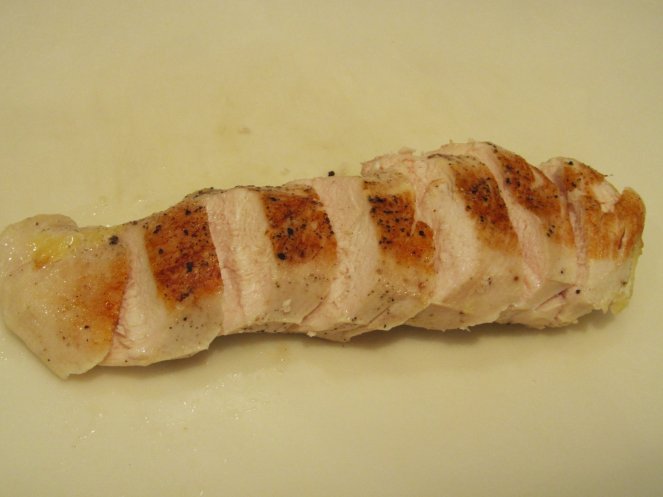
Here are some pictures of my set-up and then making a succulent,
perfectly cooked chicken breast for dinner.

Sous Vide Set-Up

Sous Vide with chicken breast cooking

Perfectly cooked (but pale) chicken breast

Perfectly cooked & then seared chicken breast

Do you have a sous vide machine?
If you do, let me know how you like it and what wonderful delights you have made with it!