Cooking Tips · Techniques

How much water do you need to cook pasta?

Image by Jan Vašek from Pixabay

How do you cook dried pasta? We are all taught that you need to bring a large pot of water to a boil, add salt until it tastes like the sea, add the pasta, stir and cook until it is done. There are some who think this technique is not only a waste of water but a waste of time. That is the subject of this Cooking Tip.

One of the first to discuss the method of cooking water in less water was Harold McGee. In his 2004 book On Food and Cooking, he recommends the standard method. However, in 2009, he began to question this and started experimenting with using less water. He found it acceptable as long as you stirred the pasta as the water was coming up to a boil to prevent sticking. He also had two Italian chefs try it.

  • Lidia Bastianich – She thought the pasta cooked in less water lacked the “gradation of texture” that she liked. She also felt the pasta lacked in the nutty flavor that she expects from a semolina pasta.
  • Marcella Hazen – Her only comment was that it took a significant amount of stirring to prevent sticking and thought it was not worth the effort.

I first read about this alternate method in a book published in 2015 – The Food Lab by J. Kenji López-Alt. He explained that the recommendation for cooking pasta in large amounts of boiling water comes from those that think it prevents sticking and clumping, it prevents the pasta from becoming mushy and it helps the pasta cook evenly. So, in his typical manner, he set out to test this directive.

In his testing, he found the textual difference argument by Lidia was not supported by his results. He did agree that stirring was necessary for the first minute or two. However, he thought this was important no matter which method you used.

Another trial he did was to bring a small pot of water to a boil, added the pasta, brought it back to a simmer, stirred, put a lid on and turned off the heat. He waited the usual 10-12 minutes and found the pasta was perfectly done.

In April of 2023, America’s Test Kitchen put this small amount of water method to the test in their kitchen but also added using cold water from the start.

They put 1 pound of dried pasta in 1 quart of cold water, brought it to a boil and stirred occasionally. They then reduced the heat to maintain a simmer. At this point, stirring was no longer needed as the agitation of the water kept the pasta from sticking. After cooking to the desired doneness, the testers found it cooked up just as well as the same pasta cooked in 4 quarts of boiling water.

They found a time savings of about 45% as the cold method took only 16-17.75 minutes depending on the pasta shape whereas the conventional method took 23.5 – 29 minutes. They also touted the water savings as the conventional method took 75% more water.

If cooking strands of pasta, it would be best to use a 12-inch skillet so all the strands can get covered in the small amount of water. Otherwise, a saucepan is sufficient.

We are also always told to save some of the pasta water to use in finishing our pasta sauce. This is because the starch from the pasta dissolves in the water, which not only thickens the sauce, but also aids in emulsification. This helps to sauce to coat the pasta and gives the sauce that silky texture.

If using the method with a small amount of water, the starch will be concentrated in less water. Therefore, you will use less of it to complete your sauce. If you salt your water before cooking the pasta, use less salt as the pasta water may make your dish too salty. One caveat, this method is not for fresh pasta as it can get too mushy.

Have you ever tried this new method? Do you like it? I have to admit that habit just makes me fill a pan with water and bring it to a boil for cooking my pasta. Next time, I will have to step back and break that habit.

Cooking Tips · Techniques

Make It or Buy It?

I have noticed lists all over the place telling you which items you should make and not buy. Those lists are the opinions of the writers and they vary greatly. I decided to see if there were any similarities in those lists and that is the subject of this Cooking Tip.

For me, there are certain items that I never buy including tomato sauce products (pasta sauce, pizza sauce, etc.), pesto, tortillas, most spice mixes and premade desserts. Some of those made it onto the lists that I had seen but not all.

Here are the items that are most commonly on a “Make It – Don’t Buy It” list. The reasons for these recommendations could be the taste, the nutritional value and/or the cost.

Image by hadevora from Pixabay

Bread – along with the next item, this is the food item that most writers recommend making. Making bread is not difficult and it is certainly cheaper than buying store-bought bread. Most decent store-bought bread is a minimum of $3.50 and can go even higher for artisan loafs. You can certainly make it for a fraction of that. Your homemade bread will also lack the preservatives and other additives that are in store-bought bread. However, you do need time to make homemade bread. I will also include in this category items such as croutons and bread crumbs. They are so easy to make and are a great use for bread that is going stale.

Salad Dressings – Vinaigrettes and other salad dressings are very simple to make and you can make flavors that are difficult to find in the store. Once again, it can also be less expensive depending on the cost of your ingredients. It can be as easy as just drizzling vinegar and oil on your salad or something a bit more involved. This is an item where I admit that I have both in my refrigerator.

Stock – this was second only to bread and salad dressings found on “make, don’t buy” lists. However, making your own stock takes time and ingredients. For example, you need some sort of meat bones for chicken/beef broth, shrimp shells or fish bones for seafood stock. If you have the discipline and space to save those items rather than throw them away, making stock is easy but does take time. You also need to portion it out and freeze it when you are done, which takes freezer space that some just don’t have. I try to make home-made stock when I can but I always have good quality store-bought stock in my pantry as it is a frequently used ingredient for me.

Dips such as hummus, guacamole, salsa and pico de gallo – these are items that you probably don’t have in your kitchen all the time. Rather, you want them for certain occasions or dishes. Because of that, you may or may not have the ingredients on hand when you want them. If you do, you can easily throw them together rather than running out and buying a pre-made version. The cost may be a toss-up.

Pesto – as I mentioned, I never buy this. I tend to make different versions when I have the time and ingredients. I freeze it in ice cube trays and transfer to freezer bags or containers. That way, I always have pesto available and I love having versions made with different herbs and/or cheese.

Nut butters – this is not an item that we consume or use much at all. So, I rarely have them in my pantry in either store-bought or home-made versions. If these are a staple for you, you might want to consider making them especially for those that are very expensive in the stores such as almond butter & cashew butter. You can control what goes into them and also personalize the flavors.

Pancake mixes – making pancakes and waffles is so easy with ingredients that you will almost surely have at home that there is really very little reason to buy pre-made mixes.

Tomato products – I never buy pasta, pizza or other tomato products. It is so simple to throw together a marinara or heartier sauce that will be less expensive and so easy to personalize to your tastes.

Granola – if you have never made your own, give it a try. Just make the amount you want with the ingredients you want. It will save you money and taste great.

Spice mixes – except for very commonly used mixes (Italian seasoning) or those that take a myriad of spices that I don’t have on hand (curry powder, chili blends), I never buy spice mixes. If you have the individual spices on hand, you can use those to make just the amount you want and not have left-over mix that might lose its flavor before you use it again. A perfect example is Pumpkin Pie spice.

There are many other items that are on some lists but the above are the most commonly mentioned. Do you agree with them? What do you never buy? Your list will probably be different than my list or other’s lists. It will depend on your priorities, your time and your desire.

Cooking Tips · Techniques

French Terms in our Kitchens

Image by Gerd Altmann from Pixabay

In the culinary world, there are many French words that are commonly used. As I discovered recently when talking to a friend, many home cooks are not familiar with these terms. That is the subject of this Cooking Tip. There are too many terms to list them all in this Tip. Rather, I will focus on those that the home cook will most likely run across. Whether you are trying to understand an item on a menu or trying to get an idea about a recipe, an explanation of these terms should prove helpful.

Beurre

This is the French word for Butter and you will see many variations of this mainly dealing with sauces.

  • Beurre Blanc – This translates to “white butter”. It is a light sauce made with a reduction of white wine, vinegar and shallots and finished by whisking in butter to create a smooth and emulsified sauce.
  • Beurre Rouge – As expected, the translation of this is “red butter”. It is made similarly to Beurre Blanc but made with red wine instead of white.
  • Beurre Manie – This roughly translates to “butter by hand”. It is an uncooked roux and is made by kneading softened butter and flour together until combined. It can then be whisked into hot sauces or soups as a thickening agent.
  • Beurre Noisette – browned butter. Butter is cooked gently until the milk solids settle out and turn brown and nutty in flavor. Can be used as a sauce on its own or as an ingredient.

Other sauces

  • Béchamel sauce – This is a classic thickened white sauce made with a roux and milk. It can be used as a pasta sauce on its own or as a component of souffles and traditional lasagna.
  • Mornay sauce – If you take Béchamel sauce and add cheese, you have Mornay sauce. The classic cheese used is Swiss or Gruyère but you can vary it based on your tastes. If you have ever made mac & cheese from scratch, you have made a Mornay sauce whether or not you knew that was the name.
  • Velouté – If you make a white sauce with roux and a light stock instead of milk, you have made Velouté. Think Thanksgiving gravy. Velouté may also be applied to a type of pureed soup.
  • Hollandaise – This is a rich sauce made with egg yolks and butter and classically served as part of Eggs Benedict.
  • Béarnaise – If you add tarragon to your hollandaise sauce, you have béarnaise.
  • Coulis – a fruit or vegetable puree and served as a light sauce or garnish.
  • Sabayon – This sauce is traditionally made with egg yolks, sugar and wine, normally Marsala. In Italian, it is known as zabaglione,

Techniques

  • Papillote – a term used to describe food that is cooked and served inside a packet such as parchment or foil.
  • Bain-marie – a method of cooking over a hot water bath. It provides for gentle and even heat and is used in melting chocolate and in cooking items such as custard and crème brulée.
  • Confit – a cooking technique where food is cooked covered in fat at a low temperature. It is usually defined as a method of cooking duck or pork in its own fat. It is also stored in the same fat.
  • Deglaze (deglacer) – a simple technique that involves adding a liquid to a pan that has been used to roast or sauté meat and scraping up the fond that has stuck to the bottom of the pan. It is the first step to making a delicious pan sauce.

French Dishes – here are just a few classic French dishes that you are likely to see on a restaurant menu.

  • Boeuf Bourguignon – a slow-cooked French stew made with beef, red wine, pearl onions, mushrooms and bacon.
  • Bouillabaisse – a traditional Provençal fish soup originating in the port city of Marseille.
  • Cassoulet – another French stew but classically made with sausage, confit (typically duck), pork and white beans.
  • Coq au Vin – translated as “rooster with wine”, this is a French chicken stew made by braising chicken with wine, bacon, mushrooms and red wine.
  • Croque Monsieur – an elevated ham/cheese sandwich layered with Bechamel sauce. If you put an egg on top, it is called a Croque Madame.
  • Gougeres – French cheese puffs
  • Profiteroles – cream puffs
  • Ratatouille – a traditional vegetable stew made with summer vegetables such as tomatoes, zucchini, peppers and eggplant.
  • Tarte Flambée – also known as Flammekueche or Flammkuchen, it is an Alsatian-style pizza. With a thin crust and spread with cream, onions and smoked pork bits, it is delicious.

Miscellaneous Terms

  • Bouquet Garni – a mixture of fresh herbs (normally thyme, parsley & bay leaf) tied together with string or wrapped inside a leek leaf and used to add flavor to stews and soups. The herbs may also be enclosed inside cheesecloth or a spice bag. In that case, it would be known as sachet d’épices (spice bag or sachet).
  • Aioli – this is usually described as a garlic flavored mayonnaise and served with vegetables and fish.
  • Roux – a mixture of fat and starch (usually butter and flour) cooked to desired color and then used to thicken sauces and, at times, add flavor. This is the basis for many sauces.
  • Mirepoix – used as the base for soups, stews and sauces, it is composed of chopped vegetables. The typical composition is onions, carrots and celery. Variations on this are discussed in this Tip.

I hope this brief foray into how we often see the French language creep into our kitchens will save you time as you look at recipes or restaurant menus.

Cooking Tips · Techniques

Fond – French for Flavor!

If you cook very much, you are sure to run across many culinary terms that are French in origin. One such word is “fond”. The literal translation of “fond” is “bottom” or “base”. However, I like to think of “fond” as “flavor”. What it is and why it is so important in cooking is the subject of this Cooking Tip.

Image by Felix Wolf from Pixabay

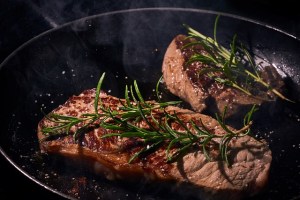
In reality, fond is what we call the browned bits that remain in the pan after sautéing or roasting meat or vegetables. These little bits are concentrated flavor that you don’t want to throw away. Instead, you want to incorporate those into the dish you are making.

Fond is formed when proteins are exposed to heat and result in a brown and crusty exterior. Chemists call this process the Maillard reaction, which is a reaction between a sugar and an amino acid. (This is different than caramelization, which only involves sugar.)

To encourage the development of fond, there are a few things you can do. First, use the right kind of pan. Generally, you want to stay away from non-stick pans. You won’t develop as much fond. Also, searing meat/vegetables require a high heat, something that is not recommended for non-stick pans.

Another point is to make sure your food is not crowded in the pan. Otherwise, your food will steam rather than sear, inhibiting fond formation. Finally, make sure your food is dry, that the pan/oil is hot and don’t move the food around too much. Allow it to sit and brown. If your food sticks when you try to flip or move it, it is not ready. Let it cook a bit longer and it will release itself and leave behind great fond.

The way to incorporate the bits of fond into a sauce is by a process called “deglazing”. Deglazing involves adding a liquid to the hot pan. Using a tool that won’t hurt your pan, scrape the fond off the bottom of the pan into the liquid.

To turn this into a great pan sauce is quick & easy. After searing your meat, take it out of the pan and set aside. Pour out any excess grease or oil. Although not necessary, it is nice to add some aromatics or spices, such as minced shallot, garlic, cumin, or paprika. Cook over medium heat until the aromatics just become tender and the spices bloom, scraping up the brown bits. Now, add the liquid of your choice – water, broth or wine – continuing to scrape up any remaining fond. Cook until the liquid is reduced into a sauce-like consistency. Some chefs will start with wine, cooking it until it is almost evaporated and then add broth, cooking until it is again reduced. Off the heat, whisk in a pat or two of butter for richness.

One final advantage of deglazing your pan is that it is a great way to clean the pan – much better & easier than scraping it off and sending it down the drain!

Cooking Tips · Ingredients · Techniques

Making a roux – a necessary skill

Something that is often used in our kitchens is something called a “roux”. Whether or not you knew the name, I am sure you have made it. What a roux is, how to make it and how to use it is the subject of this Cooking Tip.

Roux is a French term that literally translates to Red. In simple terms, it is a mixture of starch and fat that, after being cooked over heat, is used to thicken liquids but it also adds flavor. The starch that is most commonly used is flour and the classic fat is butter. The Professional Chef by The Culinary Institute of America defines a basic roux as 6 parts flour to 4 parts fat, by weight. However, most sources recommend a 1:1 ratio of flour to fat.

One can use either the stovetop or oven method although the stovetop is the most common. The procedure is to melt the fat in a saucepan without browning it. The flour is whisked into the melted fat to form a paste. This is then cooked to eliminate the raw flour taste and aroma. How long you cook it will depend on what type of roux you want. The length of cooking does affect the thickening ability of the roux. The longer you cook it, some of the starch in the flour breaks down resulting in less thickening power. To compensate for this, add about 25% more flour for a longer cooking roux.

Liquid is then added in a thin, steady stream (or a couple of tablespoons at a time), whisking all the time to achieve a homogenous consistency. Adding it slowly or in small increments will produce a much smoother sauce. If you do get clumps, whisk vigorously or use an immersion blender to smooth it out. As the sauce is then brought to a simmer, it will start to thicken. The heat should be reduced as you continue to stir until the sauce coats the back of a spoon (nappé stage). At this point, season with salt and pepper and any other desired seasoning.

The advantage of the stovetop method is that it cooks relatively quickly. The downside is you must keep your eye on it so it doesn’t darken too much or burn.

A roux may also be cooked in an oven but for a blond roux, it can take up to 1½ hours at 350 degrees. It must cook even longer for a darker roux. It can cook without a lot of your attention but what you save in that aspect, you lose in time.

Substitutions for butter

  • Lard – better for more rustic dishes such as gumbo than for delicate white sauces.
  • Oil – it is fine to use an oil but realize that stronger flavored oils will give that same flavor to your roux and eventual sauce. Therefore, you will probably want to use a neutral oil. Also, if you are going to do a darker roux, you will want an oil with a high smoke point. Oil will not, though, give you the richness that butter imparts.

Substitutions for flour

  • Rice flour – this is a nice gluten-free alternative and can be substituted 1:1 for the flour.
  • Cornstarch– this has a higher starch content than flour and therefore, will need more liquid. It is usually made into a “slurry” by mixing it with liquid and added near the end of the cooking process to achieve the thickness you want. Start be mixing 1 tablespoon of cornstarch with 1 tablespoon of cold liquid.
  • Arrowroot – similar to cornstarch but use only 2½ teaspoons to 1 cup of liquid. Arrowroot does not require cooking. In fact, heat and abundant stirring can inhibit the thickening power.
  • There are some other differences between these starches.
    • A grain-based starch (flour, cornstarch, rice) gives you great thickening but does look slightly opaque when it is cool. It can actually set up into a gel that can be sliced or molded. It can be re-heated without thinning out but should not be frozen as it can get watery when thawed.
    • A root or tuber starch (arrowroot, potato starch, tapioca starch) is great when you want the product to be clear and glossy when set. Although it thickens well, it does thin some when it cools. It will thin if reheated but does freeze and thaw well.

Types of roux

  • White roux – it is barely colored, chalky or very light beige. It normally takes less than 5 minutes to make. It is used to make a white sauce such as a bechamel, which can be served on its own or used to make a macaroni and cheese. It is also used to thicken soups.
  • Blond roux – this is golden in color with a slight nutty aroma. It may take up to 15 minutes to get to a blond color. This is commonly used to make gravy but can be used in other sauces and to thicken soups.
  • Brown roux – this roux is deep brown with a pronounced nutty aroma and may take up to 30 minutes or so. It is typically used to make a brown sauce such as espagnole.
  • Dark roux – taking up to 45 minutes, it is commonly used for Cajun and Creole dishes. Because of the prolonged cooking time, it will add flavor but will have lost much of its thickening ability. Most cooks will opt for oil over butter due to the long cooking time as it would be very easy to burn butter.

One ounce of roux will thicken one cup of liquid to the nappé stage. You may adjust the amount of roux based on how thick you want the finished product.

Storage

Let cool to room temperature; transfer to air-tight container or bag. Refrigerate and it should last up to a month. For longer storage, freeze either in small bags or ice cube trays. It can last up to a year.

As I said earlier, I am sure you have made a roux but for most of us, it would probably have been a white roux or maybe a blond one. I hope this Tip will not only help you understand a roux but will help you see how you can manipulate it for different results.

Cooking Tips · Techniques

Burgers – to smash or not to smash?

Image by Thorsten Frenzel from Pixabay

My husband and I went out for a burger the other night as I had a coupon for a free burger. (Don’t you just love free?) This place did regular burgers but my husband also likes to go to a place that does smashed burgers. What is the difference and is one better than another? That is the subject of this Cooking Tip.

If you want to learn to make a great burger at home, you may want to review two prior Cooking Tips. One was on what type of beef to use and the second was on burger cooking advice.

Even though some date the origin of smashed burgers back to 2007 when the Smashburger chain opened its first restaurant, the method actually goes back much further. According to Blue MauMau, “The story is that the original Dairy Cheer hamburger shop owner Bill Culvertson, created the “smashed burger” when a worker discovered that smashing the meat with a No. 10 bean can while grilling was a great way to get the best flavor into a burger.”

What makes a smashed burger different than a regular/thick burger is the cooking method. To put it simply, the meat patty is put in a very hot pan and then smashed down into a thin burger. But, isn’t this counterintuitive to the recommendations for cooking burgers? Weren’t we taught that you should never squash your beef patty as all the juices would leak out, leading to a dry burger? It turns out that piece of advice is not necessarily true. (For other culinary myths, see these Cooking Tips – Part 1 & Part 2.)

The goal of a great smashed burger is creating a crispy outer crust and juicy interior. Let’s look at the method to create a smashed burger and the science behind it.

Start with good quality cold meat and form balls of about 2-3 ounces. Some recommend forming the balls and placing them back in the refrigerator for about 15 minutes. Each serving will be two patties. This gives you maximal crust and flavor. Heat a heavy skillet until very hot. Do not use a nonstick skillet. Not only will the nonstick surface inhibit the crust formation, but also the high heat can ruin your pan. Finally, the nonstick coating can vaporize and possibly be bad for your health.

Both Cooks Illustrated & Serious Eats recommend putting a small amount of oil in the skillet and rubbing it in with a paper towel. Then, proceed to heat the skillet over medium-low heat for 5 minutes. You can either season your meat just before placing it in the hot skillet or immediately afterwards. When the skillet is very hot, place your balls of meat in the skillet. Only place two balls in a 12-inch skillet. Now, immediately (within 30 seconds) firmly press down to form flat patties of about 4 to 4½ inches in diameter. One method is to wrap the bottom of another small skillet with foil and use this to press down on the patties. Others will use a firm metal spatula. You can even purchase a burger press.

Cook, without moving, until at least ¾ of each patty is no longer pink on top, about 1½ to 2 minutes. You want the patties to stick to the skillet. Use a thin metal spatula to loosen the patties from the skillet being sure to scrape up all the brown bits adhered to the skillet. Flip patties and cook until done, about another 15 to 30 seconds.

Now, to the science. It has to do with what is called the Maillard reaction. This is a type of browning that occurs due to a reaction between a sugar and an amino acid in the presence of heat. (This is different than caramelization, which only involves sugar.) Since the meat patties are pressed down for maximal contact, you get more of the Maillard reaction happening and thus, more browning and more delicious flavor. For this browning reaction to occur, the foods need to be heated to at least 300°F and are accelerated at temperatures higher than that.

There is a reason why you can do this pressing without losing moisture but you must do it early in the cooking phase. According to Serious Eats,

“When ground beef is cold, its fat is still solid and its juices are still held firmly in place inside small, chopped up segments of muscle fibers. That’s the reason why you can push and press on ground meat without squeezing out too much liquid, and the reason why you can smash a burger during the initial phases of cooking without fear of losing moisture.”

If you try to smash after a minute, you lose much more moisture and end up with a dry burger. According to Serious Eats, “a good 50% more moisture is lost in a burger smashed after 1 minute versus one smashed within 30 seconds.”

That is all there is to cooking a great smashed burger. Not only is cooking a smashed burger much quicker, it is also more fail-proof than cooking thicker burgers. And, in my opinion, even more tasty. Do you smash? If not, give it a try and let me know what you think.

Cooking Tips · Techniques

Clean Eating – Good or Bad?

A phrase we have all probably heard over the past few years is Clean Eating. Is it just a catch phrase, a trendy talking point or is there more to it than that? That is the subject of this Cooking Tip.

Since the term “clean eating” is not a regulated term, there is no one definition for it. Food manufacturers can put that label on their food products but, without an agreed-upon definition, it is pretty meaningless. Also, it can mean different things to different people.

At its most basic, clean eating is healthy eating. If you had to compare it to something that the consumer is more likely to understand, it is very similar to the Mediterranean way of eating.

It generally means a type of eating that includes fruits, vegetables, whole grains, healthy proteins and healthy fats. It also means limiting refined grains, preservatives, unhealthy fats and excessive added sugar and salt. Earlier this year, I wrote a series of Cooking Tips on just this subject of cooking and eating healthy. Rather than repeat all of that in this Tip, see these prior Tips for more information.

Some Clean Eating advocates will emphasize other requirements such as:

  • Only eating organic produce. For some of the pros/cons of buying organic, see next week’s Cooking Tip.
  • Gluten Free
  • Dairy Free
  • Some will also include the environment in the list of items to consider.

Although trying to eat healthier and trying to incorporate Mediterranean eating principles is a good thing, there are cautions to be made if this “Clean Eating” is taken to an extreme. Some clean eating recommendations can be so restrictive that the intake of essential nutrients suffers.

There is even an eating disorder termed Orthorexia Nervosa (ON) that has been defined as “an obsession with proper or healthful eating”. It has not been added to the Diagnostic and Statistical Manual (DSM) as an actual disorder but is being recognized more and more.

Currently, there is no universally shared definition of ON. According to the National Eating Disorders Association, some warning signs and symptoms are:

  • Compulsive checking of ingredient lists and nutritional labels
  • An increase in concern about the health of ingredients
  • Cutting out an increasing number of food groups (all sugar, all carbs, all dairy, all meat, all animal products)
  • An inability to eat anything but a narrow group of foods that are deemed “healthy” or “pure”
  • Unusual interest in the health of what others are eating
  • Spending hours per day thinking about what food might be served at upcoming events
  • Showing high levels of distress when “safe” or “healthy” foods aren’t available
  • Obsessive following of food and healthy lifestyle blogs on social media
  • Body image concerns may or may not be present

This can lead to distress, anxiety, or obsessive-compulsiveness. According to Rachel Hartley Nutrition,

“Clean eating creates guilt and shame around food by creating hierarchies – clean, good foods vs. dirty, unhealthy bad foods. This binary approach is nutritionally inaccurate. While certainly there are foods that contain more nutrients than others, what makes a food a “healthier” choice is much more nuanced than vitamins, minerals, and fiber. Convenience, social and cultural connection, as well as other situational and individual factors all play roles that are just as important. Even if nutrition was as simple as good vs. bad foods, labeling food in such a way doesn’t actually help you eat those foods in a healthy way. Labelling food as good and bad fuels disordered eating behaviors, especially the restrict-binge cycle. In other words, thinking of a food as bad doesn’t necessarily mean you would be eating less of it, just that you would be eating it more chaotically.”

Clean eating is also very isolating as it makes it very difficult to socialize with friends/family if any sort of meal is involved. This, in itself, can be damaging to a person’s overall health.

As with so many things in life, Clean Eating is not all good nor all bad. If it helps you to get on the path to healthy eating, that is a good thing. If taken to the extreme, it can be dangerous. Let’s all make this year one of enjoying food in a healthy manner, which can greatly enhance our lives.

Image by S K from Pixabay
Cooking Tips · Ingredients · Techniques

Flavor in your food – Natural or Artificial?

Do you read labels on the food and beverages you buy? I have to admit that I do read the labels although probably not as much as I should. If you have read labels, I am sure you have come across the word “flavoring” or “flavors”. Sometimes these words will be preceded by other words – “natural” or “artificial”. What do these words mean? Does it even matter? That is the subject of this Cooking Tip.

As with so many things, it is our government that defines these terms and the use of them. Their definitions may or may not be of much use to you as they are very wordy and not exactly easy to read and understand. If you wish to read the FDA’s definition of natural and artificial, see this link to the relevant section of the Code of Federal Regulations.

After wading through the government’s definitions, there are some points that can be pulled out.

  • Both natural and artificial flavors come from the laboratory. It is just that natural flavors come from plant or animal sources. Artificial flavors can be made from inedible substances. According to a professor at Harvard, natural and artificial flavors may be the same exact molecule. An example given by a spokesperson from the Museum of Food and Drink involves lemon flavor.

    “You can have a “natural” lemon flavor made from citral, which is a chemical found in lemon peel. You can also have an “artificial” lemon flavor made from citral, which is processed from petrochemicals. The only difference between these two chemicals is how they were synthesized. Your sensory experience of each will be exactly the same, because they are the same chemical. The most important thing to note is that “natural” citral does not need to come from lemons; it can come from plants like lemongrass and lemon myrtle, which also contain citral. In short, the word “natural” does not necessarily mean a product is better for you, or more sustainable.”

  • Both natural and artificial flavorings are added to the food item to obtain the desired flavor. For example, if a lemon-flavored beverage says it contains “water & lemon flavoring”, something was added to it to give the lemon flavor. Contrast that with an ingredient list that says “water and fresh lemon juice”. There, the lemon flavor is derived totally from the juice that is blended into the water.

  • Natural and artificial flavors can also be used together to achieve the flavor that consumers want.

  • The term “flavoring” does not necessarily mean just one flavor. The FDA does not require food/beverage companies to list each flavor separately although some companies will go to that extra step. For example, the ingredient list for a tea that I have reads “Green tea, Pomegranate Flavor and Acai Flavor”.

  • Although there is a difference in origin, there is no nutritional difference between natural and artificial flavors. The nutrition (or lack thereof) in a food comes from the food itself, not added flavor.

To understand this a bit more, let’s delve into what flavor is. What flavor you perceive when eating or drinking a food item is mostly determined by the volatile chemicals in the food. These not only contribute to flavor but also to aroma as smell makes up 80 to 90 percent of the sense of taste. An interesting fact is that a single flavor can consist of 50 to 100 different chemical compounds that might be derived from natural and/or artificial sources. Besides the actual flavor chemicals, flavorings also contain solvents, emulsifiers, flavor modifiers and preservatives. In fact, according to flavor experts, these often make up 80 to 90 percent of the mixture and are called “incidental additives.” The FDA defines these as “present in a food at insignificant levels and do not have any technical or functional effect in that food.” These do not require disclosure on food labels. The manufacturer might use a natural solvent such as ethanol but may also use synthetic solvents such as propylene glycol. An exception to this is that the flavor in “organic foods” must be produced without synthetic solvents, carriers and artificial preservatives.

The people that create flavors are incredibly talented and skilled professionals known as flavorists or flavor chemists. For natural flavors, the specific chemicals are identified and isolated from natural sources, such as essential oils from fruits. A flavorist will use this data to develop a specific flavor profile. Often, flavors are a combination of many different natural ingredients.

For artificial flavors, the flavorist looks at the chemical composition of the natural ingredients and then goes on to create flavor profiles using synthetic ingredients. This artificial flavor can then be added to foods and beverages.

Why create artificial flavors? It is a matter of cost, availability and flexibility. A flavorist at The International Flavors & Fragrances, Inc, uses the example of the flavor of passionfruit. According to her, if a vodka company wanted to use actual passionfruit for a passionfruit flavored beverage, it would require a quarter of the world’s passionfruit supply. That is, obviously, not feasible. So, the flavorists look for more inexpensive sources to create a flavor that mimics the actual fruit. The lab works to identify the molecular fingerprint of the fruit and then they look for similar compounds that are available in the flavor lab. In the case of passionfruit, it might start with grapefruit essential oils and then other tropical fruit oils might be added. The result is “passionfruit flavor”. It is created totally in the lab and may not contain even a gram of real passionfruit. However, it can still be called natural on the label.

Similarly, there are not enough vanilla beans in the world to meet demand for this extremely popular flavor. Also, as you may have noticed if you have recently purchased vanilla beans, their cost is extremely high. However, the compound that gives vanilla its favor profile (vanillin) can be synthetically derived from other sources at a much lower cost with more abundant supply.

So, we see that there is no difference in the flavor we perceive from artificial or natural flavorings and there is no nutritional difference. Is there a difference in safety? According to experts, unless you have an allergy to a specific ingredient, natural and artificial flavors are safe for consumption at intended levels. If you have very specific allergies, this may be a bit difficult as the manufacturer will not list all the chemicals involved in making the flavoring. Just because the intended flavor is banana, that does not mean that there is any banana in the product at all. Rather, it will be composed of many chemicals that when put together create the banana flavor. If you are this type of person, you may need to contact the company or, if possible, avoid any food or beverages with added flavoring.

How do you feel about natural versus artificial flavor? Does it matter to you? Everyone must make their own choice but I hope this article helps you to see it is not as simple a matter as it might seem. Stay tuned as next week, I will discuss all the colors that are added to food!

Cooking Tips · Ingredients · Techniques

Cookies – make them the best they can be!

Image by Jill Wellington from Pixabay

Although making cookies is something we do all year-round, it certainly ramps up during the holiday season. Many of you probably have wonderful memories of making cookies with your mother or grandmother and want to create similar memories with your own children. Others of you just love to make – and eat – cookies. You do want your cookies to turn out well and I have written a prior Tip with some great advice on how to get the type of cookies you want. I encourage you to read that Tip. In this Cooking Tip, I want to share with you some ideas from cookie chefs out there who are always seeking that perfect cookie.

Baking pans

  • In my prior Tip, I mentioned that light-colored baking sheets are better than dark-colored ones.  That is still an excellent recommendation.
  • A number of sources advise against greasing your baking sheets. They feel it can cause your cookies to spread too much and lead to a greasy cookie. If your cookies stick, the pan may be the culprit due to the residue that accumulates over years of baking. In fact, spraying your pans with a nonstick spray is one of the items that leads to the residue build-up. To avoid sticking, the other choices are to get a new pan or use parchment or silicone mats.
  • Cookie experts do have some words of caution as to parchment and silicone.
    • Cookies baked on silicone mats tend to spread more than those baked on parchment.
    • Cookies baked on silicone also tend towards greasiness.
    • There is a bit of disagreement on the browning aspect of the cookies. Some feel that the cookies brown more with parchment and others think that is true for the silicone mats.
    • If using a silicone mat, try to remove the baked cookies to a rack as soon as you can. As silicone doesn’t breathe, cookies left on a mat to cool may sweat, affecting the texture.
  • Don’t rotate the pans. You may have heard that if you have more than one baking sheet in the oven that you should rotate them half-way through the baking time. This is said to help with even baking and the problems of hot spots in your oven.  Cookies, though, bake for a relatively short amount of time. When you open the oven, you immediately lose heat and this can lead to cookies that do not properly brown or rise as you would expect. So, you may want to skip the rotation advice with cookies.
Image by Silvia from Pixabay

Shaping cookies

  • If making a drop cookie, use a cookie or ice cream scoop. This not only helps with better shape but also ensures the cookies balls are equal in size and, therefore, bake more evenly.
  • It also helps to gently roll the balls between your hands to get as perfect of a round shape as you can before baking.
  • If making “slice & bake” cookies where the dough is rolled into a log and put in the refrigerator to chill, it can flatten as it sits. Put your dough in a slit open cylinder from a roll of paper towels before placing in the refrigerator. This will help the log keep its round shape.

Rolling out dough

  • As you have seen from cookie recipes, most advise chilling the cookie dough before rolling it out. However, it can crack if it is too cold. An alternative is to roll it out before you chill it. It will make it easier if you divide the dough in half before rolling. Just-made dough will be sticky and so, you will want to roll it between wax or parchment paper. You probably will not need to dust the surface with flour to prevent sticking. The paper also makes it easy to flip over during the rolling process to get an evenly rolled dough. It will need to be chilled after rolling before you cut out the shapes. This helps the dough to firm up but having it rolled out first means it will chill much faster than a whole block of dough.
  • Some cookie experts recommend rolling out your cookie dough on a surface sprinkled with powdered sugar rather than flour. This prevents sticking to the counter without adding extra flour to the cookies.

Doubling a recipe

  • If you wish to make a double batch of cookies, pay attention to these tidbits of cookie wisdom.
  • Make sure your mixer will hold a double batch. If you have too full of a bowl, not only can it get messy but it can lead to over-mixing as you try to get all the ingredients incorporated.
  • Know which ingredients can be scaled straight-up.
    • The main ingredients (flour, sugar, milk, etc.) can be doubled without a problem.
    • With spices, be careful you are not adding too much as some spices are very powerful.
    • Baking powder or soda can be a problem. Adding too much can lead to premature rising and subsequent collapsing when they come out of the oven. So, one expert recommends you use the following formula for these leavening ingredients. For every one cup of flour, use 1 to 1¼ teaspoon of baking powder and ¼ teaspoon of baking soda. If your recipe has both in the ingredient list, look at the ratio of one to the other and try to maintain that ratio.
  • I have written about this before but it is worth repeating. Write down the doubled measurements directly on your recipe so you don’t get partway through and then forget to double an ingredient; something that is so easy to do if you are just doubling things in your head.
  • If you are rolling out the cookie dough, divide it in half for rolling. Keep the other half in the refrigerator while rolling out the first half.

Ingredients

Butter

  • As mentioned in my prior Tip, your choice of fat affects both the flavor and texture of the cookies. Butter gives you superior flavor and a more tender cookie but leads to more cookie spread. Shortening melts slower and, therefore, you get less spread. Some recommend a 50/50 blend to try to get the butter flavor without excessive spread.
  • J. Kenji López-Alt, author of The Food Lab likes 1 part flour to 1 part sugar to 0.8 parts butter. He claims this leads to cookies with moderate spread and no “cakiness”.
  • The form of the butter can also make a difference.
    • Creamed butter yields lighter/firmer cookies.
    • Melted butter leads to denser/chewier cookies.

Sugar

  • Granulated sugar yields thin, crisp cookies.
  • Brown sugar results in taller and more moist cookies
  • For a good balance, you may want to try a mixture of the two sugars.
  • Corn syrup – this is another sweetener and can yield cookies that are soft, wide and darker in color. If you like a chewy cookie, swap out some of the sugar for corn syrup.

Leavening

  • Baking powder produces cakier cookies that rise higher during baking with smoother tops.
  • Baking soda will give you cookies that are craggier and denser.

Salt

  • Do not forget the salt as it brings out the sweetness and flavor of your cookies.

Mix-ins

  • Chefs who have tested different types of chocolate prefer hand chopped chocolate from bars saying it gives the most intense flavor and a more interesting texture.
  • Press a few of the chunky ingredients (chocolate chips, cranberries, peanut butter chips, etc.), into the tops of the cookie dough balls before baking. It tells people what is in the cookies, it is attractive and helps with the texture.

Freezing cookies and cookie dough

  • Do not freeze cookies with a more liquid batter (tuiles, Florentines, pizzelles).
  • Very cakey cookies such as Madeleines do not freeze well.
  • Baked cookies that freeze well are bar cookies, sugar cookies, drop cookies, biscotti. Place cookies on a baking sheet and freeze solid and then put in an airtight container.
  • To thaw, take out of container and allow to sit at room temp.
  • Can gently reheat cookies in a 275°F oven for a few minutes.
  • Any doughs with a good amount of fat freeze well. Examples are shortbread, gingerbread, drop cookies (oatmeal, chocolate chip, etc.), icebox cookies and sugar cookies.
  • For drop cookies, form dough balls, place on a baking sheet, freeze and then transfer to a plastic bag or storage container.
  • For icebox cookies, wrap logs in plastic wrap, put into freezer bags and then freeze.
  • For roll-out cookies, wrap the dough in plastic wrap and then in a freezer bag. Can also roll the dough out between parchment paper, wrap in plastic wrap and freeze.
  • If your cookie recipe calls for a dip in powdered sugar, freeze the dough balls without the sugar. Roll in the sugar just before baking.
  • Most cookies can be baked straight from the freezer but may need a few extra minutes in the oven.

I hope this Tip along with my prior Tip help you achieve wonderful Cookie Success!

Cooking Tips · Techniques

Brining your turkey – is it worth it?

How do you cook your Thanksgiving turkey? Do you brine it or do you use a different method of preparation? What brining is, how to do it and whether it is worth it is the subject of this Cooking Tip. I am posting this Tip early with the hope that it will help you decide if it is something that you want to do this Thanksgiving.

Brining your turkey became popular a few decades ago and chefs everywhere proclaimed its usefulness and home cooks fell in step. However, it is not nearly as popular as it once was for a number of reasons. Even chefs who were once great proponents have fallen off the “brining bandwagon”. Before we investigate why this is so, let’s look at what it is and what it is supposed to do. I will start with the procedure for wet brining and then discuss a nice alternative of dry brining at the end.

A wet brine is basically just a strong solution of salt and water. It is said to have three goals – producing meat that is tender, juicy and well-seasoned. As your turkey (or other protein) sits in this solution, salt is drawn into the meat and the protein structure of the meat changes. This reduces its toughness and increases its capacity to hold on to water and stay juicy. It also seasons the meat all the way to its interior.

Brining is not a difficult process but you must adhere to the instructions. You need to take the following items into consideration. I am not going to list actual recipes as you can find them anywhere. Instead, I want to talk about some general principles. With those, you do not necessarily need a recipe.

Ratio of salt to water

  • This is the most important factor in successful brining.
  • Most experts recommend a 5-8% salt solution. This should be done by weight, not volume, although most recipes will have done the math for you.
  • Cooks Illustrated likes a 9% solution as their tasters liked the extra salt.
  • Many scientific studies have shown that the maximal moisture absorption occurs at 6% and this is the ratio that Serious Eats recommends.
  • Pay attention to what type of salt you are using if you are measuring by volume. A cup of table salt is going to weigh much more than a cup of kosher salt. Also, the weight can even vary among brands of kosher salt. Therefore, if you are making your own brine without a recipe, grab a kitchen scale and measure it correctly. Otherwise, note which salt your recipe specifies.

Submersion

  • Your turkey must be totally submerged in the solution. Depending on how large your turkey is, this can be difficult to achieve.
  • For smaller birds, a large stock pot may work.
  • Some people use coolers, other use plastic bags or some other large container. I must advise caution with these methods, though, due to the next concern – that of keeping it cold.

Temperature

  • Since your turkey is going to be brining for a long time, it needs to stay cold (under 40°F) during this entire time. That is not a problem if you have space in your refrigerator.
  • If not, you need to ensure it stays properly cold. If you live where the weather is cold, your garage may be a viable alternative. However, stay vigilant and check that the water solution stays cold.

Time

  • Most recipes will give you a range of times for brining. Although you always want to brine for at least the lower time, you do not need to go to the longest time. Most of the salt movement happens within the first 4 hours.
  • You can brine in less time by using a more concentrated salt solution. For example, Cooks Illustrated’s normal brine using ½ cup table salt per gallon of water recommends a time of 12-14 hours. However, if you increase this to 1 cup table salt per gallon of water, they recommend reducing the brining time to 4-6 hours.

Roasting

  • After brining, the turkey needs to be thoroughly dried. If you are short of time, you can just pat it dry.
  • For crispier skin, let it sit in the refrigerator, uncovered, for a few hours or even overnight.

Other

  • Do not brine kosher or self-basing (enhanced, injected) turkeys as they have already been treated with salt.
  • Many recipes add aromatics and sweeteners to the brine. These are totally unnecessary as they only will flavor the skin.
  • Turkey is not the only protein that you can brine but you can do the same with chicken, pork, etc.

If brining has been so popular, why would you not do it? Here are two main reasons.

  1. It is a hassle – see the technique discussion above.
  2. It washes out the turkey flavor. The added moisture that you get from a wet brine is mostly water that is absorbed into the turkey. This can lead to a watered down turkey flavor.

What is the alternative?

  • First, do not over-cook your turkey. Use care and an instant read thermometer to help you get a safe but not dry turkey.
  • Try spatchcocking your turkey. The downside of this is that you do not have the entire, pretty and golden turkey to put on your table.
  • Dry Brine
    • A dry brine is basically pre-salting your protein for an appropriate amount of time. See this Tip for more info on this.This method helps a turkey to retain its natural moisture without adding any water, leading to more intense flavors. Adding baking powder to the salt can help the skin to crisp up and brown better.Here is a basic dry brine – Mix ½ cup Diamond Crystal kosher salt or 6 Tbsp Morton’s kosher salt with 2 Tbsp baking powder. Pat turkey dry and sprinkle salt mixture on all surfaces. How much of this mixture you use will depend on the size of your bird. Set it on a rack set in a rimmed baking sheet and refrigerate, uncovered 12-24 hours. Proceed with roasting, without rinsing, but do not add any additional salt.
    • The proponents of this measure feel that Kosher salt is a must for easy sprinkling and prevention of clumping as it falls evenly over the surface.

So, there you have it – the pros and cons of brining. I hope this Tip helps make your Thanksgiving dinner prep just a bit less stressful.

Happy Thanksgiving to all!