Cooking Tips · Ingredients

Extra Virgin Olive Oil

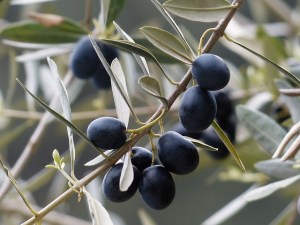
In my Cooking Tip on “Fats in a Healthy Diet”, I discussed culinary oils in general. In this Tip, I want to focus on one type in particular – Extra Virgin Olive Oil.

This is one of the most expensive type of culinary oils you will buy and we all like to make sure we get the best for our money. I have done some research on how to pick out a great olive oil and following are what the experts tell us.

Here are certain things to look for.

  1. The harvest date – The “Best By” date may be 24-32 months after bottling and 1-2 years after pressing. The “Harvest” date is a much better indicator of freshness. Try to pick one with the most recent date, remembering that olives are usually harvested in the fall and winter, meaning the harvest date for what is on the shelf will be the year before.

  2. The container – Look for oil that is in a dark container. Light can degrade the oil. Pick an oil where the container protects the oil from the light.

  3. Country/Region of origin – Look for where the oil was sourced. Higher quality olive oils will be sourced from one country. Note that wording like “Product of Italy” might only mean that it was shipped from Italy, not necessarily that the olives were grown and harvested in Italy.

    Less pricey & mass market olive oils are often a result of buying cheap bulk oils from all over the world and blending them. This means less quality control over the handling of the oil but it also means these oils lack the distinct flavor that you expect from a good olive oil.

  4. The Cultivars – Look for the specific olives that have been harvested.

If at all possible, taste the oil before purchasing it. This generally means going to a gourmet food store or a shop that specializes in oil. The typical supermarket is not going to offer tastings outside of the rare special event.

The reason that we must be savvy olive oil shoppers is that some deficits in the industry have been documented. In a 2016 article from the Denver Post, the writer noted that about 75% of the extra virgin olive oil sold in the US is often diluted with lower quality olive oil. The article goes on to note that a 2010 University of California study found that 69% of imported oils sold in California stores at that time failed to meet international standards for olive oil.

Not only will the authentic, high-quality extra virgin olive oil give you tremendous flavor and variety of that flavor but the fresher, more pungent-tasting oil is higher in polyphenols, which are high in antioxidants.

To be fair, since these exposes, the industry has attempted to improve quality standards. In 2010, the USDA issued the “United States Standards for Grades of Olive Oil and Olive-Pomace Oil.” However, these standards are voluntary. So, producers may choose to seek certification by the USDA as “US Extra Virgin Olive Oil” if they wish, but that it is not mandatory.

Some states have gone further, including California. They have adopted standards recommended by the Olive Oil Commission. According their website, “California olive oil handlers who produce 5,000 gallons or more are required by law to participate in the OOCC’s mandatory government sampling and testing program. Producers with less than 5,000 gallons may voluntarily participate in the OOCC’s government sampling program.”

The California Olive Oil Council (a different entity) has a mission to “uphold the highest standards within the olive oil industry through its Seal Certification Program”. The members of COOC must submit their oils for testing and evaluation to ensure it meets the qualifications to be labeled Extra Virgin Olive Oil. Therefore, if you buy an oil with the COOC seal, you can be assured that you are getting the real thing.

What do you do on a daily basis, though, in your kitchen? Authentic, high-quality extra virgin olive oil can be very expensive. If for no other reason, you probably don’t want to use that for all of your oil needs. That is why most of us have other more moderately-priced oils that we use for general cooking use. We save that special oil for vinaigrettes, for dipping and other uses where the flavor shines through.

What is in your kitchen? I looked in my pantry and I have two different olive oils, only one of which is extra virgin. When I looked for the above items, this is what I found. Even though I purchased it from a reputable olive oil retailer, it had no harvest date. (I wonder if this was due to the fact that the oil was brought into the store in a bulk fashion and then bottled and labeled by this particular retailer.) It did list both the country from which the olives were harvested as well as the particular varietals. It was packaged in an appropriate bottle. Since it was a Spanish oil, it did not have COOC certification. All in all, not bad.

The next time I am in my local supermarket, I am going to look for these recommendations. My guess, though, is most of those on the shelf will be sorely lacking. Let me know what you find, not only in the kitchen but also where you shop!

Cooking Tips · Ingredients

Proteins on a healthy diet

We are moving forward in this series on cooking/eating healthy. After discussing some general tips, grains, breads and veggies, in this Tip I want to look into the subject of proteins. According to a 2018 Gallup poll, only 5% of U.S. adults consider themselves to be vegetarian. Therefore, I will mostly be discussing meat/seafood. I will not be discussing cooking methods in this Tip but will leave that for the next one.

There are a couple of general recommendations that almost all experts will give. First is to avoid processed meats such as lunch meats, hot dogs, bacon, sausage and jerky. Second is to eat smaller portions of fish and meats. Given that, let’s move on to the sources of animal protein.

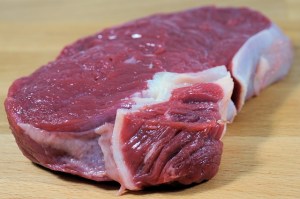
I am sure that most of you have heard that you should limit, or even eliminate, your intake of red meat. This includes beef, pork and lamb. Why is that? That recommendation is based on the fact that red meats have more saturated fat than other protein sources. I will note that there are some people out there that do not agree with this recommendation and feel that red meat is not as bad as everyone says. However, most experts feel that consuming red meat is often linked with cardiovascular disease.

When you do consume red meats, the recommendation is to eat leaner cuts. See the following chart for the USDA’a definition of lean versus extra-lean. These numbers are based on a 3½ ounce serving and will help you when looking at the nutritional labels in the store.

 LeanExtra-lean
Fat10 gm5gm
Saturated fat4.5 gm2 gm
Cholesterol95 mg95 mg

For beef, another recommendation is to choose “Choice” or “Select” cuts as they will have less fat than “Prime” cuts. For example, if you look at one of the most popular (although one of the fattiest) cuts of beef – Ribeye Steak – the fact content is 50% higher for Prime than Choice. For ground beef, choose a package that is labeled at least “90% lean” and, if you can find it, 93% or 95% lean.

A look at the nutritional label of different cuts can be enlightening. A package of Choice Sirloin steak shows 10 gm total fat and 3 grams of saturated fat, putting it into the “Lean” category. The same serving size of a Choice Ribeye contains 17 grams of total fat and 8 grams of saturated fat.

The reason the fattiest cuts are more popular is that fat contributes to flavor and moistness. When choosing the leaner cuts, you need to take care when cooking so they do not dry out. I will discuss this more in my next Tip.

For pork, the leanest choices are pork loin and pork tenderloin.

The leanest cuts of lamb are loin, leg and shanks.

Poultry

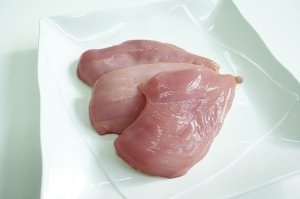
When most of us think of healthy meat, we think of poultry. The most common poultry we eat is chicken although turkey is another excellent choice. Much of the fat found in poultry is in the skin. The same serving size of skin-on poultry can have three times or more as much fat as skinless. Because the skin can protect the meat from moisture loss, many chefs will leave the skin on when cooking but remove it before eating.

Breasts will be the leanest type of poultry. Without the skin, chicken breasts have under 2 grams fat per 3 ounce serving and less than ½ gram of saturated fat. Chicken thighs can have twice as much fat as breast but would still qualify as lean. Many feel they have more flavor and are moister. Similar cuts of turkey will have even less fat than chicken although at these low levels, the difference is minimal. The lower fat content does, though, tend to make turkey drier.

Seafood

Seafood is something that most of us probably do not eat as often as we should. Although seafood can be relatively high in fat, it contains some very heart-healthy polyunsaturated fats known as omega-3 fatty acids. In fact, seafood is considered the best (but not the only) source of this type of fat. Other good sources of omega-3 fatty acids are flaxseed oil, flaxseeds, walnuts and chia seeds. There is another type of fatty acid known as omega-6 that is often discussed in tandem with omega-3. I will wait on the discussion of this fatty acid for an upcoming Tip on Fats.

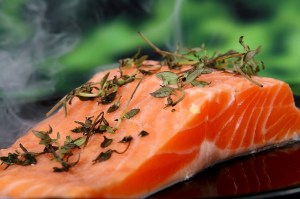
Although the above mentioned fatty fish may be healthy, they are higher in total fat than other types of seafood. If you are in the market looking at the seafood, the flesh color will give you an indication of fat content. The leaner choices are those that are lighter in color whereas the darker ones are going to contain more fat, albeit healthy fats. Below is a chart showing you the fat content in a 3 ounce serving. The amount of omega-3 fatty acids in seafood also varies with the fattier kinds containing more omega-3s. Examples include salmon, herring, mackerel and sardines. If you want more detail on this, see this article from Seafood Health Facts.

Fat ContentTypes of Seafood
High Fat (10 grams or more)Herring, Mackerel, Sardines, Salmon (Atlantic, Coho, Sockeye and Chinook)
Medium Fat (5 to 10 grams)Bluefish, Catfish, Rainbow Trout, Swordfish
Low Fat (2 to 5 grams)Tilapia, Halibut, Mussels, Ocean Perch, Oysters, Pacific Rockfish, Salmon (Chum, Pink)
Very Low Fat (less than 2 grams)Crab, Clams, Cod, Flounder/Sole, Haddock, Hake, Lobster, Mahi-mahi, Pollock, Scallops, Shrimp, Tuna

Plant sources of protein are great in that they do not contain saturated fats. Examples are beans, peas, lentils and nuts. They also provide dietary fiber and other nutrients.

Unless you are a committed vegetarian or vegan, it is good to know that both plant-based and animal protein have benefits and drawbacks. Animal foods are denser in essential amino acids and are more easily digestible.

Plant-based protein is often low in calories and high in fiber. It is, though, a little less digestible. Plant proteins rarely contain all the essential amino acids. This is not to say that you can’t get all the nutrients you need from plant foods; only that it takes effort and planning.

We all need protein although getting sufficient protein is not really a problem for most Americans. Learning how to pick and choose the best proteins is essential to a healthy diet. I hope this Tip combined with the next one on Cooking Methods will help you make better choices.

Cooking Tips · Ingredients

Veggies can be exciting!

We are now on to Tip #4 in this series of Cooking Tips on cooking/eating healthy. In this Tip, I want to talk about a very important part of everyone’s diets – Vegetables. We all should be eating more veggies but it would help if we could make them a bit more exciting without sacrificing nutrition.

All veggies are high in important nutrients such as vitamins, minerals and antioxidants. They are also high in fiber while being low in sugar, fat and sodium. There are some differences, though, in vegetables. Veggies can be divided into starch and non-starchy. Starch breaks down into glucose in our bodies and these veggies are higher in calories than non-starchy and lower in fiber.

It is recommended that we eat all types of veggies but we should consume more of the non-starchy, especially if you are diabetic or pre-diabetic.

Non-starchy vegetables contain only a small amount of starch. Here are some of the most common. One caveat – beets and carrots straddle the line between starch and non-starchy. So, if you are trying to decrease your intake of starchy veggies, you should limit these two items.

  • Artichoke
  • Asparagus
  • Beets
  • Broccoli
  • Brussels Sprouts
  • Cabbage
  • Carrots
  • Cauliflower
  • Celery
  • Chard
  • Cucumber
  • Eggplant
  • Fennel
  • Greens (Collard, Kale, Mustard)
  • Green Bean
  • Jicama
  • Kohlrabi
  • Leeks
  • Mushrooms
  • Okra
  • Onions
  • Pea Pods And Sugar Snap Peas
  • Peppers
  • Radishes
  • Rutabaga
  • Salad greens
  • Summer Squash (Yellow, Zucchini)
  • Tomato
  • Water Chestnuts

Starchy veggies contain more starch but they also have abundant nutrients. Some examples are:

  • Potatoes
  • Corn
  • Lentils
  • Parsnips
  • Peas
  • Sweet potatoes
  • Winter Squash (acorn, butternut)

The best form to eat vegetables are either fresh and frozen. Frozen is a great option as they are picked at the height of ripeness and then quickly frozen. Be careful, though, that the frozen package you pick up does not contain a sauce or seasonings. These often contain added sugars and sodium. Watch out for canned vegetables as they also often contain sodium and sugar. As I have said in my prior Tips in this series, you should become adept at reading the nutritional facts labels. Make sure the only ingredient on the label is the vegetable.

Unless you are eating canned or frozen veggies, you need to clean them. The USDA recommends washing your produce under cold running tap water to remove any dirt & reduce bacteria. If there is a firm surface, such as on apples or potatoes, the surface can be scrubbed with a brush. Do not use detergent or soap as these are not approved for use on foods. You could ingest residues from soap or detergent absorbed on the produce. Note that the recommendation is just for plain water. You don’t need any special type of produce spray. If you really want to do more than just plain water, make a mixture of 1 part distilled white vinegar to 3 parts water. This is really not necessary, though.

There is a bit of debate over washing pre-washed, bagged greens. Although some recommend washing these items, many others say you are more likely to introduce contamination from your kitchen by doing so. Also, any pathogens left on pre-washed greens are probably so tightly adhered that washing them again in your kitchen is probably not going to do anything. The latter is the opinion of the USDA.

What about peeling your veggies? It is generally accepted that the peels are full of beneficial nutrients that you will lose if you peel them. So, if you are able to just scrub your veggies and eat/cook them without peeling, you are better off. There are some peels, though that are just too fibrous to eat or they are too difficult to clean properly. In that case, wash them first and then peel them. By washing them first, you are not transferring debris/pathogens from the outside to the inside. Most pesticide residue can be removed by washing. However, if you are concerned about this, peeling will give you an extra measure of comfort.

Now that we know which veggies we should eat often, which ones we might limit somewhat, and how to clean them, how do we make them tasty? There are those people, like my husband, who just love veggies in the purest form. If you are not one of those, let’s look at some ways you can increase your interest.

Having a salad every day is one of the healthiest habits you can form, whether it is before dinner each night (as we do) or as the main part of the meal. It is a great way to get a variety of veggies in one dish. Start with a mixture of greens such as lettuce, spinach, arugula, microgreens or more. Add in fresh veg such as celery, carrots, cucumber, bell peppers and green onions. One drawback for me in making sure we eat salads every day is all the prep – slicing and dicing all those ingredients. Something I do to make this easier is to prep ahead for a few days. If I am making a salad for Monday night, I also set out small bowls for the next three nights. I then cut up enough veg for each of those nights and put them in the small bowls. Now, for the next three nights, I just have to put my greens in a salad bowl and dump in the contents of those bowls of precut veg. Voila – instant salad!

Sometimes we will eat our veggies raw but other times, we want them cooked. Cooking veggies can alter them in the following ways.

  • Texture – caused by the fiber in the veggies
    • Fiber is made firmer by:
      • Adding acids such as citrus juice, vinegar or tomato products.
      • Sugars – this is more often used when cooking fruit
    • Fiber is softened by:
      • Heat – the longer you cook veggies the softer they become.
      • Alkalis – this is why you do not want to add baking soda to your veggies as it will make them mushy.
  • Flavor – flavor can be lost in the cooking liquid and with prolonged cooking times
    • Cook your veggies in as short of time as possible to limit flavor loss.
    • Some veggies where a bit of flavor loss is preferable is with strongly flavored veggies such as onions, cabbage, Brussels sprouts, cauliflower, broccoli, turnips and rutabagas.
  • Color – there are white, red, green & yellow/orange veggies
    • White
      • Potatoes, onions, cauliflower
      • Other veggies may not be white on the outside but are on the inside. Examples are cucumbers, zucchini and celery.
      • Acid helps to keep the whiteness. So, if you are cooking your veggies in water, add a small amount of lemon juice.
      • Cooking for shorter amounts of time helps preserve the color.
    • Red
      • Red cabbage, beets
      • Acids turn them brighter red.
      • Alkalis turn them blue or blue-green.
      • Over-cooking leads to loss of the red color.
    • Green
      • Acids lead to loss of the green color.
      • Overcooking turns bright green veggies to an unappealing olive green.
    • Yellow/Orange
      • Carrots, corn, winter squash, sweet potatoes, some bell peppers
      • Yellow & orange pigments are very stable. Acids and/or alkalis do not cause much of a color change.
      • Overcooking can dull the color.
  • Nutrients — nutrients are often lost by overcooking or cooking in a lot of water.

The main ways of preparing veggies (other than eating them raw) are boiling, microwaving, steaming, sauteing, grilling or roasting. Here is a colorful guide from Cooksmart.com showing you which veggies do best with which methods of cooking. The same website has a great section on how to prep veggies if you are not familiar with how to get them ready for eating.

Boiling

This is not the best method as it is so easy to overcook the veggies and much of the flavor and nutrients can be lost in the water.

Steaming

This method leaves your veggies crisp and there is less loss of flavor. It works great for porous vegetables such as asparagus, broccoli and cauliflower.

Microwave

This is one area where your microwave is a useful tool, especially (but not exclusively) for frozen vegetables. A few minutes in the microwave and your veggies are ready for the table.

Sautéing

Sauteing is a great way of cooking veggies as it allows you to get some color on them. You can use a nonstick pan or you will need to add a bit of oil if using a regular pan. Heat your pan, add a small amount of oil and heat until hot. Before adding the veggies, add some aromatics such as shallots, garlic, or ginger. These will add great guilt-free flavor to the veggies. After sautéing the aromatics, add the veggies and cook until done. If the pan gets too dry during the cooking process, you may add a splash of water/broth. Add a bit of salt to taste as you are cooking and, if desired, finish with some acid such as lemon juice. Optional toppings include a grating of parmesan or pecorino cheese, nuts or seeds.

You can even do a combination of the above two if you are cooking raw veggies. Start them in the microwave with a touch of water to soften them – no more than about 3 minutes. Then, toss them in a hot pan (beware of splattering) as above and finish by sautéing.

You can even do a combination of the above two if you are cooking raw veggies. Start them in the microwave with a touch of water to soften them – no more than about 3 minutes. Then, toss them in a hot pan (beware of splattering) as above and finish by sautéing

Roasting

Roasting veggies requires you to preheat the oven and takes longer (~30-45 minutes) than other methods. However, as moisture is driven off in the oven, it does concentrate flavors and leaves you with crispy edges.

Something that is helpful to get crispy results is to put your sheet pan in the oven as you preheat it. That way, your veggies start to cook and sizzle as soon as you put them on that hot pan. Oven temperature recommendations vary but are usually pretty hot — 400° to 500°. I will prep my veggies, put them in a bowl, season them with salt and fresh herbs (rosemary, thyme) and toss them in a small amount of olive oil. You can even add a bit of balsamic vinegar. Carefully remove the hot pan from the oven, add the veggies and roast until tender and crisp.

Grilling/Charring

I am not a fan of most grilled foods and so, we do not own an outdoors grill. However, I do like to grill or char veggies stovetop. For that, I use either a grill pan or a cast iron pan. After preheating the pan, I add the veggies and cook them until they are brown and just a bit charred. I normally toss them first in a small amount of olive oil, salt and pepper. When cooking them on the pan, space them apart so they will char. If you place them too close together, they will steam, which is not the result you want with this method. I especially like this method for zucchini and Brussels sprouts.

None of these methods require you to add anything to the cooked veggies before eating. However, you can consider a small grating of a flavorful cheese such as parmesan, pecorino or asiago or a sprinkling of nuts such as slivered almonds. Just to be sure to watch how much you add. Some like to add a pat of butter (although this is a saturated fat) or a drizzle of olive oil. You can get butter-flavored olive oil or herb-infused oil for more flavor.

I hope this Tip will encourage to eat veggies every day whether it be in a salad, as a side dish or even both. They can be extremely tasty and are certainly a necessary part of a healthy diet.
Cooking Tips · Ingredients · Techniques

Whole Grains can be very tasty!

In this Part 2 of my Cooking Tips series on healthy cooking, I want to talk about one very important thing you can do and that is to eat more Whole Grains. I will not be talking about flours and bread in this Tip. That will be in a future Tip. For this one, I will concentrate on grains we may serve as a side dish. All recipes I note are ones that I have tested and find very tasty. Try these recipes as a way to get more whole grains into your diet in a delicious way but also as a starting point to experiment.

What are whole grains? Grains are the edible seeds of plants and for it to be “whole”, it must contain all of the main three parts of the seed.

  • Bran – fiber-rich outer layer with B vitamins, minerals, antioxidants and phytochemicals. The latter are naturally found in food and are felt to be important in disease prevention.
  • Germ – the core of the seed that is rich in healthy fats, vitamin E, B vitamins, antioxidants and phytochemicals.
  • Endosperm – the interior layer composed of carbohydrates, protein and small amounts of B vitamins and minerals.

When you are shopping, you need to pay attention to the nutritional facts label. It is not always straightforward. A 2013 study by Public Health Nutrition looked at products considered Whole Grain and evaluated them to see what would be most useful for the consumer as far as labeling. What they found was that just looking for the term “whole grain” can be misleading. You should see “whole grain” on the label and try to pick products where it is at the top of the ingredient list. However, also look for products with more fiber but less sugar, sodium and trans-fat.

There are many wonderful whole grains out there. Although you can get all of them online, I am going to limit my discussion to those you are most likely to find in your local supermarket. Some of these are gluten free and others are not. I will note that in the description.

Before discussing the individual grains, I want to talk about cooking them. I tend to cook whole grains with the “pasta method.” Cover the grains with liquid, bring to a boil, cover, reduce to simmer and cook until done. Here is a chart from the Whole Grains Council that will give you more specifics. If you are one of us that lives at high altitude, review this Tip on Cooking at High Altitude. You will need more water and more time to cook most of these whole grains.

To liven up the final dish, here are a few ideas.

  • Cook using low/no sodium broth. Can also cook in fruit juice but those are high in sugar. Vegetable juice is another alternative.
  • Toasting the grains before you cook them heightens the flavor. Those that take toasting well are amaranth, millet, oats, quinoa & wheat berries.
  • Add nuts, seeds, citrus zest and/or dried unsweetened fruit.

Now to the actual grains.

  • Amaranth
    • Gluten Free
    • These are the tiny seeds of the amaranth plant. The seeds are not a true grain.
    • When cooked, they resemble brown caviar and remain crunchy.
    • It has a strong, grassy flavor.
    • Cook it up like grits or make a porridge.
  • Barley
    • Can be whole (hulled) or pearled. The hull is very tough and must be removed.
    • Only the hulled is considered “whole”. However, it is harder to find and takes longer to cook.
    • Can be served as a side dish or added to soups/stews.
  • Bulgur
    • Wheat kernels that are boiled, dried, husked and cracked. Also known as cracked wheat.
    • Because bulgur is precooked, it is quick to prepare. You are essentially just rehydrating it.
    • Often added to soups, stuffed veggies and salads. Tabbouleh is one very characteristic bulgur-containing dish.
  • Corn
    • Gluten Free
    • Whole kernels are ground into cornmeal, which is then often used in baking.
    • Popcorn is a different strain of corn but is still a whole grain.
    • Polenta, toss fresh corn in salads, soups and quiches.
  • Couscous
    • This is not really a grain but a pasta made from semolina flour, and therefore, is not a whole grain. There are whole grain varieties that are made of whole wheat durum flour. They are much harder to find in stores but are readily available online.
  • Farro
    • This is a high-fiber, high-protein wheat that can be found in three forms.
      • Pearled – the bran & outer husk is removed but still retains some fiber. It has the shortest cook time and is the most common in our stores.
      • Semi-pearled – part of the bran is removed. It is sort of a middle ground in terms of nutrition and cooking time.
      • Whole – the whole grain remains intact. It has the longest cook time.
    • It has a chewy texture and a nutty flavor.
  • Millet
    • Gluten Free
    • A small, round ivory grain with a mild flavor.
    • Has a mild flavor and mixes well with other foods.
    • Use like rice.
  • Oats
    • Gluten Free but some companies process their oats on the same machinery as other gluten-containing grains. So, be sure they are certified gluten free.
    • Contains a special variety of fiber that’s felt to be helpful in lowering cholesterol.
    • Both old-fashioned & steel-cut are whole grains.
    • Steel cut is chewier and nuttier.
  • Quinoa
    • Gluten Free
    • A small, light-colored round pseudo-grain. It is not a true grain but is in the same family as spinach and chard.
    • It is naturally coated with a bitter and soapy layer, called saponin, that is to deter animals. It should be removed by rinsing in water before cooking. Some brands will be pre-washed when you buy it.
    • It is quick cooking.
    • Comes in white or red varieties.
    • It has a mild flavor, is chewy and slightly nutty.
    • Good in pilafs, salads, casseroles, soups.
  • Rice
    • Gluten Free
    • Limit your intake of white rice but, instead, choose brown, red, black or wild.
    • Brown rice can be long-, medium- or short-grain. Two of the most popular rices, basmati & jasmine, also come in brown versions.
    • Pigmented rices – black, purple, red, mahogany. The color is caused by the anthocyanin pigments in the outer bran. This makes them very high in antioxidants.
    • Wild rice is not true rice. It is an aquatic grass.
  • Wheat berries
    • The whole kernels of hard red spring wheat before it is ground into flour.
    • Because they are whole and firm, they take a while to cook. It is often recommended that you soak them overnight to shorten the cooking time.
    • Cook them in simmering liquid for anywhere from 30 minutes to an hour or cook them in a slow cooker.
    • It is chewy & nutty.
    • Add to soup, chili, salads, side dishes.

That is quite a bit of information but just scratches the surface on whole grains. I hope you are intrigued and challenged to try some of these whole grains. I know my favorites are bulgur and farro. What about you? Do you have a favorite?

Cooking Tips · Ingredients · Techniques

Luscious Caramel Sauce

When you want caramel sauce to pour over your ice cream, do you run to the store and buy a pre-made bottle? We have all done that but did you know you can make your own so very simply? How to do that is the subject of this Cooking Tip.

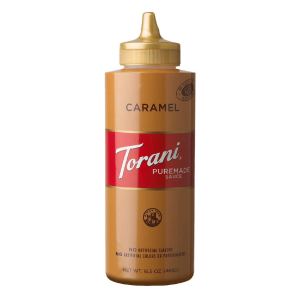
Why would you want to make your own? First, you avoid a run to the store. Second, you know what exactly is in the sauce. Here is the ingredient list for a couple of major brands.

Ghirardelli Premium Caramel Sauce – Corn syrup, water, high fructose corn syrup, sugar, skim milk, heavy cream, salt, natural flavor, pectin, disodium phosphate.

Torani Caramel Sauce — Corn Syrup, Sugar, Invert Sugar, Heavy Cream, Water, Butter, Nonfat Milk, Natural Flavors, Salt, Lecithin, Sodium Bicarbonate.

What is the ingredient list for homemade caramel sauce? It is usually just sugar, water & dairy. That is a much shorter ingredient list without any artificial ingredients.

There are two main methods of making caramel – wet and dry. In the wet method, the sugar is dissolved in water whereas in the dry method, the sugar is melted without the addition of water. The wet method takes longer as the water must evaporate but you are less likely to burn the sugar than with the dry method.

Even though recipes will give you amounts of ingredients, the timing and resulting caramel will vary depending on such variables as the size/type of pan used as well as the type of cooktop and its heat. It is something that you need to use your eyes and nose for as the color of the sugar changes and the aroma develops. It is also something that takes just a bit of practice to get it just where you want it.

In the wet method, you add the sugar and water and stir until dissolved over medium-low heat. After the sugar is dissolved, raise the heat to high and let it cook without further stirring. Keep an eye on it as after a few minutes, it will start to turn a light amber and then darker amber. The longer you cook it, the darker the color and the deeper the caramel flavor. Be careful, though, as it can quickly go from dark amber to burnt. After it is at your desired color, very carefully add heavy cream (it will bubble vigorously) and whisk to combine.

Note that the longer you cook the caramel, not only does the color darken but the harder the resulting caramel will be when it cools. If it ends up too hard, you can gently re-heat it and add more liquid to thin it. On the other hand, if it is too thin, make a second batch, cook it slightly longer than the first batch and combine the two.

For a dry caramel, sprinkle a thin layer of sugar into your pot, not reaching to the edges. Over medium-high heat, cook it and watch as the sugar starts to dissolve. It will then start to turn amber around the edges. At that point, gently and carefully swirl it to distribute the sugar. Once most of it has turned amber, add another thin layer of sugar and continue to cook until amber. Repeat until you have added all the sugar and reached the desired color. Remove from the heat and immediately and carefully add your cream.

What about butter? Some recipes call for it whereas others do not. Butter produces a very nice mouthfeel due to the high fat content. However, as butter is solid at room temperature, your caramel sauce will be firmer when cooled, especially after being in the refrigerator.

Many pastry chefs will tell you that you can use either of these methods interchangeably and get similar results. Others will say that since with the wet method, you must take time to evaporate the water, the sugar cooks longer resulting in more complex flavors.

The biggest problem people have is that the sugar can crystallize, making the sugar syrup very grainy. If it does this, take it off the heat, add a couple tablespoons of water and heat again until the crystals dissolve.

The following are recommended methods to prevent crystallization in the first place.

  • Use a wet pastry brush to wipe down any sugar crystals on the side of the pan. Not all chefs do this and say they have no problems.
  • Although not as common, some will lightly oil the sides of the pan before starting so the sugar does not stick to the pan.
  • Another method involves putting a lid on the pot if you see any crystals on the side. This will produce steam and dissolve the crystals.
  • Add a different type of molecule. Crystallization is most common in what is called a “pure solution”. By adding a different type of ingredient such as corn syrup (mostly glucose) or a few drops of acid (lemon juice, vinegar, cream of tartar), you can prevent crystallization.
  • A common recommendation is to not stir as the sugar is cooking, particularly before the color starts to change. Then, only stir if spots are getting too dark. I must say that there are pastry chefs, though, who do some careful stirring without resulting crystallization.

Another problem is that the caramel gets too dark or even burns.

  • Use a heavy gauge stainless steel pot. With a thin pan, you are more likely to experience uneven cooking and a higher likelihood of burning.
  • Try to not to use a pot with a dark interior as it is much harder to judge the color.
  • A wide saucepan or even a deep skillet is better than a tall and narrow pot. With the latter, there is less surface area, which slows down the caramelization process.
  • Have a bowl of cold water ready. When you reach the desired color, submerge the bottom of the pan into the cold water to quickly stop the cooking process.
  • Quickly add your cream as the cold cream will cool down the solution. Just be careful as it will bubble vigorously as you do this. Stand back and then whisk together.

Once you get the correct color, there will be almost no water left. As this cools, it will become rock hard. You need to add moisture to get the desired consistency. The more liquid you add, the thinner it will be. If you add too much, just put the pot back on the heat to evaporate some of the water. If it is too thin, add more liquid.

Remember that cooked sugar is extremely hot and can cause serious burns. Always be careful when making caramel or anything that requires you to melt sugar. Use heavy oven mitts and long sleeves. Many experts recommend that you put a bowl of ice water nearby in case any of the mixture splashes onto your hands. If so, immediately put them into the ice water. NEVER taste it until it has fully cooled!

Homemade caramel sauce is a delightful concoction. Although it does take a bit of practice, once you master it, there will be no more quick runs to the store for that pre-made sauce.

Cooking Tips · Ingredients

An Essential Ingredient to Thai Curries

In the last couple of Cooking Tips, I discussed different aspects of Thai Cooking. In the first Tip, I explained the differences between a Thai curry and an Indian curry. Tip #2 was a more general discussion of important Thai ingredients. In this Tip, I want to spend a bit more time looking at one of those ingredients – curry paste.

The word curry can be used to either mean a dish or a spice mixture. In Indian cooking, that spice mixture would be made up of dry, ground spices. In Thai cooking, it is called curry paste and it is a moister mixture that is finely ground or pureed made not only from spices but also from many fresh ingredients.

There are many different versions of curry pastes and the ingredient list for each may vary depending on the cook and/or brand. Let’s first discuss ingredients and then the most common types of curry paste.

Ingredients

  • Chilis – depending on the variety of curry paste, it may contain red or green chilis, either in the dried or fresh forms.
  • Fresh aromatics – typical ones are shallots, garlic, lemongrass, galangal, cilantro root, makrut (aka kaffir) lime zest, grachai (a member of the ginger family), turmeric and ginger.
  • Dried spices – other than those pastes that have some Indian or Muslim influence, dried spices are not typically used. When they are included, you might see coriander seeds, cumin, cinnamon, cardamom, nutmeg, mace and cloves.
  • Umami boosters – shrimp paste and dried shrimp. Besides giving an umami boost, shrimp paste also gives an authentically Thai flavor.

Types of Curry Paste

Red
This paste is made with dried red chilis and can have up to 20 different varieties. Traditionally, the dried red chilis are soaked, which reduces some of the harshness and heat. One expert lists what he calls the “Basic 10” of ingredients – dried red chilis, garlic, shallots, lemongrass, galangal, cilantro root, makrut lime zest, white peppercorns, shrimp paste and salt. Others may also add coriander and cumin.

Green
The chilis used in this paste are very similar to those in red but here they are in their fresh (green) state. Besides the fresh green chilies, other typical ingredients are shallots, lemongrass, white pepper, coriander root, garlic, kaffir lime zest, shrimp paste and sea salt. This all gives this paste a green color. In the final dish, sweet basil leaves, round green Thai eggplant and kaffir lime leaves are often added, which contribute even more to an overall green hue. As compared to red curry paste, this one has a more balanced and herbier flavor.

Some consider red curry paste as the spiciest whereas others give that prize to green paste.

Traditionally, Thai people considered green curries as the hottest followed be red. As Thai food became popular in the West, the red curry emerged as the hottest. However, in authentic Thai cuisine, a green curry will always be spicier than a red.

Yellow
The color of this variety comes from fresh turmeric and curry powder. Other common ingredients are coriander, cumin, lemongrass, galangal, shrimp paste, dried red chilies, sea salt, ginger, garlic and shallots. It is milder than the other pastes but the actual spiciness will depend on the actual chilis used. It also often has a touch of sweetness.

Panang
This curry paste is similar to red but has the addition of ground peanuts as well as cumin, coriander seeds, dried red long chilies, shallots, garlic, galangal, lemongrass, kaffir lime zest, coriander root, white pepper, salt and shrimp paste.

Massaman
Because of the Muslim in influence in this curry paste, it has abundant dry spices that are commonly seen in south Asia – cinnamon, star anise, cloves, cardamom and nutmeg. Other ingredients are dried red chilies, shallots, garlic, galangal, lemongrass, coriander, cumin, white pepper, salt and shrimp paste. It is a relatively mild curry paste.

The most common use for curry paste is in Thai curries where the curry paste is cooked with a protein and/or veggies and a liquid such as coconut milk or stock. That is not the only use, though and these pastes can be used as a marinade, a rub for chicken, fish or beef as well as in stir fries.

If you have been reading these Cooking Tips for very long, you know that I do not use or recommend many convenience items. For example, when you need a small amount of Chinese Five Spice, do not buy an entire bottle that may go stale before you use it all up. Rather, make your own from ingredients that are probably already in your pantry.

Curry pastes are different, though. You can certainly make these pastes from scratch but it is a fairly time consuming process and involves a whole host of ingredients, many of which are difficult to come by outside of a good Asian or international food market. Therefore, most of us will buy a good prepared curry paste.

A good curry paste is said to have an aroma strongly of herbs. When looking at the ingredients, there should only be herbs, spices, salt and shrimp paste. No oils, no additives and no water. Many Thai cooks strongly suggest only buying Thai brands.

Some differences that may be seen between store-bought & home-made is that the home-made version may have more complex flavors and may have a fresher taste as the herbs are added at the end and not further processed. Another advantage of home-made is that you can customize the blend to accommodate dietary restrictions and flavor preferences.

Brands – Favorite store-bought brands are:

  • Maesri – one advantage of this brand is that it comes in small cans rather than larger containers.
  • Mae Ploy – this is my favorite brand but it does tend to be saltier than other brands.
  • Chef’s Choice – this brand is mostly found in Europe and Asia.
  • Mae Anong – a favorite of many Thai afficionados.

Storage
Curry paste can be refrigerated for at least a week or frozen for six months to a year.

With the info found in these last three Cooking Tips, you should be able to make your own kitchen your favorite Thai restaurant!

Cooking Tips · Ingredients

Ingredients – The Key to Great Thai Meals

Learning to make Thai meals is always one of my most popular classes. Since so many people love it, I thought I would write a few Tips on this subject. Last week was the difference between Thai and Indian curries. This one discusses Thai cooking in a general sense and the next one will concentrate on Thai curry pastes. If you want to learn how to cook Thai in your own kitchen, contact me for information. In the meantime, for some tips on cooking Thai at home, read on.

One thing I teach over and over is that mastering cooking techniques rather than recipes should be the goal of all of us. If you have a good grasp of techniques, you can cook any cuisine. The techniques of cooking Thai as opposed to Italian or Indian or French are not all that different. What really makes the difference are the ingredients.

What do I mean by cooking techniques? I would recommend reviewing a couple of resources as a starting point. On my Home Page, you can download a free article entitled “Great Tips to Improve Your Cooking”. I also wrote an earlier Tip on “What Not to Do in the Kitchen”. These would be a great foundation for you.

Besides what you will find in those articles, a good cook should know the difference between cooking methods such as sauteing, stir-frying, grilling, roasting, poaching, steaming and so forth. Having good knife skills and always trying to improve is also important. (Why not book a class concentrating on Knife Skills?) Knowing what pots/pans are best to use for a particular dish as well as controlling the heat under that pot is very helpful.

For the rest of this Tip, we are going to presume you have a working knowledge of good cooking techniques. Let me move to what makes Thai food taste differently than other cuisines and that is Ingredients.

There is no way I can discuss all the ingredients that a Thai cook might use but I do want to go over some common ones. If you really want to make Thai dishes with authentic flavor, I strongly encourage you to seek out the real ingredients rather than relying on some of the substitutions I list. The following are listed in alphabetical order.

Aromatics

These are veggies from the allium family and include items such as shallots, onions, scallions and garlic.

Basil

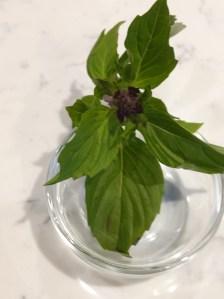
Most commonly used is Thai basil, a relative of Mediterranean basil. It has purple stems and flowers with a slight licorice flavor and a hint of spiciness. As the flavor profile is so distinct from Mediterranean basil, it is best to seek out the Thai version rather than substituting if that is what is called for. Some Thai recipes call for sweet basil, which is the Mediterranean version.

Chiles

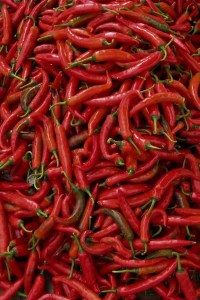
Although it does not have to be overly spicy, most Thai food will have somewhat of a bite to it. This is provided by fresh and dried chili peppers. The one most commonly seen in our local supermarkets is called a Thai chili pepper, a small and very hot pepper. In reality, though, there are many different varieties with varying heat level. On the Scoville scale, they can range anywhere from 50,000 to 100,000 heat units. To put that in perspective, the jalapeno averages around 5000 units. For more information on chili peppers in general, see this Cooking Tip.

Cilantro

Also known as Chinese parsley, this herb is commonly found in our supermarkets.

Coconut Milk

Although not used in all Thai dishes, it is used in many. Coconut milk is made by soaking fresh or dried coconut in water, squeezing out the liquid and discarding the pulp. It is not the liquid inside fresh coconuts. Although you can drink that, it is not generally used in cooking. Also, stay away from Cream of Coconut, which is a sweetened product used for making cocktails.

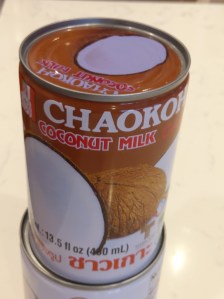
The best coconut milk has a significant layer of coconut cream that rises to the top of the more liquid part. This is one thing that distinguishes a quality coconut milk from a lesser one. The better ones have a nice layer of cream on top. At times, you will want to use the cream separate from the thinner milk and at other times, you will just mix it all together. The cream layer, though, will give you a more luxurious taste and texture. My preferred brand is Chaokoh. Cooks Illustrated also likes that brand but at their last review, they chose Aroy-D as their favorite. These may or may not be available in your local supermarket although they certainly would be at an international market.

Curry Pastes

Thai curry pastes are a mixture of many fresh and dried ingredients. They are totally different from curry powder. There are numerous kinds with some of the most common being red, green, yellow, panang and masaman. Each has a different blend of ingredients yielding a different taste and level of spiciness. They are used not only in Thai curries but can also be used in Thai soups and stir-fries.

You can make your own but despite the advice in my Spice Cooking Tip, it is not something I normally do. The ingredient list is long and fairly complex. There are great commercially available curry pastes from which to choose. My favorite is Mae Ploy. The important thing to remember is that even among the same type of curry paste, the flavor and especially spiciness can vary greatly from brand to brand. Whether you are using a recipe or making your own Thai curry paste, always start with less than you need. If you are used to using one tablespoon of your favorite brand, don’t assume one tablespoon of another brand will be the same. I recommend finding a brand you like and then sticking with it for consistency.

Fish Sauce

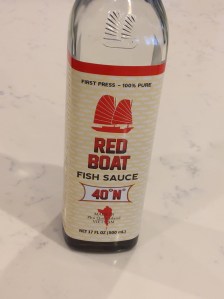
Made from fermented fish, typically anchovies, this is the “salt” of Thai cooking. It is both a condiment and an ingredient and is full of glutamates that enhance flavor. In taste tests, the best fish sauce had the highest protein content. The higher protein content helps to balance the saltiness and other flavors. Most experts recommend the Red Boat 40°N brand but other highly rated ones are Thai Kitchen, A Taste of Thai and Golden Boy. Megachef is another recommended brand but the one you are most likely to see in an international market is in a blue bottle and is said to be formulated more for Vietnamese cooking. Megachef does have a Thai version in a brown bottle but is more difficult to find.

Galangal

Another herb with a pale yellow root and a distinctive flavor. Since it is a relative to ginger root, you can substitute that although it will not have the same taste.

Kaffir lime leaf

These are the leaves of a dark green knobbly lime that add a sharp and sour flavor. The leaves are used in curries and soups and the juice is sometimes used in soups. There is no real substitute but you can try lemon leaves or finely grated lemon/lime rind. One kaffir lime leaf is equal to ½ tsp lemon rind.

Lemongrass

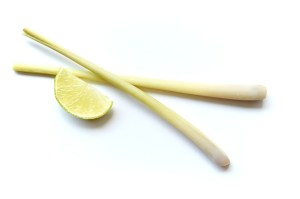
This is a Thai herb with a distinctive, lemony flavor. The outer layer is discarded along with the straw-like top. Only the bottom ⅓ is used and is normally sliced or chopped. Although many mainstream grocery stores will carry pre-packaged lemongrass in their herb section, I usually find it dried out and not worth buying. You are much better off getting fresh lemongrass from the international markets.

Limes

Juice from regular limes is a very common ingredient used to add sourness and balance other favors.

Palm sugar

Made from various palm trees, it is a light brown, raw sugar. It comes in two forms: hard/lumpy or softer/paste-like. I would suggest you seek it out due to its distinctive flavor but in a pinch, you could try substituting raw sugar, brown sugar, coconut sugar, maple syrup or even honey.

Rice

Easily found in our supermarkets due to its popularity, Jasmine rice is the type that is served with Thai dishes. It is very flavorful with a distinctive aroma.

Tamarind

This is an ingredient made from the seed pod of a large Asian tree. It often comes in a block requiring you to break off a piece and soak in lukewarm water for 5 mins. (1 Tbsp of pulp in ¼ cup water) After soaking, the pulp should be squeezed & kneaded well to dissolve everything that can be dissolved followed by straining out the seeds/fiber. You can also easily find tamarind concentrate, which does not require soaking/straining. Although the taste will not be authentic, you can try substituting lemon, lime or grapefruit.

This is not an exhaustive list but if you have these items in your pantry, you are well on your way to delicious Thai meals. Stay tuned for the next Tip on Curry Pastes.

Cooking Tips · Ingredients

Oregano – not just one herb!

I had a friend visiting and I took her to my favorite spice shop, Savory Spice, (This is an affiliate link and I may earn a commission if you decide to purchase.) to restock her spice pantry. One of the items she wanted was Oregano. I asked her if she wanted Mediterranean Oregano or Mexican Oregano. She looked at me strangely and asked about the difference. She said she did not know there was more than one kind. Since she is a great cook, I figured if she didn’t know this that maybe many of you did not know either. Thus, this Cooking Tip was born.

What most cooks think of as oregano is probably the Mediterranean version. It is part of the mint family, Lamiaceae.

Mediterranean is a bit of a generic term for all types of oregano grown in that region. Different varieties include Greek, Italian and Turkish. Most supermarket versions will not specify what type it is but good spice shops will often list that information. The most common is probably Greek. It is typically known as the “true oregano” although some will also apply that term to the Italian variety.

Mediterranean oregano in general has a robust flavor with sweet, minty and peppery notes. It will, however, vary somewhat in taste depending on which variety it is. Some may be more bitter, sweet or peppery than others. Greek is said to be the most savory and earthy, Turkish is the most pungent and the Italian is the mildest. The latter is actually a hybrid of sweet marjoram (also a type of oregano) and common oregano.

Mexican oregano is native to Mexico, the southwestern United States and Central America. It is part of the Verbenaceae family, to which lemon verbena also belongs. Its flavor is different than Mediterranean oregano. It has pungent, citrusy flavors with a peppery note and a subtle licorice undertone.

When do you use which variety? Well, if you have read many of these Cooking Tips, you will know I do not have many hard and fast rules. However, the best results happen when you pair the particular variety to the cuisine of that geography.

Therefore, you would use the Mediterranean variety when you are making those dishes. It pairs well with flavors such as onion, garlic, basil, flat-leaf parsley and thyme. It is especially known for its use in Italian dishes including pizza & pasta sauce, herb butters and Italian vinaigrettes.

Pair your Mexican oregano with other spices such as cumin, chili and paprika. Use in dishes with Mexican or southwest-type flavors such as chili, enchiladas or salsa.

One last tidbit about oregano. Chefs generally prefer fresh herbs over dried herbs in many preparations. However, oregano maintains excellent flavor when dried. In fact, many feel that fresh oregano is too pungent and they prefer the dried.

Did you know that there were different types of oregano? Do you always use just one or do you switch it up depending on what you are cooking? Now that you know the differences, I hope you will feel much more comfortable using this wonderful herb!

Cooking Tips · Ingredients

Nuts-so useful in your kitchen!

Nuts are delicious to eat and, in moderation, are thought to be a great part of a healthy diet. They are also wonderful to use in your culinary creations. Not only do they add a wonderful flavor but they also give a textural element that can elevate your dish. These great ingredients are the subject of this Cooking Tip.
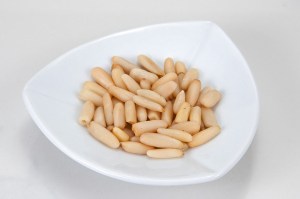
Many recipes call for roasted nuts as it enhances the nutty flavor. It is usually preferable to roast your own as ones that you buy already roasted often have salt and other ingredients added to them.

How to roast/toast nuts

  • Oven – the preferred method for roasting nuts is in the oven as you get more even heat. To do this, preheat your oven to 350°F. Place the nuts on a baking sheet. Roast for 8-12 minutes, stirring occasionally, until fragrant and roasted. Remove immediately from the hot pan when done to prevent over-cooking. The timing can vary as whole nuts take longer to roast than chopped nuts and larger nuts will take longer than smaller ones.
  • Stovetop – for smaller quantities of nuts, you may toast them in a dry skillet over medium heat but watch them carefully. Shake the pan occasionally and remove from pan immediately when done.
  • Microwave – there are also those that love to toast small amounts of nuts in the microwave. They feel it is more even heating and, therefore, takes less stirring. Place nuts on a microwave-safe dish and microwave on high for one minute. Stir and repeat in 30 second to one minute bursts until done.

Storage

Nuts can easily go rancid and so, store your shelled nuts in the freezer to prevent this. Whole nuts still in the shell may be stored either in the refrigerator or at room temperature. Keep away from moisture and heat.

No matter which nuts or seeds you wish to use, buy them unsalted if you want to use them in a recipe. Save the salted ones for your snack bowl. Let’s look at a few specific nuts and how to use them in the kitchen.

Almonds

  • These nuts can be found whole, sliced or slivered.
  • Flour – you can buy almond flour or make your own to use as an alternative to wheat flour in baking or as a coating for fried foods.
  • Butter – almond butter is a tasty change from the ubiquitous peanut butter.
  • Almonds can be used in both sweet and savory applications. Some ideas include enrobing in chocolate, added to granola bars, as a salad topping, as a coating for meat (almond-crusted chicken) or as a sauce thickener.
  • Tossing sliced or slivered almonds into veggie dishes is common.

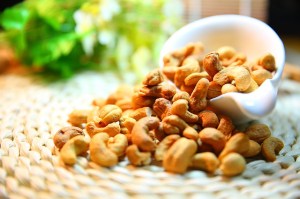
Cashews

  • In my book, there is no better way to enjoy cashews than right out of your hand.
  • Cashews are typically found in Indian dishes such as chicken korma or in Chinese dishes such as cashew chicken or other stir fries.
  • These nuts are often used by vegans to make cream soups or sauces.
  • Other uses include dips/spreads and they also make a great nut butter.

Hazelnuts

  • These are also known as filberts and are typically found in sweet applications especially paired with chocolate such as in truffles or the popular Nutella.
  • They can also be used in savory dishes, especially Italian ones, such as pasta, ravioli and pesto.
  • Roasting them followed by rubbing with a kitchen towel will help you remove most of the skins.
  • They have a lower oil content than other nuts, making it fine to toast them before baking. (see walnuts below)
  • Hazelnut spreads and butters are very popular.

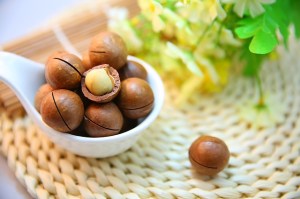
Macadamia nuts

  • These nuts are typically used in sweet applications but can also make a surprising addition to pesto.
  • As they are grown in Hawaii, you will often find them paired with tropical flavors such as pineapple.
  • They are very high in oil, the highest fat content of any tree nut, which results in a very buttery flavor when baked.

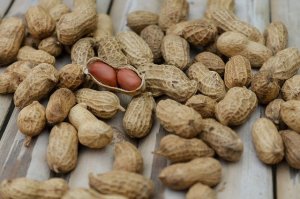
Peanuts

  • Peanuts are not only a staple in many American households (usually as peanut butter) but are also often found in many Asian recipes such as sate sauce.

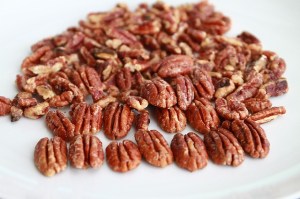
Pecans

  • Pecans are very versatile easily going from sweet desserts to salads.
  • The also pair well with spices in savory dishes and are often found in chicken salad. Just as with almonds, they can make a wonderful crust on your chicken or fish.
  • They can be ground with butter and sugar to make a gluten free pie crust.

Pine nuts

  • Pine nuts have a soft, nutty flavor with an undercurrent of sweetness, similar to cashews.
  • These are an essential ingredient in traditional pesto but can also be used in salads, dips, desserts and even pastry dough.

Pistachios

  • All nuts can be pricey but pistachios are near the top. Buying them in the shells is more cost effective if you are willing to take the time to shuck them.
  • They are commonly used in Middle Eastern dishes (think baklava) and are often used as a garnish due to their pretty green color.

Walnuts

  • Toasting walnuts decreases the bitterness that can be found in walnuts. Because of the high oil content, walnuts toast more quickly than other nuts. It is, therefore, recommended that you use raw walnuts in baking to prevent burning.
  • Walnuts are commonly used in Chinese and Mediterranean dishes as well as sweet applications such as brownies or just tossed in a salad.

Nuts are a great pantry staple all year-round but as we approach the fall and holiday season, they especially shine.
Embrace the use of nuts in your kitchen!

Cooking Tips · Ingredients

Canned Milk Products

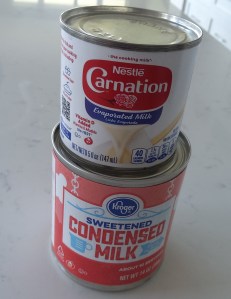
I was making homemade ice cream this week and my recipe called for a can of evaporated milk. That caused me to wonder if the average person knows the difference between that product and the other canned milk product – sweetened condensed milk – and when to use them. Afterall, they are both in little cans that look similar but they are very different products. That is the subject of this Cooking Tip.

Let’s start with the definition of milk. According to the FDA, “Milk is the lacteal secretion, practically free from colostrum, obtained by the complete milking of one or more healthy cows … that shall have been pasteurized or ultra-pasteurized.” All of us know what milk is and where it comes from but have you ever defined it like that? That’s government-speak for you.

The different types of milk and other dairy products vary by their milkfat content. Here are the percentages of each kind from the highest to the lowest fat content. This will help you make decisions about substitutions for the canned milk if necessary.

  • Heavy cream – not less than 36% milkfat
  • Light whipping cream – between 30% and 36% milkfat
  • Light cream – not less than 18% milkfat
  • Half and half – a mixture of milk and cream to create a product that is between 10.5% and 18% milkfat
  • Whole milk – not less than 3.25% milkfat
  • Reduced fat – about 2% milkfat
  • Low fat – about 1% milkfat
  • Skim/fat-free – essentially no fat

Evaporated Milk

To make this product, fresh milk is simmered until the liquid is reduced by about 60%. This results in a product that is concentrated and creamy. The cooking process breaks down the milk proteins (caseins), which means it is less likely to curdle in your recipes.

According to the FDA, it must contain not less than 6.5% milkfat. It is homogenized and contains vitamin D. The addition of vitamin A is optional. It is processed by heat to prevent spoilage.

It will be sweeter than regular milk as the natural sugar in milk, lactose, has been concentrated during the evaporation process.

This type of milk is often used to give a creamy texture to dishes such as sauces, macaroni/cheese, mashed potatoes, puddings, fudge, etc.

It can stand in as a substitute for regular milk in recipes by adding an equal amount of water. However, it will cause a deeper color with a slightly sweet, caramelized flavor. So, it may not be something you want to use for your bechamel sauce.

If you do not have a can in your pantry, you can use a fresh dairy product. Use the milkfat content info above to pick a suitable choice. You may also use a mixture such as for one cup of evaporated milk, mix ¼ cup cream with ¾ cup whole milk.

Another alternative is to make your own. All you have to do is to simmer milk until the volume is reduced by about 60%. It can be stored in the refrigerator in an air-tight container for up to 10 days.

Condensed Milk

This is also known as “sweetened condensed milk” and therein lies the difference between this product and evaporated milk. Sugar to the tune of 40-45% is added to the milk. As it is boiled down, it becomes very thick and caramelized.

Due to the sugar, this product is mostly used in desserts such as puddings and sweet custards. It is also a key ingredient to Thai iced tea. In baked goods, it provides tenderness, moisture and flavor as well as adding color to pastry crusts.

According to the FDA, it must contain not less than 8% milkfat. It is pasteurized and homogenized and contains vitamin D. The addition of vitamin A is optional. The sweetener must be added in sufficient quantity to prevent spoilage.

Because of the sugar, it cannot substitute for evaporated or regular milk. Once again, though, you can make your own. There are different recipes but here are two.

  1. Mix ¾ cup sugar, ½ cup water and 1⅛ cup dry powdered milk and simmer until thickened, stirring frequently.
  2. Heat ⅓ cup + 2 Tbsp evaporated milk or regular milk with 1 cup sugar and 3 Tbsp margarine/butter until sugar dissolves.

Because both of these products are shelf-stable and have different purposes in the kitchen, it is a good idea to have some available rather than substituting. Once opened, just keep the left-overs in an air-tight container in the refrigerator. Do you have some in your pantry right now? I hope so!