Cooking Tips · Ingredients

Maple Syrup — a great sweetener

I do not know too many people who don’t just love the flavor of real maple syrup. Yes, we often pour it over our pancakes, waffles or French toast but it can be used in many more ways in the kitchen. In this Cooking Tip, let’s explore what maple syrup is and how to use it.

Maple syrup is made from the sap from certain species of maple trees. The three major species of maples are the sugar maple, red maple and the silver maple with the sugar variety being the main tree. Vermont is the leading producer in the nation although it is also produced in other states.

It takes about 30 to 40 years for a sugar maple to reach the required size for tapping. According to NYS Maple, the trees produce and store starch from May through August. As the thaws begin and the snow melts, starch turns into sugar (sucrose). The sap starts to run at the time of thawing but before the leaf buds open. Although sources vary, an average tap can produce from 5 to 20 gallons of sap.

Maple sap, however, is not the same as maple syrup. The sap is a clear and slightly sweet liquid with a consistency close to water. Maple syrup is produced by boiling the maple sap and thus concentrating it into maple syrup. According to experts, it takes about 40 parts of sap to make 1 part syrup. Another way to think about it is that it takes about 10 gallons of sap to produce one quart of syrup. This should give you an idea about why maple syrup is relatively expensive.

When I first started buying and using maple syrup in the kitchen, I always grabbed Grade B rather than Grade A. It wasn’t an inferior syrup (all the grades had similar quality) but was darker in color and had a deeper flavor, which was great for cooking and baking. At that time, there were three grades: A (light), B (dark), and C (very dark, and only sold commercially).

Then, in 2014 Vermont introduced a new grading system which was adopted by the USDA in 2015. Many people like it better but I personally think it became a bit more confusing for the consumer.

The USDA regulations use both color and flavor in the grading of maple syrup. There are now four grades although some states and Canada may use slightly different terminology. According to the USDA, this is how the grades break down.

Grade A Light Amber – this used to be called “Fancy”. It is a light golden color with a mild and delicate maple flavor. It is usually made earlier in the season when the weather is colder. Some say this is the best grade for making maple candy and maple cream.

Grade A Medium Amber – formerly called “Grade A Medium Amber” or “Grade A Dark Amber”, this is a bit darker with more maple flavor. It is the most popular grade of table syrup and is usually made after the sugaring season begins to warm, about mid-season.

Grade A Dark Amber – older names include “Grade A Dark Amber” or “Grade B”; it is darker yet, with a stronger maple flavor. It is usually made later in the season as the days get longer and warmer.

Grade B – this might also be called “Grade C” and used to be called “Grade A Very Dark”. It is sometimes called “Cooking Syrup” or “Processing Grade” and is made late in the season. It is very dark, with a very strong maple flavor, as well as some caramel flavor. Many people use this for table syrup, but because of its strong flavor, it is often used for cooking, baking and flavoring in special foods.

Besides pouring it on the aforementioned pancakes, how else can maple syrup be used in the kitchen? Here are just a few ideas.

  • Candy – caramels (my personal favorite), hard candy, fudge
  • Baking – breads, cookies, fruit crisps, custards, pies, blondies
  • Savory cooking – glaze for salmon or chicken, candied bacon, veggies such as brussels sprouts, carrots and sweet potatoes, BBQ sauce, sauces for pork
  • Vinaigrettes

If you have a recipe that uses a different sweetener and you want to try to swap in maple syrup, here are some items to consider.

Most sources tell you to substitute ¾ cup maple syrup for 1 cup of white sugar in baked goods while reducing other liquids in the recipe by about 3 tablespoons. However, King Arthur Baking advises to replace it 1 to 1 but do recommend decreasing other liquids by 3 to 4 tablespoons per 1 cup substitution. If there is no liquid called for in the recipe, they suggest adding about 1 tablespoon of additional flour for every ¼ cup of maple syrup used. They also caution to make sure the maple syrup is at room temperature as cold syrup may cause the other ingredients to clump, especially if baking with butter.

Just as with honey, excess browning may occur. With honey, the recommendation is to reduce the oven temperature by 75°F. With maple syrup, the risk of browning is not as great and you can probably get by with a reduction of 25°F.

Substituting maple for other liquid sweeteners is also possible. However, as honey, molasses and corn syrup are thicker than maple syrup, the recommendation is to start by trying ¾ cup maple syrup plus ¼ cup of white sugar for every 1 cup of the other liquid sweetener.

Another great product to try is granulated maple sugar which is made from continuing the concentration step until a dry, granulated product is achieved. It can be substituted for white sugar one-to-one.

I am not even going to mention “pancake syrup”. Why? Look at this list of ingredients: “High fructose corn syrup, corn syrup, water, salt, cellulosegum, caramel color, natural and artificial flavors, sodium hexametaphosphate,sorbic acid and sodium benzoate (preservatives).” Now, look at the ingredient list for pure maple syrup: “Pure Maple Syrup”. Which do you want to eat? Which do you want to feed your family?

Maple syrup – the last thing I have to say is YUM! Do you agree or not?

Cooking Tips · Techniques

Weighing Ingredients for Successful Baking

I have written before about weighing ingredients rather than measuring them in terms of cups, tablespoons, etc. This is much more important for baking rather than savory cooking and even more so if you live at high altitude where baking has so many challenges. I have written a prior Cooking Tip on measuring/weighing ingredients but in this one, I would like to expand on it.

If you really want to improve your baking in 2021, I hope to convince you to invest in a good kitchen scale and start weighing your ingredients rather than baking. Here is a link to a great video from The Institute of Culinary Education that demonstrates weighing vs volume measuring better than I can explain it. Not only does the instructor show you visible differences in amounts of ingredients depending on how they are measured but he also shows how it can change the end result of the baked good. Here is a written article about the same thing from the King Arthur Blog.

In the video, he also discusses what I call the “comma” effect. If you have ever taken one of my classes, I teach that when reading a recipe, you need to take notice of commas in the ingredient list. For example, “1 cup pecans, chopped” is different than “1 cup chopped pecans”. In the first listing, you measure the cup and then chop the pecans. In the latter, you chop the pecans and then measure to get your cup. Because more chopped pecans can fit into a cup than whole, those will be different measurements. How finely you chop them will also add to the variation. However, if the recipe stated “3½ ounces” of pecans, it doesn’t matter if you chop them before or afterwards as 3½ ounces of whole pecans will be the same as 3½ ounces of chopped pecans. To get even more accuracy, measure in grams rather than ounces. Almost all good kitchen scales will measure in both grams and ounces.

If you are not already weighing your ingredients and you want to start to do so, there a couple of hurdles to overcome. First is that you need a good kitchen scale.

Cooks Illustrated tested different scales in 2016 and updated their testing in early 2020. They recommend the Oxo Good Grips scale. It retails for about $50. If you do not want to spend that much, they also recommended an Amazon Basics model that costs just over $10. Serious Eats also recommends the Oxo but their less expensive choice was by Escali

.

The more difficult hurdle is that most recipes from American sources do not list ingredients in weights. One alternative is to choose sources that do use weights. Some examples are:

What if you see a recipe that you want to try but it is only in volume measurements? Can you convert it to weights? Yes and No. If your recipe calls for 1 cup flour, how many ounces/grams is that? Depending on what source you consult, it can vary from 120 grams (4.2 ounces) to 145 grams (5.1 ounces). That is almost an ounce difference. You may not think that is very much, but in can make a real difference in the outcome. You may find similar variations with weights of other ingredients.

You can try by using the average but it may or may not work. If it doesn’t, you may need to make some changes and try again.

If it is a recipe you have made before and you are pretty sure it will come out correctly, measure with your cups as you would normally do. However before adding the ingredients to the bowl, weigh them and write this down on your recipe. If, indeed, your recipe turns out well, you have made a successful conversion and every time in the future you make that recipe, use the weight measurements to ensure continued success.

You could also use those conversions to try new recipes. Using your notes on your successful recipe, convert the volume measurements to weight in your new recipe. If the result is what you want, great. If not, make small changes by weight until you get it right keeping notes as you go.

Do you measure by volume or weight? I hope this year that more and more of you will do the latter. There are just so many advantages to doing so and very few disadvantages.

Here’s to a great baking year!

Cooking Tips · Techniques

Are you part of the Instant Pot fan club?

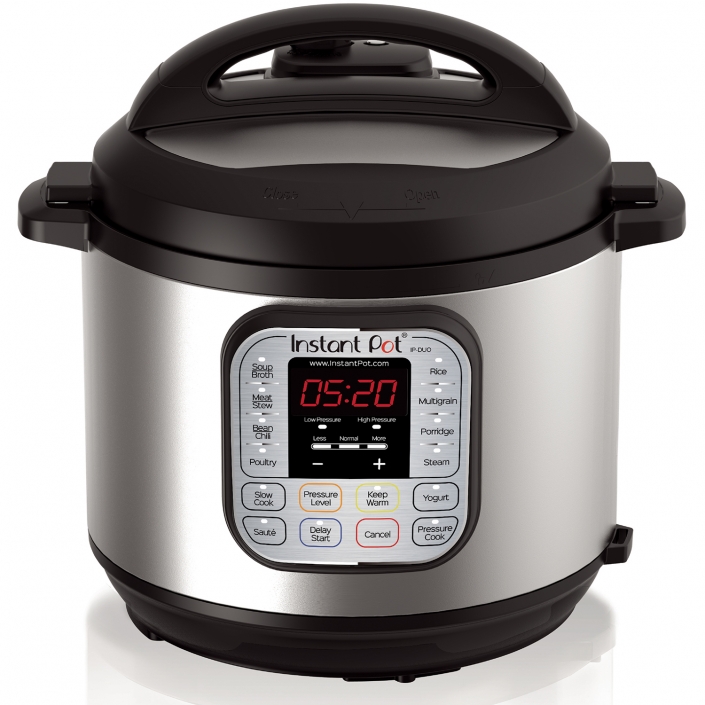
One cooking appliance that I have never felt a need to purchase is an Instant Pot. I saw no reason for it and did not want to take up any more precious space in my pantry. One of my husband’s colleagues recently gave us one as she said she did not need it. So, I have begun to delve into the world of the Instant Pot and decided to devote this Cooking Tip to this subject.

At its most basic, the Instant Pot is an electric pressure cooker although it can also be used for other functions such as slow cooking, yogurt making, rice cooker and even sautéing food. The actual programs that are available will depend on the model of the Instant Pot.

Any pressure cooker works by creating high pressure inside the cooker. This allows the boiling point of water to increase above normal. Therefore, you are cooking the food at higher temperatures than you can achieve on the stovetop and thus, the food cooks faster. As the pressure pushes water into the food, it not only helps to speed up the cooking process but also keeps food very moist.

One point about cooking food faster. Yes, that is correct but the cooking time does not usually include the time it takes for the Instant Pot to fully pressurize. The cooking time begins after that happens. You need to add anywhere from 5 to 20 minutes to the overall time to account for this pressurization step. There is also the time to depressurize to consider. If doing a natural (rather than quick) depressurization, add another 10-15 minutes.

If you live at high altitude as I do, you realize that cooking and baking sometimes takes adjustments. For prior Cooking Tips, see these links.

Since pressure cooking increases the temperature that you can achieve within the pressure cooker, you might think that altitude adjustments would not need to be made. However, this is not true. The general recommendation is to increase the cooking time by 5% for every 1000 feet over 2000 feet. For example, I live at 6000 feet, which is 4000 feet above 2000 feet. So, 4 X 5% means I should increase the cooking time by 20%. There are charts that you can find. Here is one from A Mindfull Mom.

So, why use an Instant Pot? It is said to cook foods up to 70% faster than a conventional cooking method. Because of that, I find it most useful for cooking items that do take a significant amount of time such as tough cuts of meat, beans or whole grains. If you are cooking something that would cook in under 20 minutes stovetop, there is really no reason to use the Instant Pot.

There are also things that you should not cook in an Instant Pot. Let me address just a few. Because the Instant Pot cooks by using steam, anything you want crispy such as breaded meats will not get crispy but will rather be soggy. Delicate cuts of meat are better stovetop where you can cook to a recommended internal temperature as well as achieving the surface caramelization. Similarly, burgers are not good in the Instant Pot as they will taste “boiled” and not have that nice crispy exterior.

Dairy and creamy sauces bring their own problems to the Instant Pot. Curdling is a real risk. The pressure valve can easily get clogged from the dairy, leading to problems with sealing and pressurization. So, any dairy product should be either cooked conventionally or added at the end of the cooking time by using the Sauté function or just the residual heat of the Instant Pot,

Another advantage is that it is pretty much “hands off” during the cooking time so you can do other tasks.

Because the Instant Pot is so popular, there are a myriad of online sources that will help you to get the most out of it. There are also cookbooks galore; a search of just my library showed 90 results. You may also try converting your stovetop recipe to one for Instant Pot. Here is another chart that will help you with that.

I have just started experimenting with this appliance and am not totally sure about it as of yet. That may change as I use it more. What about you? Do you have one? What do you love to cook in it? Let me know.

Cooking Tips · Ingredients

Bacon, pancetta & other cured pork products

Even though we do not eat it on a regular basis, I always have bacon in my freezer. Not only do we love the taste and how versatile it can be in cooking, my husband makes his own bacon. So, our freezer always has a nice supply.

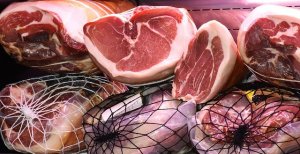
Bacon is something that is called a “cured pork product”. Curing is a method of preserving meat by removing moisture. The process makes it less hospitable for pathogens. It starts with salt, which is often mixed with nitrites and/or nitrates. These are used to ensure that the bacteria that produces the toxin responsible for botulism cannot grow. They also speed up the curing process, are what give the meat the pinkish color and add to flavor and texture. Curing also often involves smoking. Cured meat products may be cooked as in luncheon meats or uncooked as in bacon.

Bacon

In the US, bacon is a cured, lightly smoked pork belly. (In other countries, what they call “bacon” is made from other cuts of meat.) US bacon has a decent fat content but less salt than other cured pork products. Bacon can be cured in either a wet or a dry brine. The brine contains salt, sugar (honey, molasses, brown sugar, maple syrup, etc.) and a spice mixture. Nitrite is usually added either as a synthesized product (here is one example) or naturally occurring nitrates/nitrites derived from celery powder. Bacon is also smoked after the curing process.

Pancetta

We often refer to pancetta as “Italian bacon” but it is different. Similarly to bacon, it is made from the pork belly but is more heavily cured and has a higher salt content. It is usually not smoked but is seasoned with a mixture of garlic, black pepper, juniper berries and thyme. There is one form of pancetta that is smoked – pancetta affumicata. However, it still differs from bacon in its higher salt content and more curing.

There are two forms of pancetta – arrotolata and tesa. The former comes rolled into a log while tesa comes in a slab form, similar to bacon. Some experts recommend against buying the pre-sliced pancetta, which is often what we find in our supermarkets. They say they are usually of a lower quality and are less flavorful than pancetta that has not been pre-portioned. Of course, if that is all your stores carry, it is probably better than trying to substitute.

Prosciutto

This product comes from the hind leg of the pig with a curing process that lasts from a few months to a few years. This is one of the products that is typically eaten without cooking.

Prosciutto (made from the back leg of the pig) or dry cured ham comes in two different styles:  prosciutto cotto (cooked) or prosciutto crudo (uncooked). The former is bright pink and has a lighter flavor than the uncooked product. Although uncooked, crudo is cured and safe to eat as is. It is redder in color and more intensely flavored.

Salt Pork

This cut comes from the lower portion of the pork belly and is usually almost all fat with only a small layer of lean protein. This product is more heavily salted than bacon.

Guanciale

This word comes from the Italian guancia, meaning cheek. As the name implies, it comes from the pig jowl. This product will probably only be found in specialty butcher shops. It is often flavored with black pepper and herbs. However, the meat itself tastes different than the cuts from the belly. It is an extremely fatty product and is what gives the product its unique flavor. These unique characteristics mean it is very difficult to find an adequate substitute.

Lardo

This is made from the fat on the back of the pig (fatback). It is salt-cured and seasoned with herbs. This product is pure cured pork fat.

Substituting

When you are thinking about substituting these products for each other, there are some differences that should be considered.

  • Fat content
    Whereas bacon and pancetta are similar in fat content, guanciale has considerably more fat. Salt pork is almost all fat while lardo is 100% fat.
  • Smoking
    Bacon is a smoked product where as pancetta and guanciale are not.
  • Salt content
    If you do not take this into consideration, you could ruin your dish with too much salt. Pancetta, due to the curing process, will have a higher salt content than bacon. Prosciutto has an even higher salt content.

Nitrites/Nitrates

Although the discussion of the safety of nitrites/nitrates is outside the scope of this Cooking Tip, I will just mention a few items for consideration.

The cancer warning from many years ago has not stood up to the test of time and scientific sources do note that there are health benefits to these chemicals. Most of the nitrites/nitrates we eat are from natural sources – mostly vegetables such as lettuce, celery, and carrots. There is a debate, though, whether the synthetically derived compounds are worse for us than the natural ones. I will leave that debate to you to investigate.

If you are a cured meat lover, you may want to try to make your own as my husband does with bacon. I, for one, am not interested in that skill as there are plenty of great products in the market. Do you have a favorite? Let me know.

Cooking Tips · Ingredients

Eggnog — Love it or Hate it?

Where do you fall on the scale concerning eggnog? Do you love it or hate it or are you in the middle? I am not a huge fan but I was making some White Chocolate Eggnog Truffles and I must say that flavor did well in that preparation. In this Cooking Tip, let’s delve into eggnog and what it really is.

According to The New Food Lover’s Companion, authentic eggnog is “a homogenous blend of milk or cream, beaten eggs, sugar, nutmeg and usually a liquor.”

Proponents of fresh eggnog over store-bought claim the flavor and thick texture are superior in fresh and that those characteristics come from real eggs. The FDA defines eggnog as “a milk product consisting of a mixture of milk or milk products of at least 6.0 percent butterfat, at least 1.0 percent egg yolk solids, sweetener, and flavoring. Emulsifier and not over 0.5 percent stabilizer may be added.” That is not a lot of egg in the store-bought version. Since eggs can be expensive, companies will use the least they can to get the product they want. There are also thickeners added such as carrageenan, guar gum, and locust bean gum.

Also, a great homemade eggnog is foamy from the beaten eggs, something you won’t get with a commercial product. By law, the store-bought products must be pasteurized, which changes the flavor and texture. Finally, commercial versions are generally sweeter than homemade.

If you want to try homemade eggnog but are wary of the raw eggs, you can buy pasteurized eggs or cook the eggnog.

Some sources looked a little closer into this issue. As we all know, the FDA warns against consuming products with uncooked, unpasteurized eggs. According to a story on Chowhound, the writers say that the alcohol that is classic in eggnog will kill harmful bacteria. The recipe sited in this article contained more than 20% alcohol.

Serious Eats also looked at this issue. They quote a laboratory study showed that eggnog containing at least 20% alcohol will be sterile after 24 hours.

Recipes will differ in types of dairy used – milk, cream or a mixture. Some recipes call for using just egg yolks whereas others will start with the yolks, beat the egg whites separately and fold them in at the end. Others will add whipped cream to finish. Some have alcohol and some do not although without the alcohol, there is more of a concern for consuming raw eggs.

Nutmeg is classic but some recipes may add other flavorings such as cinnamon and vanilla. I even saw an interesting recipe from Jamie Oliver for chocolate eggnog with cardamon and cloves.

There is something called “aged eggnog”. According to the above referenced story on Chowhound, as eggnog ages, chemical reactions occur causing a blending of flavors. Other effects are that the color becomes more golden and the texture thickens. They say that the longer it ages, the mellower it becomes.

In the Serious Eats discussion, they did a taste test with three samples (one aged, two not aged), the un-aged eggnog was unanimously preferred. They felt that the aged product was stronger, even medicinal, in flavor. If you read this article through, you will see that there is a great difference of opinion on which is best. As with many things, taste is very personal.

So, are you a fan of eggnog or not? Do you buy it or make your own?

Let me know your thoughts!

Cooking Tips · Ingredients

Fungi — Great Umami Flavor!

I taught a Thanksgiving cooking class but did a Vegetarian take on it. If you look at many vegetarian dishes, you will see that mushrooms often play a large part in those dishes. I realized that I had never written about mushrooms, probably because they are not one of my favorite foods. I decided it was time to delve into this ingredient and that is the subject of this Cooking Tip.

Mushrooms are a type of Fungus (Perhaps that is why they are not my favorite!). As everyone knows, some are edible while others are toxic. If you are going to forage for wild mushrooms, you need to be thoroughly educated about mushroom types.

They have a rich, almost meaty flavor, making them a great ingredient for more substantial vegetarian dishes. This flavor-boosting ability is due to a high content of free amino acids such as glutamic acid. For a more in-depth explanation of how this can boost umami flavor, see this Cooking Tip. I will first discuss storing, cleaning and cooking. That will be followed by a discussion of the most common types of mushrooms.

After harvest, mushrooms remain metabolically active. This can be slowed by storing them in a refrigerator. They should be loosely wrapped in moisture-absorbing packaging to avoid the accumulation of moisture on the surface, which can lead to spoilage. The recommended methods are to leave them in their original packaging or place them in an open paper bag. Do not store them in a plastic bag.

Mushrooms last 4-7 days in the refrigerator. Some say you can freeze them but they will be mushy when thawed. They freeze better when sautéed first as the cooking process will draw out moisture and concentrate the flavor. After cooling, put them in a freezer-safe container and freeze for up to 9 months. To use, there is no need to thaw but because of the textural changes, they are best used in dishes that are cooked.

As mushrooms grow in dirt, you need to pay special attention to cleaning them. One of those “old kitchen tales” is that you should never wash mushrooms as it will cause them to become soggy and less flavorful. In 2009, on the blog Cooking Issues by the International Culinary Center, they claimed to debunk this myth. They cooked two batches of mushrooms side-by-side. One was washed in water and the other was just brushed off. They note that although the mushrooms do take on water, it all cooks off in the hot pan. More importantly, in a taste test of these mushrooms, the tasters could not tell the difference.

They did notice an interesting event. The brushed-off mushrooms tended to absorb a lot of oil and thus, became greasy. The washed mushrooms did stew a bit until the water was cooked off. However, during this time, they were not absorbing oil. By the time the water was all evaporated, the mushrooms weren’t as porous and so, did not absorb the oil very well. The brushed-off ones started absorbing oil from the moment they were in the pan. In this testing, they cooked the wet mushrooms in a very crowded pan whereas they dry mushrooms were given plenty of room. Even with this, tasters preferred the less greasy mushrooms.

Whichever method of cleaning you use, as with much produce, do not clean them until right before you are going to cook them.

Mushrooms can be used whole, halved, quartered or sliced. Some mushrooms such as shitakes must have their stems removed. The stems of portabellas are also very large and woody. They are normally removed before eating although they can be used to flavor stocks, soups or sauces. For most other varieties, the choice is yours.

As for cooking methods, they can be sautéed, grilled, roasted or even microwaved. The cooking method that develops the most flavor is when they are cooked slowly with dry heat. And, of course, they can certainly be consumed raw.

Types of mushrooms

White button – These are undoubtably the most common mushroom you will see in the markets. They make up about 40% of the mushrooms grown around the world. They are the mildest tasting and can be eaten either raw or cooked. Examples of dishes include soups, salads and pizzas.

Cremini – This is a firm, dark brown variation of the standard white button mushroom. They have a fuller flavor than the white but they can be used interchangeably. Another common name you will see is baby bella as they are a young portabella.

Portabella – These are fully-matured cremini mushrooms. They have very large (4-6 inches) flat caps with fully exposed gills. Because of their dense texture and meaty flavor, they are often used in vegetarian cooking as a meat substitute. Other great uses are grilling and stuffed mushrooms. They are very common in Italian cooking as they give depth to creamy sauces and pastas. As mentioned above, the stems are very woody and are usually removed. The dark gills are typically scraped out and thrown away. Although edible, they do no favors for the appearance of your dish. Another spelling is portabello.

Porcini – These mushrooms have round, golden- to reddish-brown caps with bulbous white stems. The flesh is tender and cream-colored while the flavor is described as earthy, meaty and even nutty. They are available fresh or dried although in the US, it can be difficult to find fresh ones. The dried porcinis need to be soaked in water before using. They can be added to braised meat dishes, ground up and sprinkled onto meat or cooked into a risotto.

Chanterelles – Described as trumpet-shaped with yellowish stems and frilly brown caps. The flesh is delicate and golden with an almost fruity aroma. Their shape leads to accumulation of dirt, requiring a thorough cleaning before consuming. Their woodsy flavor means they work well in souffles, cream sauces, soups, pasta or just sautéed in butter.

Morels – Morels have a distinctive spongy and conical shaped cap, ranging in color from tan to dark brown to gray. The flesh is delicate and spongy and their flavor is earthy, nutty and somewhat spicy. They are another type that traps dirt and so must be cleaned well. They are often just sautéed in butter and served with meat or poultry or added to soups or pasta.

Oyster – These are fan-shaped with cream to gray colored caps (although there are yellow, pink and blue varieties) and short white stem and gills. Delicate in aroma and flavor, they are very common in Chinese cooking for stir-fries and soups. If you use these, be aware that they will take a longer cooking time.

Shitake – These are recognizable by their dark brown umbrella-shaped caps with cream colored gills and stems. The flavor is earthy, woodsy and slightly meaty. As previously mentioned, the stems are tough and should be removed. They come in fresh and dried form with the latter being more intense in flavor. Very common in Asian cuisines, they release an earthy, umami flavor when cooked. They can be sautéed, stir-fried, roasted, sprinkled on pizza or added to soups.

There are, of course, many other varieties. The problem will be in finding them in our supermarkets. You will probably always be able to find button, cremini and portabellas. You can occasionally find some of the other varieties although it might be easier to do so in specialty markets.

Whether you are a forager or just shop for mushrooms in the market, they are an ingredient that can add great umami flavor to your dishes or help you make a substantial and “meaty” vegetarian dish. Have fun with them!

Cooking Tips · Techniques

Confit – A Delicious Cooking Method

If you have ever been to a French restaurant, you may have seen Duck Confit on the menu. If you ordered and eaten it, you know it is a special dish. My husband cooked the other night and made an absolutely delicious Rabbit Confit. If you think you do not like rabbit, you have probably never had it this way. Just what does “Confit” mean? That is the subject of this Cooking Tip.

According to Harold McGee in On Food and Cooking, the word “confit” comes from the French verb “confire” and the Latin “conficere” meaning “to do, to produce, to make, to prepare.” This book goes on to explain that it was first applied to fruits cooked and preserved in a sugar syrup, honey or alcohol during medieval times. Later it was applied to vegetables pickled in vinegar, olives in oil, meats under fat and various food in salt.

Confit is not really a dish but a method of cooking. It is said to be a specialty of Gascony, France and to have derived from an ancient method of preserving meat where it is salted and cooked in its own fat. The meat was then packed into a crock and covered in its own cooking fat, which acted as a seal and a preservative.

Today, it is generally used to describe anything that has been cooked slowly and gently in fat to a wonderful consistency and flavor.

There are three basic components to this process.

  • A salt cure – salt is rubbed into the meat and then allowed to age for at least an hour or even up to 3 days. This draws out moisture, which then allows that water to be replaced by oil. This results in a very tender and flavorful product.
  • The fat – very common fats include duck, goose or chicken fat. An oil such as olive or vegetable can also be used. The food item is submerged in this fat.
  • A slow cooking process – after submerging the food item in the fat, it is cooked at a low temperature (~200-250°F) for a few hours. Often herbs and spices are added to infuse flavor.

Although you can eat the meat as soon as it is done cooking, there are those that say that it is not true confit unless you then store it submerged in the fat for two weeks. During this storage period, muscle and connective tissue continue to break down and tenderize the meat.

When stored properly, confit can be kept for several months. This means that it is fully covered in the oil without any air and it is kept cool, <40°F. Without this, there is a risk, albeit small, of botulism. This organism can grow in a low-oxygen environment. The meat is often salted again before storage to decrease this risk. Nitrates are also occasionally added.

You might ask how this is different from deep fat frying. The answer is the temperature. Confit is done at a relatively low temperature (~200-250°F) while deep fat frying is done at a much higher temperature (325-450°F). This higher temperature leads to quick moisture loss and a crispy exterior. Deep fat frying is also done in minutes, not hours as in confit.

Have you ever eaten duck (or other meat) confit? What did you think?
Even more, have you made it yourself? It is not hard; it just takes some time and care.
Let me know if you have or plan to make it.

Cooking Tips · Techniques

Microwaves — Friend or Foe?

If I did a poll of all of you and asked if you had a microwave, I would suspect over 90% of you would respond in the affirmative. Statista.com reports that almost 13.5 million microwaves were shipped in the US in 2019. If you are a part of the group that does not have one, let me know and why you made that choice. In this Cooking Tip, I want to discuss this very useful but often maligned kitchen appliance.

Since most of us have a microwave, what should we be using them for and what should we keep out of them?

I mainly use my microwave for just a few tasks. I occasionally defrost food in them. I really do not like defrosting meat in them, though, as they often defrost unevenly and you can even get some cooked parts. I realize that it may be your only choice if you need to get that Chicken Marsala on the table quickly and your chicken is still frozen. If you can plan ahead and put your frozen item in the refrigerator the night before, that is the ideal situation. Another item I have mentioned in another Cooking Tip is a defrosting tray. This option is not as fast as a microwave but it is fairly quick and does a great job.

I will also use my microwave to melt butter and occasionally melt chocolate. The only real “cooking” I do is to heat frozen vegetables or to make my morning oatmeal.

Here are some other “non-cooking” ideas that others recommend.

  • Softening hard brown sugar — measure the amount of brown sugar you need into a microwave-safe bowl. You only want to warm the amount you need as the excess will just harden again. Place a dampened paper towel over the sugar and cover with plastic wrap. Warm in the microwave for 30 seconds at a time, checking often to avoid melting the sugar. I have done this and it does work well.
  • Toast nuts or spices – place in shallow bowl or pie plate in a thin, even layer. Start the microwave but stop, stir and check every 30 seconds until there is browning and you can smell the aroma. I must say that for a small amount of nuts/spices that this can be just as easily done stove-top in not much more time.
  • Softening the rawness of garlic – put unpeeled cloves in bowl and microwave for 15 seconds until cloves are warm. Not only does it soften the flavor but it also makes the cloves easy to peel.
  • Liquifying crystallized honey – Uncover honey jar and microwave 30 seconds or so. I prefer putting my jar of honey in a pot of hot water but the microwave method does work.
  • Soften stale bread — wrap bread in a damp paper towel, microwave for about 10 seconds. Check and repeat as needed.

What about the power levels? Microwaves work differently than your regular oven. In the latter, you turn down the temperature and the cooking temperature lowers. In a microwave, when you change the power level, the “magnetron” just cycles on and off. Because of this, Cook’s Illustrated recommends the following.

  • OK to use high power to:
    • Heat water, watery soups or beverages (But, see below for a warning about heating plain water.)
    • Make popcorn (or other foods less than ½ inch thick)
  • Use 50 percent power when:
    • Heating/reheating foods that can’t be stirred, such as lasagna, frozen chicken, potatoes
    • Bringing food to specific temperatures: softening butter, tempering chocolate
  • Lower power level OR stir frequently when:
    • Heating dairy-based foods such as chowder that can curdle
    • Heating splatter-prone foods such as tomato sauce
    • Melting splatter-prone butter

Here is some other general advice on using a microwave.

  • Always cover food. This not only protects the interior of the oven but it traps steam resulting in better cooking.
  • Stir or flip your food. This allows the microwaves to hit new parts of the food and promotes heat transfer.
  • Allow the food to rest when you take it out of the microwave. This allows the temperature of the food to even out.
  • Realize that not every container in your kitchen is microwave safe. If the item does not tell you that, GE Appliances recommends the following test.
    • Fill a microwave-safe cup with water.
    • Place the cup in the oven on or beside the utensil in question.
    • Microwave for only one minute on high.
    • If the water becomes hot and the dish remains cool, the dish is microwave safe. If the dish heats up, it should not be used for microwaving.

What about items you should not put in a microwave? We all know that foil or any type of metal is a no-no and I just mentioned not using dishes that are not meant for the microwaves but there are other items.

  • Nothing – do not run your microwave empty. Since there is nothing to absorb the microwaves, it can catch fire or otherwise damage the appliance.
  • Grapes – they can explode but I’m not sure why you would want to put your grapes in the microwave. For a scientific explanation, see this link. For a quirky video demonstrating this, see this link.
  • Eggs – whole eggs can explode and egg dishes such as scrambled eggs and frittatas will become rubbery.
  • Paper bags – these can release toxins and even catch fire.
  • Chili peppers – the capsaicin in these peppers can vaporize and irritate you when you open the door.
  • Plain water – water can actually become super-heated and bubble up vigorously and burn you. Putting something in the cup such as a wooden skewer helps to prevent this. It is still preferable, though, to heat your water either in an electric kettle or on the stovetop.

There are plenty of books and websites out there that talk about actually cooking meals with your microwave. I do not really see the point as you can put great food on your table using traditional cooking appliances in not that much time. Others feel differently. How about you? What do you use your microwave for? Let me know.

Cooking Tips · Ingredients

Puff Pastry — yummy layers of dough and butter!

After writing about Pastry Doughs in general, I wanted to get a bit more detailed about a few types. I already wrote about Phyllo Dough and in this Cooking Tip, I will expand on Puff Pastry.

The French call Puff Pastry by the name Pâte Feuilletée roughly translated to “pastry leaves”. It is a type of laminated dough, which means layers that are bonded together. In the pastry world, it is layers of dough and butter.

You can certainly buy puff pastry in the market. The most commonly-found and very highly rated is from Pepperidge Farm. They sell it not only in sheets but also in what they call cups and shells.

Making your own is not difficult in a technical manner but does take some time. You start by making something called a detrempe, which is the dough component. It is composed of flour, a small amount of butter, water and salt. The second component is the butter layer – the beurrage.

The detrempe is rolled into a large square and the butter layer is pounded into a slightly smaller square. There are different ways of incorporating the beurrage into the detrempe but most commonly, the beurrage is placed on top of the detrempe in a diamond pattern. Then, each corner of the detrempe is folded up to the center so that the butter layer is totally enclosed within the dough. This results in what is termed a paton. This paton is then rolled out to a rectangle and a process of rolling and folding commences. This process also involves chilling/resting the dough in between a number of these steps.

After the paton is rolled out, there are different types of folds you can do. One is called a “Book Fold” or “Double Fold”. This is where you fold both ends of the rectangular package into the center and then you fold one side over the other. This is termed “locking” the beurrage into the detrempe. This cycle of rolling out the dough and folding it again, turning the orientation by 90 degrees each time is repeated for at least 4 times.

Another type of fold is called a “Letter Fold”, which means just what it sounds like. You fold the dough like a letter. This has less layers than the book fold and so, it is recommended to repeat the rolling/folding 6 times.

How many layers do you end up obtaining? Many sources will quote all sorts of numbers from 500 to over 4000! Any mathematicians out there?

You might ask why a person would ever want to make their own puff pastry rather than buying it. Pros for store-bought are the convenience and consistency. The arguments for homemade are taste and the satisfaction of producing your own. You might also consider the ingredient list.

  • Pepperidge Farm ingredients – enriched wheat flour (flour, niacin, reduced iron, thiamine mononitrate, riboflavin, folic acid), water, vegetable oils (palm, soybean, hydrogenated cottonseed), contains 2% or less of: high fructose corn syrup, salt, mono and diglycerides, soy lecithin, malted barley flour, turmeric and annatto extracts for color.
  • Homemade puff pastry – flour, butter, water, salt.

That being said, there are ones you can purchase with an ingredient list much closer to homemade but probably not in your local supermarket. Whole Foods Market does carry some although they are twice the price of Pepperidge Farm and, of course, there is always online.

Working with puff pastry

  • Use care when rolling out so you do not damage the structure. Do not roll over the edge as that will compress the edges.
  • Try to use even pressure as you roll so the butter is evenly distributed.
  • Try to let the pastry rest 5-10 minutes between rolling and cutting. After cutting, another rest period of 15 minutes helps to minimize shrinkage.
  • When you cut the rolled out dough, try to cut at a 90 degree angle so it will rise straight up in the oven.
  • Try to keep everything cold as you do not want the butter to melt before it goes into the oven.
  • Use a hot oven as you want maximal steam to puff it up.

Freezing puff pastry

This pastry freezes well either as a raw dough or when made up into the shape of your choice. It will be fine in the refrigerator for up to 5 days. Any longer than that could result in fermentation and the dough turning gray.

Uses for puff pastry– both sweet and savory

  • It is often used to wrap items such as with a Beef Wellington or a sausage roll.
  • A sweet or savory tart or pie.
  • Palmiers (elephant ears) are an item that can be either sweet or savory depending on the filling/topping.
  • Cheese straws
  • Mille-feuille – French for a “thousand leaves”, it is very similar to what is known as a Napoleon. Both are composed of layers of puff pastry alternating with a sweet filling (often pastry cream) although a savory version can be made with a cheese filling.
  • Vol-au-vent – a creation where the puff pastry is baked into a sort of shell with a pastry lid and a filling.

Have you ever made your own Puff Pastry? Would you ever want to give it a try?

Let me know and I would be happy to show you how.

Cooking Tips · Ingredients

The Ins & Outs of Phyllo Dough

In my last Cooking Tip, I wrote in general terms about pastry doughs. In this Tip, I want to delve deeper into just one of those types — Phyllo Dough.

The word Phyllo (also known as filo/fillo) is said to come from “the Greek ancestor of the French word feuille, meaning leaf.” This type of pastry dough may go back as far as the 1500s in Istanbul.

It is made by making a stiff flour/water dough with a bit of salt and maybe some acid or oil. It is kneaded, rested and then stretched out so it gets thin enough to be translucent. In recipes calling for phyllo, these paper-thin sheets are layered to give a structure that is similar to puff pastry but the dough itself is virtually fat-free.

We will normally find phyllo in our stores in the freezer section. Although not the only brand, the major one you will find in our supermarkets is Athens and they make not only the sheets but also little phyllo cups. Because of the minimal fat content, many prefer these to little tart shells made with pie dough or puff pastry. They will be crunchier and more delicate, though.

It will most likely be frozen when you buy it and, most sources, including Athens, say phyllo should be allowed to defrost slowly in the refrigerator overnight. Some experts warn that if it thaws too quickly, the dough can become sticky. Others claim it can be thawed for several hours at room temperature. If at all possible, I would opt for thawing in the refrigerator.

Athens also recommends allowing it to sit at room temperature for a couple of hours before using. 

When you are ready to use it in your recipe, you must take certain precautions. Because of how thin it is, phyllo will quickly dry out and become brittle. The typical recommendation is to cover the sheets you are not using with a damp cloth to keep them moist and pliable. Cooks Illustrated finds that people often make the towel too wet leading to a sticky dough. They, therefore, recommend either covering the sheets with plastic wrap or parchment followed by a damp towel.

As the phyllo sheets are layered in a recipe, they are brushed or sprayed with oil or melted butter to keep them supple.  It is easy to get tears in the phyllo dough as you use it. If this happens, just make sure the tears don’t line up as you stack the phyllo sheets.

Bo Friberg in The Professional Pastry Chef warns that if phyllo is re-frozen, the sheets can become brittle. Athens say that you can store unused sheets in the refrigerator for up to 1 week if wrapped tightly in plastic wrap. They also say it can be refrozen for up to 2 months but recommend wrapping tightly in plastic wrap followed by foil. From personal experience, I can say that it does become more brittle the more you refreeze it.

Strudel is a variant of phyllo dough but it is made differently in that it is a wetter dough and contains more fat, often an egg. These two terms (phyllo & strudel) are sometimes used interchangeably and many apple strudel recipes are made with phyllo dough.

So, what can you make with phyllo dough? Many of us think of dishes such as baklava and spanakopita. It is also used in making both sweet and savory strudels. You can experiment and try phyllo in place of other pastry in items such as tarts and pies although the results will be different.

Yes, you can make your own phyllo dough but it does take some technique and quite a bit of practice. Have you ever made your own?  Let me know.