One less well-known ingredient in Asian dishes is Tamarind. If you want to make authentic-tasting Asian cuisine, you will want to use it. This Cooking Tip, part of our ongoing series on Asian ingredients, explains what tamarind is and how you use it.
Origin

Tamarind trees are native to Africa and Asia but also grow in tropical climates worldwide. In the Western hemisphere, Mexico is the largest producer. The trees produce fruit pods that have a brown exterior and are somewhat bean or peanut-shaped. The edible part is inside these pods and is dark brown.
Flavor
The pods have a more greenish hue when unripe, and the flesh is very sour. If ripe, the fruit’s flavor is a mixture of sweet and sour with complex notes of caramel and molasses. It is acidic but less so than citrus fruits such as lemons and limes.
Forms
There are many forms in which to find tamarind, although some will be easier to find than others.

Pods – These are the whole form of the fruit, as described above. However, most tamarind pods sold in the US are considered “sweet tamarind.” Their flavor is more sweet than sour and is meant for a snack rather than in cooking. The sour varieties are typically processed into tamarind pulp, and is the type used in cooking. If buying the whole pods, be sure to look for a label indicating which it is. The flesh must be removed from the pods and processed into a usable pulp.
Pulp –This is the edible paste from within the pod. Even though it is not that easy to find the pods, finding blocks of tamarind pulp is not difficult if you frequent an Asian market. It will be a very dark and sticky rectangular block wrapped in plastic.

To use this form, you must make it into a useable paste. Break off some of the pulp and place it in a bowl. Cover with hot water and let sit for about 15-30 minutes. When the water is cool enough to touch, start massaging the pulp into the water. With this, you are breaking the edible part away from inedible fibers and membranes. Even though the blocks are usually seedless, occasionally a seed may be present and you can remove it. Once it is as dissolved as much as possible, it should be put through a fine-mesh strainer. You will be left with a tamarind liquid or paste.
How thin it is will be dependent on how much water you use. Cooks Illustrated recommends using 4 ounces of pulp to one cup of water. You do not want to use so much water that the result is very liquid with a diluted flavor. It is better to make it thicker and add water at the end if you wish.
Many Asian chefs feel that this gives you a more flavorful and tarter product than using one of the other forms.
Paste/Concentrate – These terms are used interchangeably and sometimes together on the label. Neither is accurate.
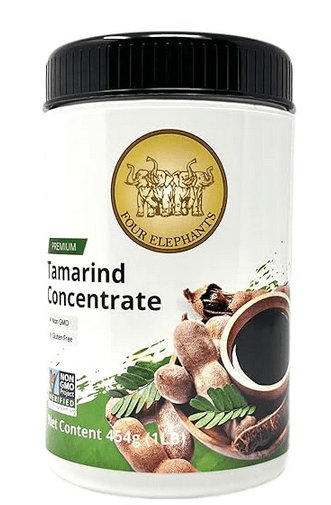
This is a form of tamarind that you will find in a plastic or glass bottle. It is the commercially produced version of the paste you can make yourself with fresh tamarind. This form is much easier to use as all you need to do is to spoon it out. Some do feel that the flavor is not as good as if you make it yourself.
Be aware that you might see tamarind paste from Thailand, Indonesia, and India. The latter is an actual concentrate as it has been cooked down to a very thick consistency. The flavor is very intense and is not interchangeable with the other version. I can attest to that from my own experience. I made Thai Sate with Peanut Sauce for a friend’s adult daughter when she was visiting. At that stage in my cooking life, I did not truly appreciate this difference and used an Indian version. The peanut sauce was nothing like it should have been. I would not have said it was inedible, but it was not extremely pleasant. So, take the time to look at the label and ensure you have the variety you wish for the dish you make.

Powder—This is dehydrated, ground tamarind. It is generally used in candies, beverages, and snacks. It is also used as a souring agent in certain types of Indian cuisine.
Tamarind sauce—This is another product that needs to be avoided. It is tamarind paste that has been thinned and combined with other ingredients such as brown sugar, chili pepper, ginger, and/or soy sauce.
Tamarind juice/beverage—Tamarind is an ingredient often used in cocktails and other beverages. You can make your own tamarind juice by stirring the paste into hot water. After it cools, strain out any remaining pulp and add cool water and sugar to taste. Bitters are often added to cocktails.
Uses
The main recipes that call for tamarind are Asian recipes, especially Thai and Indian. It may be just added in a small amount to add complexity to a dish. At other times, it is an essential part of the flavor profile. An example is Pad Thai.
The unripe version is often pickled and mixed with tomatoes, chilis or carrots.
Curries
Chutneys
Beverages & syrups used to flavor sodas, cocktails and iced tea.
Sauces
It is an ingredient in Worcestershire sauce. Look at your bottle’s ingredients; you will surely see tamarind there.
Marinades – tamarind contains tartaric acid, which is a tenderizer.
Substitute
Many people ask if there is an acceptable substitution that can be made. If the tamarind is an integral part of the dish, such as in Pad Thai, nothing else will taste the same. If it is not a primary flavoring agent, you could try using something that has both a sweet and sour element. Some combine brown sugar with lemon/lime juice or white wine vinegar.
Storage
Unopened packages of tamarind pulp or jars of tamarind paste are shelf-stable. Both should be refrigerated after opening to prevent the development of mold, and they should last a few months. If you use it infrequently, consider freezing it in small amounts, which can then be thawed as needed.
Homemade tamarind paste, however, is much more likely to go bad and should always be refrigerated. To prolong the shelf life, it can be cooked before storing. Smaller jars are better for homemade tamarind, as you can introduce pathogens every time you spoon some out. That is also a reason always to use a clean spoon.
With this discussion of tamarind, I end my Asian ingredient series. If there is an ingredient that I did not cover, let me know. Otherwise, I hope this series will enliven and improve the Asian cuisine you make in your own kitchen.


 Culinary Journeys, LLC