Asian · Cooking Tips · Ingredients

Coconut Milk – A Creamy Delight

Image by pixagrum from Pixabay

In our continuing series on ingredients used in Asian cuisine, we now turn to Coconut Milk. This ingredient is probably more commonly found in our pantries, but just what is it, how should we use it, and are some better than others? We will delve into those topics in this Cooking Tip.

How it is made

If you were to open a fresh coconut, you would see the tough outer husk, layers of white coconut flesh (sometimes called coconut meat) and a clearer liquid in the middle. Coconut milk is made by shredding and pureeing the fresh coconut meat and pressing it to extract the liquid, sometimes adding water to aid the process.

According to Thai chefs, there is “First Press” (hua gati) and “Second Press” (hang gati) coconut milk. The first is just what it sounds like, the product that results from pressing fresh coconut flesh with little or no water. This results in a rich, flavorful liquid and is the type that is sold in stores. To make the second press, producers take the already-pressed coconut meat, add more hot water and press again. It has a more diluted flavor and is not sold commercially.

Coconut milk is composed of coconut oil (fat), coconut protein and water. The oil solidifies into coconut cream at room temperature. When you open a can of coconut milk, you see two layers. There will be thicker white cream at the top and liquid water at the bottom. Different brands will have varying amounts as well as varying thickness of the cream layer.

Types of coconut products

In our stores, we might see various coconut products such as coconut water, cream of coconut, coconut cream and coconut milk.

  • Coconut milk—This product is produced as described above, and is a mixture of oil, protein and water.
  • Coconut water–This is meant to be used as a beverage, not in cooking.
  • Coconut cream—A can of this contains just the thick cream part with much less water.
  • Cream of coconut—This is also made from pureed coconut meat but blended with sugar. It is meant for drinks.
  • Lite coconut milk—As implied by the name, lite coconut milk contains less fat than regular coconut milk. It is more watery as most of the cream is eliminated. Companies often add stabilizers and other ingredients to compensate for the lack of fat, which can contribute to unpleasant flavors. Also, since the coconut flavor comes from the fat, when you eliminate that, you eliminate flavor.

What to look for
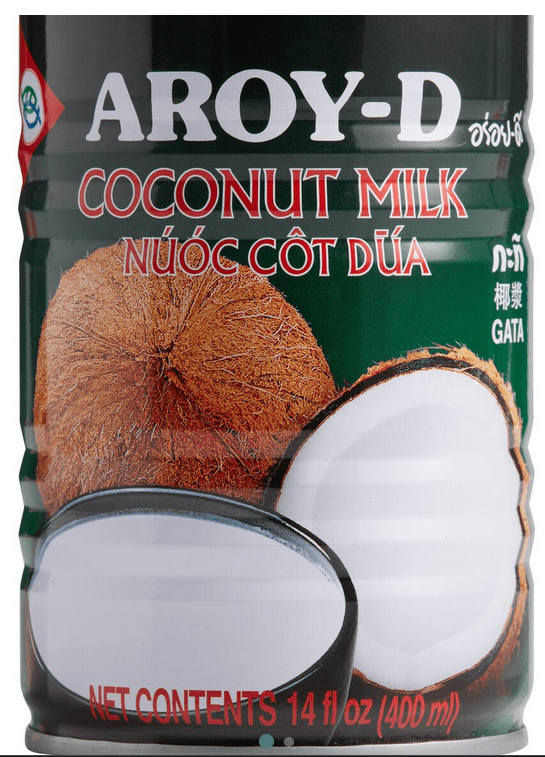
  • Packaging–What we will mostly see in our stores are cans of coconut milk, which are perfectly acceptable. Hot Thai Kitchen prefers using coconut milk packaged in UHT cartons. They explain that the cartons have been heat treated for a shorter time than cans, leading to better flavor. Although they say that one may not notice a difference in most savory dishes, the better flavor shines through in desserts. They go on to state that in Thailand, the cartons are what are mostly sold. Cans are preferred for export as they are more durable for shipping. I will warn you that the coconut milk sold in the dairy aisle is not the same thing. Those items have a much longer ingredient list and much less fat than those sold in the cans or the UHT cartons. They are meant to be used as a dairy milk substitute, not as a coconut milk substitute.
  • Ingredients–Look for a short ingredient list, preferably only coconut and water. Some labels might list coconut extract instead of coconut milk. According to America’s Test Kitchen research, these indicate the same thing. Some companies will add a preservative and may add guar gum, which serves as a thickener and prevents separating. If you read Thai recipes that start with coconut milk, they will often direct you to cook it until the oil begins to separate out. As I can attest by personal experience, this is much harder to do with a product that contains guar gum. This is understandable as preventing separation is the function of that ingredient.
  • No added sugar–It is best to buy unsweetened so you can control the amount of sugar in your dish.
  • Fat content—Look at the label to see the fat content. Generally, the higher the fat content, the better since the fat is where the flavor resides. Those products will have a much thicker cream layer as compared to the water. I looked at a number of different brands of coconut milk, and they ranged from a low of 9 grams for Goya up to 17 grams for Aroy-D.
Brands

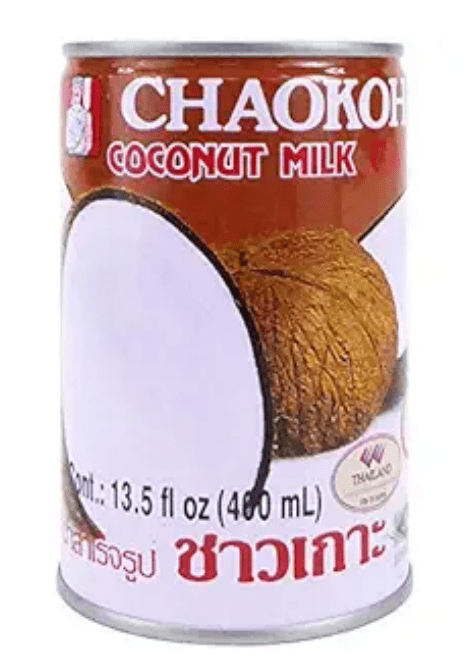
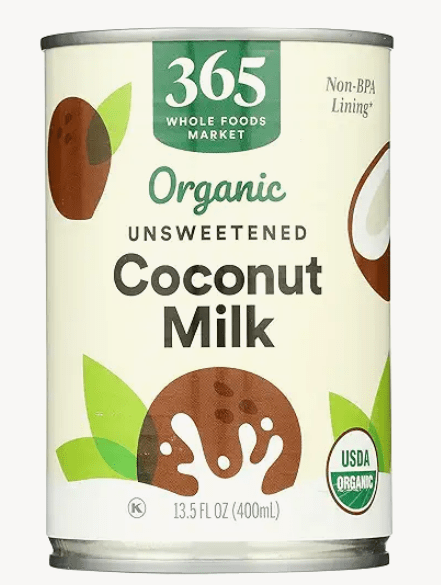
As with so many Asian ingredients, your choice of brands will be more limited in a general supermarket than in an Asian market. However, you can find acceptable products in both. I looked at taste tests from America’s Test Kitchen, Bon Appetit, Eater, and Epicurious. Here are some brands that rise to the top.

  • Aroy-D
  • Roland
  • Chaokoh
  • Thai Kitchen
  • Whole Foods 365
  • Trader Joe’s
  • A Taste of Thai was not recommended.

Although impractical, you can make your own by opening a coconut, scraping out the meat, and processing it in a blender with some of the coconut water and regular water. It then needs to be strained through cheesecloth. This is much more work than purchasing a can, but some swear by it for the fresh flavor. Others will start with a package of unsweetened shredded coconut. Combine it with hot water, blend and strain.

Uses

Coconut milk can be used in both sweet and savory applications. Here are some ideas.

  • Sauces
  • Stews
  • Soups
  • Curries
  • Rice
  • Puddings
  • Baked goods
  • Non-dairy whipped cream. This can be done by chilling the coconut milk, scooping out the fat and whipping. It won’t taste like regular whipped cream because of the strong coconut flavor, but it will have a similar texture and creaminess.
Storage

After opening, store any unused coconut milk in the refrigerator for up to a week. It is possible to freeze coconut milk, but it will alter the texture and be grainy when it is thawed. This should not be a problem when making something like a curry but would not be acceptable in a dessert where you want a creamy texture. Do not store it in the can; it can pick up a metallic flavor.

I always have coconut milk on hand, partly because we love Thai food, especially curries. However, its use is not limited to those dishes. Give it a try and see what you think!
Cooking Tips · Ingredients

Fish Sauce – Umami Galore

Fish sauce is an Asian ingredient that is not common in the average person’s pantry. However, if you want to make authentic-tasting Asian cuisine, you should grab a bottle. While taking a cooking class in Thailand, the chef told us that fish sauce is the “salt” of Asian cuisine. However, it doesn’t just impart saltiness; it also adds umami and acidity. What fish sauce is, how to purchase it, and how to use it are the subjects of this cooking tip.

What it is

Fish sauce is the liquid that results from the fermentation of a mixture of fish (usually anchovies), salt and water. This mixture is placed in tanks or vats and allowed to ferment anywhere from a few months to a couple of years. As the fish breaks down, it releases a flavorful liquid that we call Fish Sauce.

The liquid that is extracted first is called “first press” and is considered the most flavorful and valuable. It is sometimes referred to as extra virgin fish sauce. After this first extraction, more salt and water are added to produce more fish sauce, although it will be lighter, have less flavor, and be less nuanced. Sometimes, these later extractions are mixed with earlier extractions to achieve the desired concentration for the final product. Extremely low-quality fish sauce is said to have such a small amount of first press that the producers add artificial color and flavor to compensate. The first press fish sauce will be more expensive and can be harder to find in a regular supermarket. It can, though, easily be found in Asian food markets.

Some brands will have an “N” number on the label. This number indicates the nitrogen concentration and is an indicator of the protein content. Experts will tell you that a sauce with 30°N and above is considered high-quality and has a more complex taste. Vietnamese fish sauces are more likely to display the N content than Thai fish sauces.

Styles of fish sauce

Many Asian countries have their own version of fish sauce. The two we are most likely to see are Thai and Vietnamese fish sauce. Others that you might see in an Asian market are Korean and Filipino.

  • Thai-style fish sauce is known as nam pla. It is a bit on the stronger side in regard to flavor. Thai producers also tend to add sugar to the fish sauce. This is not necessarily bad, as it is added to balance the other flavors in the fish sauce. Great food is generally a balance of salt, acid and sweet. So, with a non-Thai fish sauce, you may end up adding a bit of sweetness to balance the flavors in your final dish.
  • Vietnamese-style fish sauce is called nuoc cham. It undergoes a lengthier fermentation process, which makes it lighter in color and flavor.
  • Premium vs. non-premium fish sauce: This is based on whether or not the fish sauce is a first press, as described above.

How to choose a fish sauce

Many chefs recommend keeping two products on hand: one higher-end first press, which is better used in raw applications such as salads and dips and one less pricey, lower-grade sauce for cooked dishes.

When you are looking at a shelf of bottles, here are some tips to look for.

  • Simple ingredient list – A good fish sauce will only have anchovies, water, salt, and maybe sugar.
  • Higher protein content – Look for one that has at least 2 grams per tablespoon.
  • Price – As with so many things in life, if an item is so cheap as to be unbelievable, there is probably a reason, and it generally means it is not as good quality. Although you do not have to buy the higher-end, more expensive fish sauces, you also don’t want to buy the absolute cheapest.
  • The phrase “nuoc mam nhi” – According to Andrea Nguyen, an authority on Vietnamese cooking, in an Epicurious article, this term refers to that first-press liquid. She states that some producers speed up the fermenting process so they can add more salt and water and get more output. They will get higher volumes but of a lower grade. Another term you might see is nuoc mam cot.
  • The term “ca com” – This refers to a specific type of anchovy found in Phu Quoc waters. This is an island off the coast of Vietnam, and the fish are said to be the most desirable, and the producers insist on maintaining traditional production methods. Authentic Phu Quoc fish sauce is made from ca com anchovies and is a Protected Designation of Origin product, like Parmigiano-Reggiano and Champagne. Because copycats are rampant, also look for a statement on the label stating that it was made and bottled in Phu Quoc, Vietnam.

Brands

It is hard to recommend particular brands as testing results vary. However, here are some commonalities between taste tests. Let’s look at both those products more available in general supermarkets and those that will be found in Asian markets. What you are looking for (besides the above advice) is a balanced fish sauce that is not just salty but has a nice umami taste and a complex flavor.

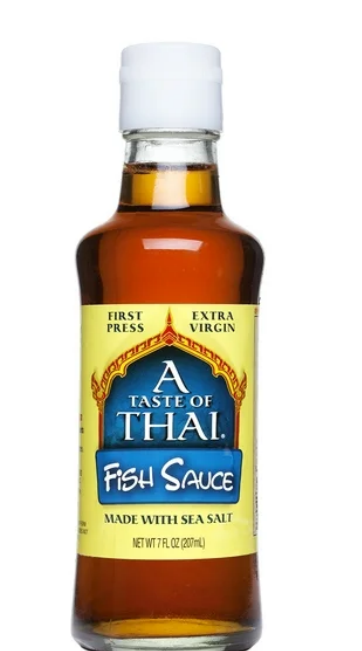
Supermarket brands that you will find are Thai Kitchen, A Taste of Thai, and Dynasty.

Most testers were not enamored with Thai Kitchen but found both of the others to be a good product.

Other brands

  • Golden Boy – Although some tasters found this one acceptable, others did not like it.
  • Squid – There is a general Squid fish sauce and a premium Royal Squid fish sauce.
  • Megachef – There are two varieties. One had a brown label and is sold widely in Thailand. The other has a blue label and is for export only
  • Tiparos
  • Red Boat 40°N – This is considered a premium brand, but they also have a higher-end product called Red Boat Phamily Reserve Maple Bourbon fish sauce. It is a 50°N fish sauce and is aged in maple bourbon barrels. The 40°N version is becoming more mainstream and I have found it at Sprout’s Market and Walmart.
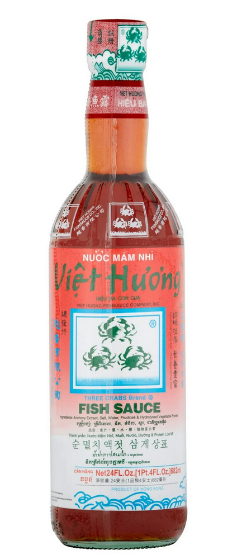
  • Three Crabs
  • Abalone

Storage

A bottle of fish sauce will last several years, although it may darken and deepen in flavor over time. It can be kept in the pantry, but if your kitchen is very hot or if you do not use it very often, you may want to put it in the refrigerator.

How to use

Fish sauce is a mainstay ingredient in Thai and Vietnamese cooking, but it does not have to be limited to those kinds of dishes. Use it whenever you want an umami boost or to add depth and complexity to your dishes.

Try it in soups, stews, chili, and meaty sauces such as Bolognese. You can also whisk a small bit into a vinaigrette or drizzle it over roasted vegetables or fried rice.

Do you use fish sauce? Do you have a favorite brand? If you haven’t used it before, you may want to consider adding a small bottle to your pantry!

Cooking Tips · Ingredients

Oyster Sauce – An Asian Umami Ingredient

This is the second installment in a little series about ingredients used in Asian cuisine. Last week, we discussed the very popular Hoisin Sauce. In this Cooking Tip, I want to look at Oyster Sauce.

Origin

As the name suggests, it all starts with oysters. The story told by the company Lee Kum Kee is that this sauce dates back to 1888. According to them, “A restauranteur named Mr. Lee Kum Sheung from Southern China was boiling a pot of oyster soup and forgot about it until the soup was simmered down to a thick gravy. He tasted it and discovered an irresistible, delicious new flavor. Since then, he started selling this as Oyster Sauce.” Mr Lee then became the founder of Lee Kum Kee, a brand that is very well known for its Asian ingredients.

Ingredients

Today, producers use oyster extract to make oyster sauce. Oyster extract (or oyster extractives) is the liquid leftover after shucked oysters are boiled. Other ingredients, such as salt, sugar, and soy sauce, are often added. Most recipes also add a starch as a thickener.

It is also known as oyster-flavored sauce. According to America’s Test Kitchen, do not confuse oyster-flavored sauce with cooked oyster sauce. The latter uses oyster-flavored sauce but adds other ingredients such as broth, soy sauce, sake, and sugar.

Flavor

Its flavor is described as savory with a touch of caramel sweetness. It is an ingredient that will add plenty of umami. Most find that it does not taste of oysters but the more premium brands can have a fishy note. Besides flavor, it also adds a dark caramel color.

Best Brands

Many sources (America’s Test Kitchen, Sporked, Bon Appetit) recommend the Lee Kum Kee brand. This company produces two different products.

Lee Kum Kee Panda Brand Oyster Sauce – This is the one you will most commonly find in regular supermarkets. It has a red label with a panda on it. It is milder in flavor than the premium offering. From its ingredient label, you will see it has 11% oyster extract.

Lee Kim Kee Premium Oyster Sauce – This is a more premium offering with a stronger flavor. Its label lists 40% oyster extract and shows two people in a boat. To purchase this oyster sauce, you will probably need to visit a specialty food store or look online.

Food & Wine, Milk Street, and several chefs prefer a different offering.

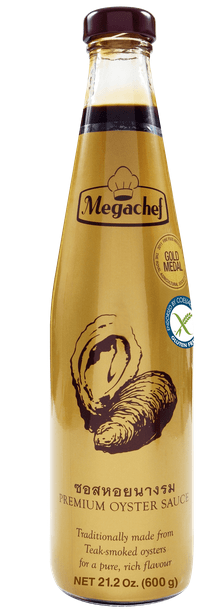
Megachef Premium Oyster Sauce—This oyster sauce is from Thailand and is considered to have a deeper and more complex flavor. You may find it in a specialty food store, or you can get it online.

Uses

Reach for oyster sauce when you want to add umami to your dishes. However, start with a lesser amount and titrate to your tastes.

Common uses:
Stir-fries
Kung Pao Shrimp
Marinades
Soups
Asian noodle and rice dishes
Can add a splash to a dish of cooked meat or vegetables.

Storage

As with many condiments, unopened oyster sauce can be stored in the pantry for one year, but once opened, it should be refrigerated, where it will last six to twelve months.

If you are serious about cooking Asian cuisine, oyster sauce is just one of the ingredients you will want to search out and learn to use.

Cooking Tips

Hoisin Sauce – A Sweet & Savory Flavor Punch

Do you like to cook any Asian cuisine, whether it be Chinese, Japanese, Thai, Vietnamese or others? If so, you probably have several Asian ingredients in your pantry and refrigerator. Even if you don’t cook this type of cuisine at home, you probably have at least a couple of Asian condiments. In some upcoming Cooking Tips, I would like to highlight some of these ingredients, what they are and how to use them. This Tip will focus on Hoisin Sauce.

I have already written a few Cooking Tips on other Asian ingredients & techniques. Here are links to those Tips.

Origin

Hoisin sauce hails from the Chinese pantry, specifically the Cantonese region. According to America’s Test Kitchen, the origin of hoisin sauce goes back to an ingredient termed “triumphant sauce.” It was used by Chinese people from the Guangdong (Canton) province. They used it in the preparation of fish. The Chinese word for triumphant (hoi syun) sounds similar to the word for seafood (hoi sin). Eventually, the name hoisin became the name for this ingredient.

Other sources say the name may be derived from a time when a seafood ingredient was included in hoisin sauce. Today, in the US, it is sometimes called Chinese barbecue sauce.

Finally, the company Lee Kum Kee says this about the name “The word ‘hoisin’ is Cantonese and translates to ‘seafood sauce’, although it contains no seafood. It was created by a chef as a dip to accompany seafood at a local food stall. It was so unique and tasty, that people refer to the sauce as “seafood sauce” and the name stuck with the sauce.”

It is thought that Chinese immigrants from Guangdong brought this ingredient to the US. It has become very popular with Americans. It is one of the easiest Chinese ingredients to find in our supermarket and is often called Chinese barbecue sauce.

Ingredients

The ingredients in hoisin sauce will vary from brand to brand. However, the key ingredient is fermented soybean paste (miso). Other components may include sugar, vinegar and seasonings such as salt, five-spice powder, garlic, chili peppers and sesame. Most contain cornstarch or potato starch, which is what gives hoisin its thick consistency.

Flavor profile

The flavor is both sweet and savory, and it is described as having a “deep umami richness.” One source claims it is like “a non-smoky BBQ sauce with extra-warm spices, sugar, and salt.”

Brands

America’s Test Kitchen did taste tests and recommends the following three supermarket brands.

  • Kikkoman Hoisin Sauce
  • Koon Chun Hoisin Sauce
  • Lee Kum Kee Hoisin Sauce

Sporked.com likes the following.

  • Kikkoman Hoisin Sauce
  • Lee Kum Kee Hoisin Sauce
  • Kroger Hoisin Sauce
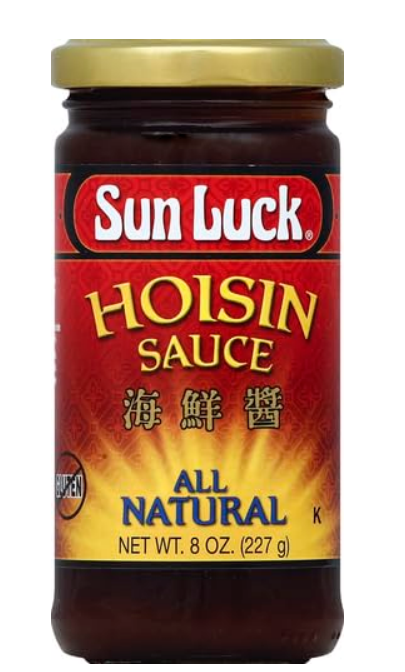
  • Sun Luck Hoisin Sauce

Bon Appetit prefers the Lee Kum Kee brand, with Kikkoman as a close second.

How to use it: Hoisin sauce is an ingredient in recipes, but it is also used as a finishing sauce and condiment. Its flavor is strong, so if you are experimenting with it, start with small amounts and then adjust to your taste. You may want to consider diluting it with water, sesame oil, or some peanut butter.

Here are some dishes where you might find hoisin sauce adds a perfect touch.

  • Soups
  • In dipping sauces
  • Noodle dishes
  • As a glaze or marinade
  • Stir Fry dishes
  • Fried rice

Make your own

Many people swear by making their own rather than buying a commercial product. Most of the recipes I saw, though, use peanut butter rather than soybean paste. It may be a nice condiment, but I am unsure how similar it would be.

Storage

If unopened, a jar of hoisin sauce can last for years when stored in a cool, dark place. Once opened, the recommendation is to seal the container tightly and store it in the refrigerator. There, it can last up to 18 months.

Do you have a jar of hoisin sauce in your pantry or refrigerator? I know I do. I may not use it very often, but it can be just what you need for that umami punch with a touch of sweetness.

Cooking Tips · Techniques

Slow Cookers – Do You Need One?

Do you own a crock pot? How about a slow cooker? Wait – aren’t they the same thing? That is just one of the facts we will explore in this Cooking Tip on Slow Cookers.

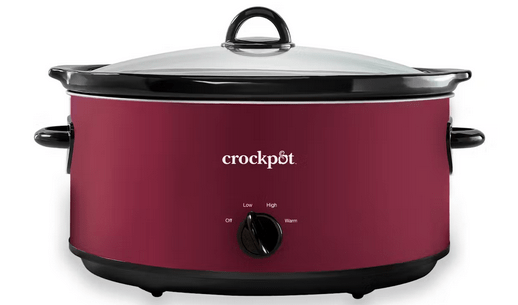
First, what about that name? A slow cooker is a small kitchen appliance. There are many brands, and Crock Pot is just one of them. It is the brand, though, that first popularized this appliance when it brought out its version in the 1970s. Today, there are a myriad of different brands.

I must admit that I rarely use my slow cooker. There are others who probably use theirs every week, but most others undoubtedly fall in the middle in terms of frequency of usage. Let’s look at the types, why people like them, and how to use them to get the best results.

Types of Slow Cookers

Traditional—The cooking vessel is ceramic, and it heats due to a heating element strip made of nickel and chromium that wraps around it.

  • Pros
    • They are thick and have excellent heat retention.
    • They absorb and transmit heat gradually.
  • Cons
    • They are heavy and can crack if dropped.
    • You cannot sauté in the crock. Instead, you must brown the meat in a skillet and transfer it to the cooker.

Other models – The cooking vessel is usually a nonstick-coated metal, usually aluminum. It sits on an electric heating element in the base, acting like a burner.

  • Pros
    • They are lightweight and durable.
    • They allow you to sauté and brown food in the crock rather than in a separate skillet.
    • They cook much faster than ceramic models.
  • Cons
    • Because they cook faster, your food can overcook if you are not paying attention.
    • Most recipes are developed for ceramic cookers; therefore, the time given in the recipe may be too long.

Benefits of a Slow Cooker

Convenience

  • This is the most common reason I hear for using a slow cooker: Just throw the ingredients in, turn it on and forget (or almost forget) it. At the end, voila, you have dinner. While much of this is true, there are certainly some precautions to take to ensure that dinner is something you wish to eat, which I will discuss.
  • Using a slow cooker frees up your oven and stovetop for other dishes, making it nice for the holidays or large gatherings.

Heat

  • Because you are not turning on the oven, you are not heating the house.

Energy efficiency

  • It uses very little energy, less than your cooktop or oven would use

Tenderizing

  • One of the great advantages of a slow cooker is that you can take tough (often cheaper) cuts of meat and turn them into tender mouthfuls.

Flavor

  • The extended cooking time can allow better distribution of flavors.

Travel

  • A slow cooker can be taken from your kitchen to the office or a party.

How best to use your slow cooker

  • Slow cookers are great for tougher cuts of meat, which are often less expensive. In fact, you do not want to use leaner cuts of meat, such as chicken breasts or pork tenderloin. If the meat is lean, it tends to get tough and stringy with the prolonged cooking. Using fattier and tougher cuts, including chuck roasts, short ribs, pork shoulder and lamb shank, is better. Whereas chicken breasts do not turn out ideal in a slow cooker, dark meat chicken is a good choice.
  • Trim the fat from the meat before cooking. As the meat cooks, it will release fat. If you are cooking stovetop, you can drain it off. This is not possible with a slow cooker. This can result in the cooking liquid becoming oily and greasy. For this same reason, most also recommend removing the skin from the chicken before cooking.
  • For the most flavor, sear your meat first in a skillet. Some slow cooker models allow for searing in the cooking vessel, thus eliminating the need for a separate skillet.
  • Cut the food into uniform sizes for even cooking and avoid over-crowding.
  • Layer the food properly. Put firm slow-cooking root veggies at the bottom and then the meat on top. If you want your veggies to have crunch, you may add them later in the cooking process.
  • Do not take the lid off until the dish is done. When you open the lid, heat is lost and takes time to recover. It can add 15-20 minutes to the cooking time. Also, the lid is very important in initially bringing the cooker up to a suitable temperature.
  • Fresh veggies are better to use than canned or frozen as the latter can cook too quickly.
  • To keep the freshness, wait to add delicate herbs until the end. Similarly, add your acid, such as citrus, at the end.
  • Tender foods such as pasta, squash, asparagus or peas should be added in the last hour of cooking.
  • Seafood such as shrimp, scallops, and fish should be added in the last 15-30 minutes of cooking.
  • Add any dairy at the last minute to prevent curdling.
  • Submerge the food in liquid while cooking. For increased flavor, use broth instead of water.
  • Although some do not agree, it is generally recommended that ground beef be cooked and drained of fat before adding to the vessel. With ground beef, it is also possible that it won’t cook evenly and thoroughly, leading to the risk of undercooked beef or being in the danger zone (40°F–140°F) for too long.
  • Because the cooking vessels take some time to heat up, some recommend preheating for about 10 minutes before adding the food.

Safety Advice

  • To remove food from the danger zone more quickly, start the cooker on high for an hour before lowering the heat setting.
  • Thaw foods first. The USDA says that since the cookers start at such a low temperature at the beginning of the cycle, the pathogens are not killed but remain in the meat and can stay in that danger zone for too long.
  • Are slow cookers safe to use overnight or unattended? Hamilton Beach says they are since they work on low wattage, only as much as 1½ 100-watt light bulbs. However, they do list the following cautions.
    • Follow the directions for your specific slow cooker.
    • Supervise children around the appliance.
    • Remind yourself that the outside will get hot. Only touch the handles.
    • Keep away from water.
    • Unplug when finished cooking.
    • Look the appliance over and do not use if you see any damage to the cord or the unit itself.
    • If leaving the house, ensure the appliance is set to low, placed away from the walls, and on a heatproof surface.

Purchasing a Slow Cooker

If you are looking to purchase a slow cooker, here is some advice from America’s Test Kitchen (ATK).

  • Look for one that is easy to use without overcomplicated displays.
  • Get one with a glass lid so you can see the progress without opening the cooker, which allows heat to escape and slows cooking.
  • Oval/rectangular shapes are more versatile. They accommodate large roasts, and the large surface area is better for cooking grains/beans.
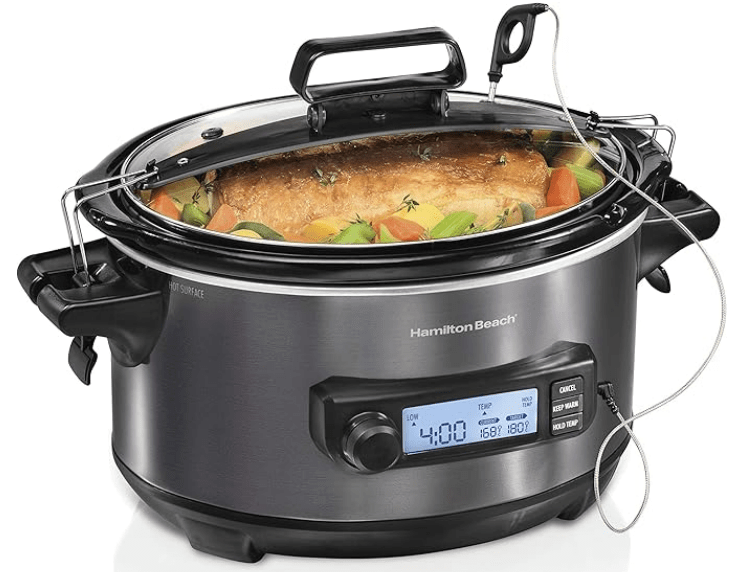
  • Better quality cookers have internal temperature sensors and controls. This means they cook more gently and successfully than those without temperature controls. Cookers with sensors keep food at a braising temperature, just below boiling. Cookers without sensors will just keep fully heating to the boiling point, and you are more likely to get an overcooked result. The problem for the consumer is that you most likely won’t see this listed as a feature on the box. ATK used temperature probes to confirm this feature, and their recommendations are below.
  • Large, stay-cool handles are preferred.
  • An attached temperature probe is nice to have as you do not have to open the lid to check on doneness.
  • Latching lids with silicone gaskets are also great if you transport food in the cooker.
  • A hold-temperature feature will keep food at a desired temperature for up to 24 hours. This allows you to reheat food, use it as a fondue pot or make yogurt.
  • ATK prefers digital over analog controls. Although the latter are simple to use, they do not indicate cooking progress and will not switch to keep warm when cooking is done. They keep cooking until you turn it off.

ATK Ratings

ATK tested and rated the following as the best slow cookers as of August 2024.

  • KitchenAid 6-Quart Slow Cooker (Although ATK just published this review recently, it is no longer on the KitchenAid website.)
  • Hamilton Beach Temp Tracker 6-quart Slow Cooker
  • The best slow cooker with searing capabilities was the Cuisinart 6-quart 3-in-1 Cook Central.

Here are their recommendations for smaller slow cookers.

  • Cuisinart 4-quart Cook Central 3-in-1 Multicooker
  • Hamilton Beach 4 Quart Programmable Slow Cooker

Recipe Conversion

  • As with many things, using recipes developed for the slow cooker will give you the best results. However, if you wish to try converting recipes, here are some tips.
  • You will have the best result with soups, stews, braises and roasts.
  • Reduce the liquid in the non-slow cooker recipe by 20-30%. The liquid won’t evaporate in a slow cooker, as the lid should be tightly sealed. Only use enough liquid to cover the meat and vegetables.
  • Ideally, only fill the cooker half to ⅔ full and never more than ¾ full.
  • Since the liquid doesn’t reduce by evaporation, it won’t thicken to a sauce-like consistency. So, dip your meat in a small amount of flour before cooking. You can also make a cornstarch slurry (water/cornstarch), stir it in, and allow it to simmer until it becomes thick. Alternatively, put the liquid in a saucepan on the stovetop and use the cornstarch slurry to thicken.
  • Slow cookers can amplify cayenne or other spicy ingredients. So, reduce the amount called for.
  • Onions and garlic can intensify in the slow cooker. So, use less than called for, or finish the dish with chopped green onions or chives.
  • Timing
    • The Spruce Eats lists conversion cooking time recommendations in this article.
    • BBC Good Food recommendations
Regular Recipe TimeSlow Cooker Time
15-30 minutes2 hours on High or 4-6 hours on Low
30 minutes – 1 hour2-3 hours on High or 5-7 hours on Low
1-2 hours3-4 hours on High or 6-8 hours on Low
2-4 hours4-6 hours on High or 8-12 hours on Low

Cleaning

  • Most slow cookers are easy to clean, and many have dishwasher-safe cooking vessels. You can help by using a non-stick cooking spray or rubbing oil inside the slow cooker before you begin the recipe.
  • Some like to use slow cooker liners, although they can be pricey. There is also the consideration of cooking your food in plastic.
  • If you do have food stuck on the inside of your slow cookers, here is some advice for clean-up.
    • Fill the cooker to the top with water. Turn it on to low and allow it to set for several hours. This should allow the food to loosen.
    • Some like to add a few tablespoons of baking soda and a few drops of dish soap and proceed as above.
    • If you have white mineral stains on the inside, fill the cooker with water and 1 cup of vinegar. Allow to set overnight and wash and dry as usual.

High Altitude

  • A final piece of advice for those of you who live at higher elevations like me. You already know that water boils at a lower temperature, and food takes longer to cook. You may wonder if that could affect how you use your slow cooker.
  • Colorado State University warns that there is more of a risk that your food will stay in the danger zone for too long. To counter this, they recommend setting your cooker to maintain a temperature of at least 200°F. Start the food on high for the first hour. After that, you can either continue cooking on high or turn to low at that time. You may also expect that the food will take longer to cook. Some experts suggest that you will need to add 30 minutes for each hour of time specified. Legumes can take twice as long.

Are you a slow cooker user? Are you considering buying one? I hope this Tip will help you choose the right one and use it to obtain the best results.

Cooking Tips · Techniques

Spätzle – Is it just another pasta?

Image by Hans from Pixabay

Have you ever had the German dish of Spätzle? Have you ever made it yourself? That is the subject of this Cooking Tip. What is Spätzle, and how do you make it?

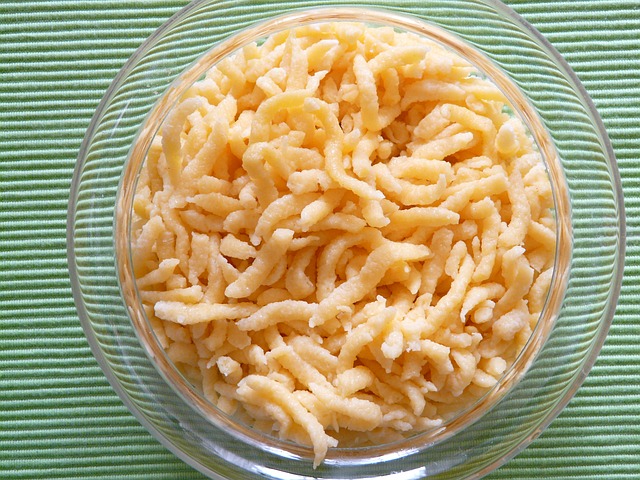
Some like to call spätzle Germany’s answer to pasta. It has similar ingredients – flour, eggs, water, and salt. However, spätzle is moister and softer than pasta dough. It is far too soft to roll out or use a pasta machine. Instead, it must be made using other tools.

Although eaten all over, it is a specialty of the Swabia area of Germany. According to Brittanica, Swabia is a historic region of southwestern Germany, including what is now the southern portion of the state of Baden-Württemberg, the southwestern part of Bavaria, as well as eastern Switzerland and Alsace. This dish is so popular and so much a part of this region that there is a Spätzle museum in southern Germany.

The name means “little sparrow” in German. There is some disagreement over the origin of this name, although most attribute it to the shape when made by hand. Others say it comes from how a German cook holds the dough as they break off pieces to put into water to cook as if they are holding a sparrow. Another theory is that the word originated from the Italian word spezzato, which translates to small or broken pieces. The Swabian people then changed this into spätzle. Other German names you might see are Spätzli, Spatzen, and Knöpfle, although the latter refers more to a dumpling shape than a noodle shape.

The recipe may seem quite easy, but there is some technique involved in achieving a light and tender noodle. As I mentioned above, there are four ingredients: flour, eggs, water (or milk), and salt. Some recipes may add nutmeg or other seasonings. Generally, the flour and salt are combined, the eggs are whisked and added, followed by the water or milk. The dough is mixed to the right consistency before being formed and cooked in boiling water.

Making the dough

As with so many traditional recipes, the above general instructions have many variations and nuances.

  • Flour—Most will use all-purpose flour, but others like to use semolina, 00 flour or a combination.
  • Liquid–Some like water, while others think milk gives a richer result. Whether the liquid should be cold or warm is a matter of debate. You may even see quark or sour cream in some recipes. The liquid should be added gradually so it doesn’t get too thin. If it does, you will need to add more flour. Others will say you must use mineral water for the liquid. They claim that this will result in a softer and fluffier noodle.
  • Eggs—The proportion of eggs to the other ingredients may vary by recipe, but the Swabian rule of thumb is to use a number of eggs equal to the number of servings plus one.
  • Mixing—Traditionalists will mix by hand, but mixing can also be achieved with an electric mixer. The key is to achieve the proper consistency. The recommendation is that it should resemble a thick pancake batter.
  • Consistency–This will differ depending on which method you use to form the noodles and can only be determined by practice. One piece of consistent advice is that the dough needs to start forming air bubbles before it is ready. After 10-15 minutes of beating, use a wooden spoon, scoop some of the dough, and pull to stretch. If you see bubble-like holes, the dough is ready. If not, continue mixing for another minute or two and then repeat the test. This should be followed by a rest of 10-15 minutes to allow the gluten to relax.

Forming the noodles

Each of these methods will give you different shapes/lengths of dough. It is said that to a Swabian, to be called spätzle, the noodle must have a length four times it’s diameter. If it is more of a shorter, rounder button shape, it is called knöpfle.

Here are the different tools you can use. Wetting or oiling any of them will help prevent the dough from sticking.

  • Spätzlebrett (spätzle board)
    • The most traditional way is to spread the dough over a wet spätzle board or wooden cutting board. The dough is then cut into thin strips with a butter knife, offset spatula, or bench scraper and dropped into the hot water.
  • Spätzle Press
    • This is similar to a ricer used for potatoes. It presses the dough through holes, forming it into long strips directly over the water.
    • The dough will need to be a bit thicker if using a press.
  • Spätzle Sieb
    • This looks like a flat colander through which the dough is pressed into the water. You could also use a regular colander with ¼-inch-wide holes. The spätzle dough is pushed through the colander using a wooden spoon or rubber spatula. You can use this same method with any heat-proof tool that has ¼-inch-wide holes, such as a box grater or a slotted spoon.
  • Spätzle Hobel
    • This appears like a cheese grater. It is usually topped with an attachment that slides and thus presses the dough through the holes into the water.
  • Spoon Method
    • If you do not have any of these tools, you may just drop spoonfuls of dough into the boiling water. It is best to use a metal spoon and wet the spoon between scoops to prevent sticking.
    • This will not produce the typical spätzle shape but a shape more like gnocchi or even a little pancake.

Cooking/Storing

Image by Rita-undmit from Pixabay
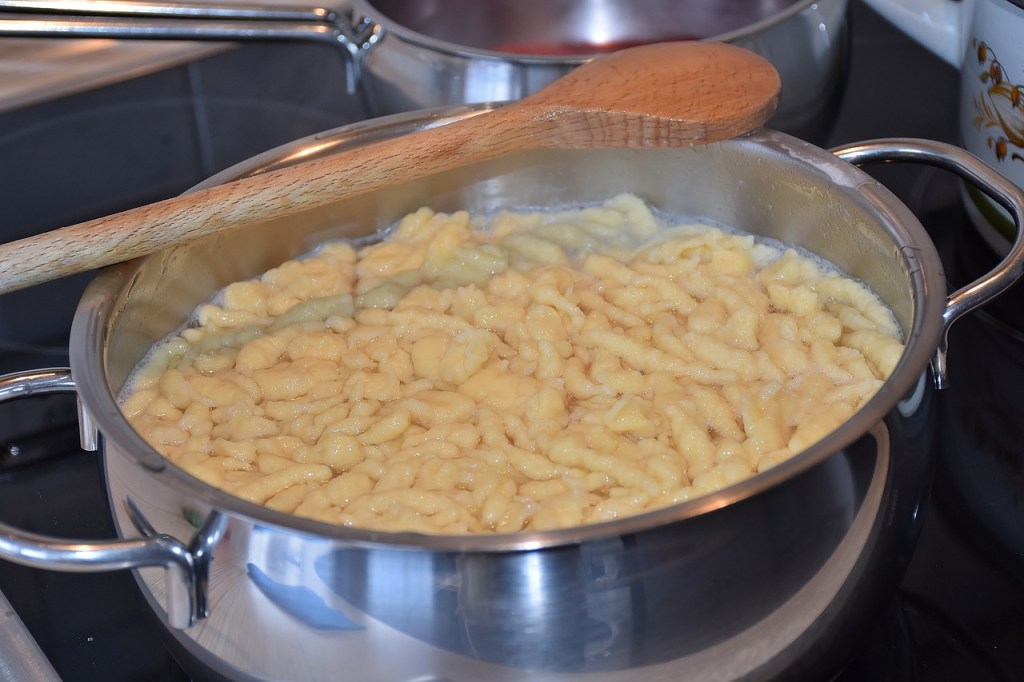
  • No matter how you form the noodles, they are then dropped into boiling salted water. They are only cooked until they rise to the top, which shouldn’t be more than a couple of minutes. This might need to be done in batches as you do not want to crowd the noodles.
  • Once cooked, they are generally sauteed in melted butter and garnished with fresh herbs, cheese, bacon and/or breadcrumbs.
  • Spätzle can be made in advance, cooled, and stored in a covered container in the refrigerator for 3-4 days. To reheat, sauté in melted butter.
  • Spätzle may also be frozen for up to 3 months. When ready to use, thaw overnight in the refrigerator.

If you have eaten spätzle, has it only been in a restaurant or when you purchased a package in the store? This dish requires very few ingredients and can be made relatively quickly once you master the technique. I hope you give it a try!

Cooking Tips · Ingredients · Techniques

Does your homemade bread really need salt?

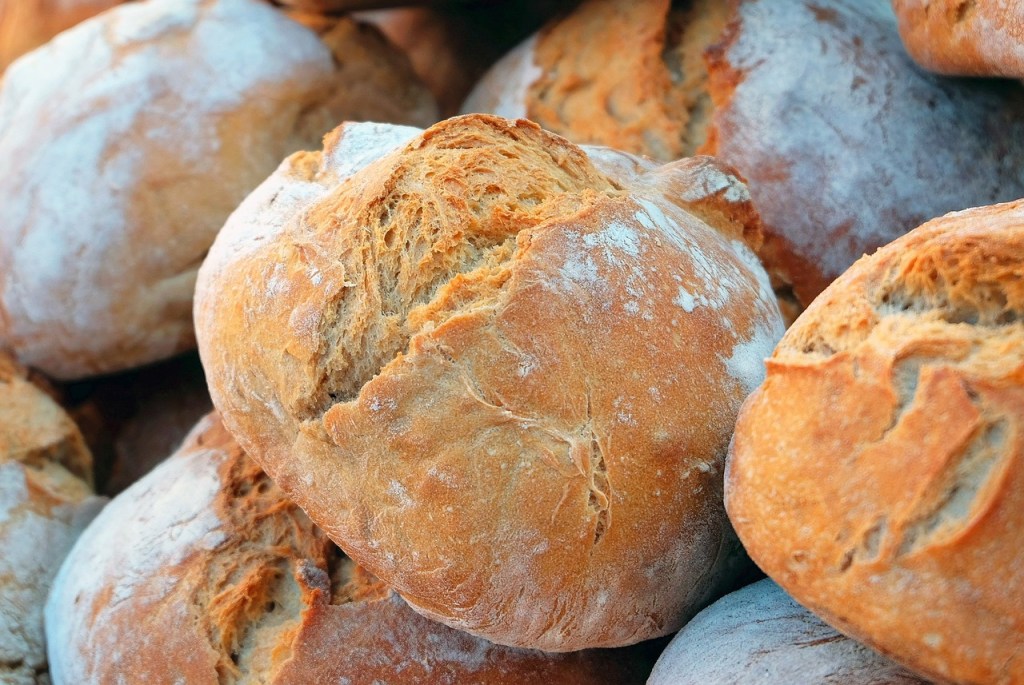
I love to make bread, although I do not do it nearly enough. It takes some time but has a short list of ingredients: flour, yeast, salt and water. Some people wonder just how important that salt is to the final bread product. That is the subject of this Cooking Tip.

Why is salt in bread recipes?

Taste

Image by Couleur from Pixabay

Just as with almost everything we cook or bake, salt helps with flavor. It should not make your dishes taste salty. Instead, it balances other flavors, enhances some flavors, and creates a much yummier result. You can prove this to yourself by a taste test. When you are cooking something, do not put any salt in it to start with. Taste it, add the salt and taste again. You will be amazed at the difference.

It is the same with bread. Bread made without salt will just taste bland and one-note rather than more nuanced and rounded. Salt enhances the natural sweetness in the flour while tamping down any bitterness.

As you will read below, salt also slows down the yeast activity. As I have mentioned in other Cooking Tips, slower fermentation results in a more flavorful dough.

Interaction with Yeast

Image by Karyna Panchenko from Pixabay

Yeast causes fermentation and the ultimate rising of your bread dough. Salt plays an inhibitory role with yeast. It slows down this fermentation by drawing water away from the yeast. Less water means less yeast action.

This slower rising time allows the gluten to develop and strengthen. A stronger dough can trap more gas bubbles and make the distribution more even. This all means that you end up with a better loaf of bread with a nicely risen shape.

Image by Couleur from Pixabay

Crust

Salt gives you a darker, more attractive crust. Because the salt slows down yeast activity, it consumes less sugars. These free sugars contribute to caramelization, which is what gives you a browner crust.

Freshness

An additional advantage is that bread made with salt keeps fresher for longer.

How much salt is needed?

Expert bread bakers always weigh their ingredients and use the Baker’s Percentage. The standard measurement is about 2% salt. The percentage is based on the amount of flour. So, if you are using 1000 grams of flour, you would use 2% or 20 grams of salt.

Image by Couleur from Pixabay

Too little salt prevents the important work of the salt in bread. Too much can be detrimental, as fermentation is halted. Therefore, most bakers stay around that 2% measurement, although some will go as low as 1%, but no lower.

ChainBaker.com has an interesting article in which they bake three loaves of bread. One had no salt, one had the recommended 2% salt, and one had too much salt at 10%. The dough without salt meant the yeast worked rapidly, causing quicker fermentation but weaker gluten. The finished bread loaf rose quickly but spread sideways due to the weaker structure.

The dough with 10% salt did not ferment at all, as that much salt stopped the yeast from doing its job. The result was that the dough was difficult to work and the baked loaf was very dense and unrisen. See pictorial evidence of this here.

Here is another great article by King Arthur Baking showing how differing amounts of salt can dramatically affect bread dough.

When to add the salt to the dough

Everyone has their preferred time for adding the salt. Some will add it at the beginning, while others like to delay it. Proponents of this latter method feel it allows the gluten to develop better before adding the salt and thus makes the initial mixing easier. This is known as the “autolyze” method. Recipes using this method will call for the flour and water to soak for a while. After the prescribed amount of time, the yeast and salt are added, and mixing and kneading commence.

This allows better hydration of the flour and resultant strengthening of the proteins. This is said to make the dough more extensible (the ability for the dough to stretch out without tearing) but less elastic (the tendency for the dough to resist stretching), allowing the shape of the formed dough to be better maintained. An example is a long baguette.

How to add the salt

The most common and easiest method is to mix the salt with the other dry ingredients at the beginning. Some experts feel this method results in a more elastic dough.

Another method is to dissolve the salt in water before adding it to the dough. Experiments show that this could strengthen the gluten better.

A final method is to add it to your yeast mixture if you are blooming it. Although blooming is not necessary with modern-day instant yeast (and probably active dry yeast), some still like to do it. If you do this, you can add the salt to the water as long as there is enough water to totally dissolve the salt, the yeast, and the sugar. Busby’s Bakery states that salt needs three times its weight in water to dissolve at room temperature. Another thing to note is that the salt may slow down the yeast, lengthening the time for it to bloom.

If you bake yeasted products, you will surely have heard that you must keep the salt away from the yeast as it will kill it. Testing has shown that this is not necessarily true. The two ingredients must be in contact for hours before the salt can damage the yeast. So, go ahead and add both the yeast and salt to your flour without fear.

Salt is an essential ingredient in the kitchen in many ways. Here is another Cooking Tip about all the different types of salt—Salts Galore. Don’t fear salt. If you have a medical condition requiring limiting salt, follow your doctor’s advice. Otherwise, embrace all that salt can do for your food, not just in bread but in all your dishes.

Cooking Tips · Ingredients

Deciphering Beef Grades & Beef Cuts

It is no surprise that Americans consume a large amount of beef. For 2024, it is estimated to be about 58 pounds per person. According to the USDA, the most beef consumed was in 1976, almost 92 pounds per person, and the lowest point was in 2009, at about 55 pounds per person. I am not a huge beef lover, so my consumption is very low. Since I buy beef so infrequently, I want to make sure I am buying the best type of beef for my purposes. That means decoding all the terms that are used to describe beef. That is just what I will discuss in this Cooking Tip.

Image by POLAT DÖVER from Pixabay

Ground Beef

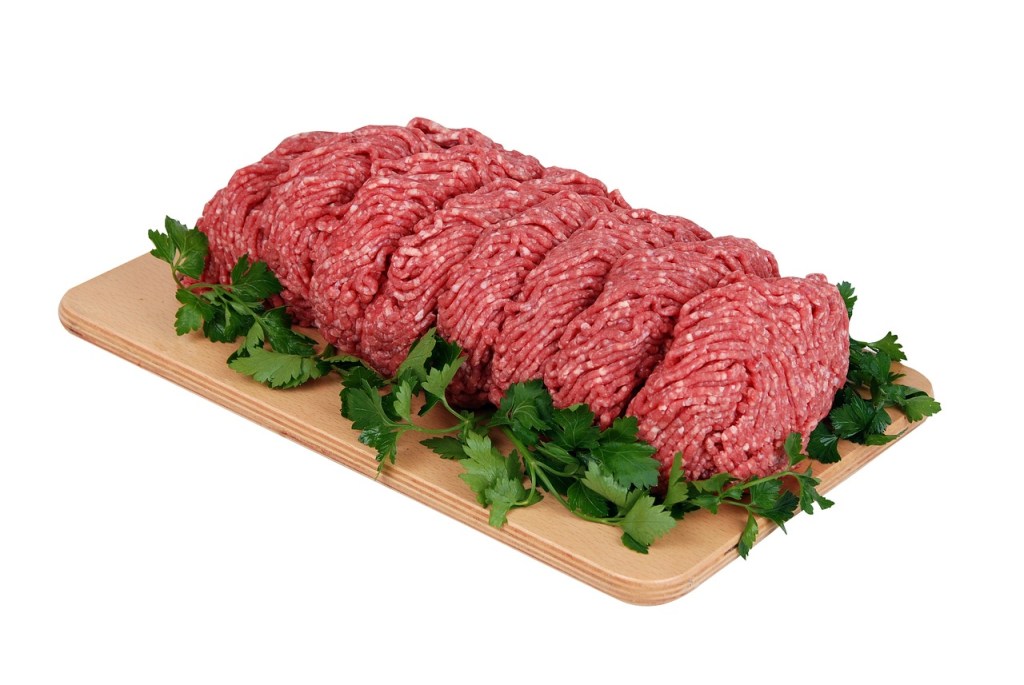
According to the National Cattlemen’s Beef Association, ground beef sales were 51% of all retail beef sales as of November 2022. I have written another Cooking Tip on Ground Beef and urge you to read that one for information about the types of ground beef.

When you purchase pre-packaged ground beef from a supermarket, the packaging will probably be one of three kinds.

Traditional Packaging

  • This is the most common type of packaging.
  • The beef is placed on a foam tray and covered with plastic wrap. This packaging allows oxygen in, giving the meat a red color.
  • The oxygen exposure does lead to faster spoilage, meaning you should either use it within just a few days or freeze it in an air-tight package.

Modified-Atmosphere/Controlled Atmosphere Packaging

  • This packaging is usually a plastic container that has had the air vacuumed out and replaced with other gases.
  • The beef still has the desired red color.
  • It also has a slight increase in shelf life.

Vacuum Sealed

  • With the air all removed, the beef looks more purplish-red than bright red.
  • Vacuum sealing produces the most extended shelf life.
  • You can either freeze it in that container or portion it out and freeze it in other air-tight containers.

Chubs

  • These are rolls of ground beef.
  • They have been vacuumed sealed.
  • Just as with the other vacuumed sealed ground beef, it will appear more purplish.
  • It also can be frozen as is or frozen in smaller portions.

Beef Grades

Though inspection for safety is mandatory and carried out by the Food Safety and Inspection Service, meat quality grading is voluntary and paid for by the producer. Because it is voluntary, you will not always see the following grading labels on the package. If you do, though, it will tell you that the USDA has assessed the meat for quality and approved the use of its label.

The degree of marbling, which is the intramuscular fat, determines the grade. It is this fat that provides flavor, tenderness and juiciness. The USDA collaborated with the United States Meat Export Federation and Colorado State University to develop an educational video about the beef grading process. They say the video “provides a comprehensive overview of the beef grading system – from farm to table.”

Prime

  • A beef cut labeled “Prime” will have the most marbling.
  • It will be the most tender.
  • No more than 2% of beef produced in the US will bear the prime label.
  • It is often hard to find in regular supermarkets as it is purchased for sale at high-end restaurants, hotels, boutique butcher shops and upscale grocery stores.

Choice

  • Although less than prime, choice cuts still have a moderate amount of marbling.
  • This cut will still be very tender.
  • It makes up 50% of all graded beef.
  • This is what you will find in mid-level restaurants and not uncommonly in local supermarkets.

Select

  • This cut will have minimal marbling and, therefore, will be tougher.
  • Due to less marbling, it will be slightly leaner.
  • Select cuts compose 65-70% of beef produced in the US.
  • This is a very common cut to find in supermarkets.
  • Because of its lower fat level, it tends to be tough if cooked with high-temperature cooking methods such as grilling or searing. A better use is a gentle cooking method such as braising.

Other lower grades of meat include standard, commercial, utility, cutter, and canner. These are not typically sold to consumers but are used in processed meat products.

If there is no USDA stamp, look for the degree of marbling, as that will generally give you a juicer and more tender cut of meat.

Other Beef Terms

Wagyu

  • This term refers to four main breeds of Japanese beef cattle that produce a large amount of intramuscular fat.
  • This type of beef is graded differently. They use a beef marbling score that ranges from 1 to 12, with 12 having the most marbling.
  • You may also see grades from A to C, with A being the highest.

Grain-Fed or Grain-Finished

  • This term indicates that the cattle are fattened on grain (usually corn) for 3-6 months before slaughter.
  • Very often, grain-fed cattle are treated with antibiotics and possibly growth hormones. However, there are ranchers that raise grain-fed cattle without using either of these.
  • Grain-fed beef is known to be well-marbled.

Grass-Fed or Grass-Finished

  • Here, the cattle are fed grasses and legumes, making the meat lower in saturated fat, cholesterol and calories.
  • The flavor is richer but gamier.
  • This practice of raising cattle is more time-consuming and requires a large amount of land.

Beef Cuts

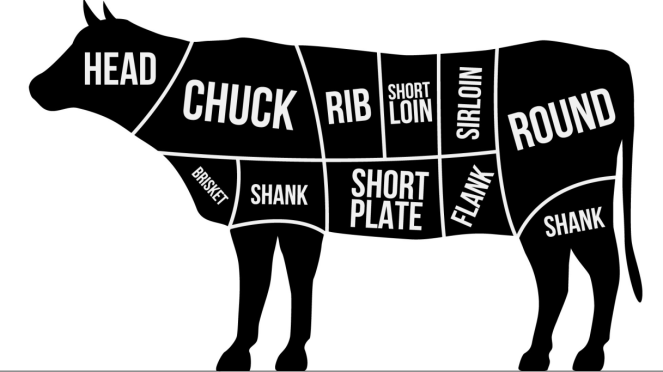
Besides choosing the grade of beef, you need to choose which cut you want. Below is an explanation of the most popular cuts. For more information on other cuts and recommended cooking methods, see this chart from the Beef Association Website.

Sirloin

  • This cut comes from the rear half of the loin.
  • Although it is tender, it is not as tender as some other cuts.
  • Quality and tenderness vary by type of sirloin.
    • Top sirloin is of excellent quality and will be very tender.
    • The bottom sirloin is of slightly lesser quality and is usually tougher.
  • As it is relatively lean, it is very easy to overcook.

Rib Eye

  • A ribeye is cut from the rib area just behind the shoulder.
  • This is a well-marbled beef cut that can be purchased either bone-in or boneless.
  • A Tomahawk steak is a thick ribeye with a long bone.

Strip (New York Strip)

  • This cut comes from the short loin.
  • It has good tenderness and a beefier flavor than the ribeye or filet.
  • It may be purchased bone-in or boneless.

Filet Mignon

  • This well-known cut is from the beef tenderloin, cut from the back’s center.
  • It is sought after due to its extreme tenderness.
  • It is milder tasting and less rich than the rib eye.
  • It is one of the most expensive cuts.

T-Bone

  • A T-Bone is composed of a strip steak, the accompanying bone and a portion of the tenderloin.
  • It can be challenging to cook as the filet part will cook quicker and can become overcooked before the strip side is done. Experts recommend a 2-stage reverse sear.

Porterhouse

  • This is composed of a strip steak with a whole filet attached.
  • It has the same problems with cooking as the T-Bone. A reverse sear is recommended, although broiling is also an excellent cooking method.

I hope this will help you pick out the best beef for what you want the next time you go to the store. Remember that the grading system is voluntary, so you will likely not see the USDA shields on all the meat. I just took a brief look at the websites of our local supermarkets. When the meat carried the USDA shield, it usually noted Choice meat. Only one or two offerings were of the Prime level. When you find it, the price may make you think twice about purchasing it. No matter what you buy, remember that cooking the meat properly, using an instant-read thermometer and not overcooking it will help you get the best meat on your table.

Cooking Tips · Techniques

Game Meat – Is it for you?

Some of you probably grew up eating at least some game meat, and some of you probably continue to do so. Others of you may have never tried game meat. Should you? What does it taste like? An introduction to game meat is the subject of this Cooking Tip.

Game meat refers to the meat obtained from animals typically hunted in their natural habitats. Today, the term is applied to those same animals raised on farms. In fact, according to the USDA, “Game species raised on farms under appropriate regulations can be sold. Wild game species that can be legally hunted under Federal or State regulatory authority cannot be sold but can be harvested for personal consumption.” What can be sold and where will vary by state. This is to ensure the sustainable use of game meat and that they are handled in such a way as to prevent food safety issues.

Before I discuss different game animals, there are some generalities about game meat.

  • Game meat, whether farm-raised or wild, will taste different than meat from domesticated animals. This is mainly because wild animals have different diets and activity levels. Meat from domesticated animals will have the mildest flavor, whereas the wild game has the most robust flavor, with the farm-raised game having intermediate flavor.
  • Many call the flavor of this meat “gamey.” The flavor profile often is described as strong, musky, and earthy. This flavor is not an indicator of the meat’s freshness or safety. As opposed to some of the cliches, game meat does not taste just like chicken or beef, although they may share some similarities.
  • Proper handling of the meat from harvest to plate and the cooking method will help decrease the gamey flavor.
  • Game meat is typically lower in saturated fat and calories than domesticated meat.
  • Because of the lower fat content and the fact that game animals get more exercise, game meat can be tough if not handled properly. This type of meat generally benefits from cooking slowly or in a pressure-type environment.
  • All game meat is a good source of protein and vitamins.

Here are some suggestions for reducing the gamey flavor.

  • The gamey flavor comes from the fat. Removing the fat can remove some of this flavor but also decreases juiciness and tenderness.
  • Chefs use spices, herbs and marinades to help with these flavor challenges.
  • Soaking the meat in a solution may help. Make sure to cover the game completely in the solution and discard the solution after soaking. Small animals may only need 8-12 hours, while larger ones may benefit from a 24-48-hour soak. Here are some ideas from game experts.
    • Salt solution – use ¼ cup kosher salt per quart of cold water.
    • Vinegar solution – use one cup per quart of cold water.
    • Milk solution – cover with milk and soak.
    • Red wine solution—This is good if you will then cook your meat in a stew. Those who advocate this method recommend boiling the wine, cooling it and then using it for the soak.

Cooking temperatures—Just as with meat from domesticated animals, it is best to use a food thermometer to ensure the meat’s safety.

  • According to the USDA, fresh game should be cooked to an internal temperature of 160°F. They note that the meat may still be pink in the center, but it will be safe to eat if it reaches that 160°F mark.
  • For the most tender meat, they recommend cooking at this 160°F temperature for more extended periods or even cooking to higher temperatures to break down the tough connective tissue.

Types of game meat

Here is an interesting tasting chart from Fossil Farms from New Jersey that breaks down the flavor profiles for 16 different types of game. Below is a discussion of a few of the most common.

Venison

Image by Jessica Rockeman from Pixabay
  • Although we think of venison as deer meat, that term can also be applied to meat from elk, moose, caribou, antelope and pronghorn.
  • It is a type of dark meat.
  • It is rich in flavor.
  • It has less fat marbling than other meat, so it is leaner but still tender.

Wild boar

  • This is the meat from an undomesticated pig.
  • It is leaner than regular pork, making it tougher. Therefore, it is often cooked with pressure or in a slow cooker.
  • The meat is darker with more robust flavors.
  • It is one of the gamier flavors with nutty tones.
Image by Hans Benn from Pixabay

Bison

  • It is also known as an American buffalo.
  • Common cuts include bison steaks, chili/stew meat and ground meat for burgers.
  • It is slightly sweeter than domesticated beef.
Image by Lori from Pixabay

Elk

  • The meat is similar in texture to beef.
  • The flavor is deeper and bolder.

Antelope

  • It is similar in flavor to deer meat.
  • It is leaner than deer meat.

Rabbit

  • This white meat is lean but tender.
  • It has a somewhat delicate flavor but is stronger and earthier than chicken.
  • In cooking, it is often treated similarly to poultry.

Goat

  • Goat has a very distinct taste that many do not like.
  • It is rich with an unpleasant smell and aroma. To reduce this, it must be treated before cooking, which also tenderizes the meat.
Image by rfotostock from Pixabay

Pheasant

  • It is a white meat that is leaner than chicken or turkey.
  • It has a relatively mild taste.
  • It is often roasted like a chicken/turkey or made into sausage.

Quail

  • A very small and delicate bird that has a sweet but gamey flavor.
  • It is often served roasted whole.

Duck

  • There are both domesticated and wild ducks.
  • It is very rich in flavor.

Are you a game eater? If you do not hunt or have a hunter that gives you the game, it may be hard to find in a typical supermarket. In my area, it is very easy to find different forms of bison. It is not true of other types of game.

Game does show up on restaurant menus, particularly those establishments in the same area as where the game live. Are you a fan? Are you even interested in trying game meat? Have fun and experiment with these other flavors!

Cooking Tips · Ingredients · Techniques

Strawberries – The Epitome of Summer

My husband has been harvesting strawberries since June. He has four different varieties growing; they mature at different times and have different flavors. If you do not have a garden, what can you do to ensure you are getting the best strawberries you can? That is the subject of this Cooking Tip.

Strawberries are a member of the rose family and are Native to North America. The large majority of US strawberries come from California, with Florida being a distant second.

Varieties

As with so many produce items, there is not just one strawberry, although you may think so if you only buy them in the supermarket. There, you will find what is known as the Garden Strawberry (Fragaria Ananassa). However, there are said to be over 1,000 different varieties grown worldwide.

If you are a gardener, you will have a myriad of choices to plant. They are broadly broken into two categories.

  • June-bearing – these produce the largest berries over a 2-3 week period during June/July.
  • Everbearing strawberries generally produce two harvests a year – one in the spring and one in later summer/fall. Their fruit is usually smaller.
Image by Shirley Hirst from Pixabay

Although the typical strawberry is red, there are green and white berries. The greens are unripe berries, and the whites have been cultivated so as not to develop the typical red color.

Picking Ripe Strawberries

Because strawberries (as with so much fruit) do not continue to ripen after harvesting, you want to pick the ripest you can when you buy them to get the sweetest and most strawberry flavor. The best way to test the flavor of a strawberry is by tasting it, something that you probably cannot do in the supermarket, although you may be able to do so at farmer’s markets.

Apart from tasting, a deep red color is another indicator of flavor. However, strawberries will continue to redden after being picked, even though they do not continue to ripen. Therefore, color alone can be deceiving. One strawberry grower recommends looking to see how red they are all the way to the top, under the leaves. The redder they are in this area, the sweeter & juicier they will most likely be.

Another tip is to smell them. They are much more likely to have good flavor if they have a wonderful strawberry scent.

Another interesting point comes from America’s Test Kitchen. They tell us that the flavor of a strawberry is related to its aroma, and the aroma is related to temperature. A room temperature berry will likely taste sweeter than one just out of the refrigerator. Too much heat, though, is not good, as it can drive off much of the aroma. Therefore, rather than cooking strawberries, they like to macerate them by tossing them in a bit of sugar and letting them sit until they soften and the liquid starts to come out.

Hulling Strawberries

When you are ready to eat or use the strawberries, after washing them, you will want to hull them, which means removing the leaves and the core. There are different methods for this.

  • Paring knife
    • This doesn’t require any equipment other than what you already have. It does, though, take away more of the berry than other methods.
  • Straw
    • Insert a sturdy straw into the strawberry’s point. Push the straw through the berry, and it will remove the leaves with the hull attached. This method does work, although it is easy to go off-center and miss the hull.
  • Hullers
    • Spruce Eats tested several different hullers and found that the Oxo Good Grips Strawberry Huller worked the best. They liked its nonslip grip, easy cleaning, and ability to use different-sized berries. The only negative was that it was hard to store.

Roasting Strawberries

Roasting strawberries is an interesting way to try to enhance their flavor by intensifying the natural sugars present in the berries. To do this, toss the berries in about two teaspoons of sugar per cup of berries. If desired, add a touch of acidity with a bit of lemon zest. Roast in a 425°F oven for 15-20 minutes, stirring halfway through. Although you may or may not want to eat them out of hand, you can use them in baked goods or as a topping.

Dried Strawberries

Image by Engin Akyurt from Pixabay

Making dried strawberries is not difficult. If you have a food dehydrator, follow the instructions for that appliance. You can still dry them in a low oven if you do not have one. After washing and hulling the berries, cut them in half or quarters. Place the berries on a baking sheet, cut side up. Place in a 200°F oven for about 3 hours. Allow the berries to cool and crisp up, and then store them in an airtight container for up to a week.

Storing Strawberries

We all know just how perishable strawberries are. How can we make them last the longest? There are all sorts of recommendations out there. Three that seem to stand out as the best are the following.

  • Do not rinse them until you are ready to eat them. Rather, pick out any berries that are going bad, put the rest back in the container and store them in the refrigerator. Some recommend storing the container upside down to encourage airflow. This way, your berries should keep up to a week.
  • A second method is to wash them in a solution of 1 part white vinegar to 3 parts water, drain them and dry them thoroughly before putting them in the refrigerator. One method of drying is placing them is in a paper-towel-lined salad spinner and gently spinning them until dry.
  • A final method is to soak them for about 5 minutes in a mixture of 1 tablespoon of kosher salt per cup of water. Drain, rinse, dry and place in the refrigerator. The proponents of this method say that the salt is abrasive, and therefore, it cleans better than water alone. This same source does not like using baking soda or vinegar, as these ingredients can be absorbed into the berry and not rinse off completely, possibly compromising flavor and texture. As can be seen by the second method, though, not everyone agrees with this caution.

Freezing Strawberries

For more extended storage, strawberries can be frozen.

Image by congerdesign from Pixabay
  • Remove the tops.
  • Chop them as you prefer – quarter, slice, etc. You can leave very small berries whole.
  • Freeze in a single layer.
  • Transfer to a freezer bag/container.
  • Use within a few months as their quality deteriorates after about six months.
  • Some like tossing the berries in sugar before freezing, as this preserves the color and texture. However, it does limit how you can use them later.
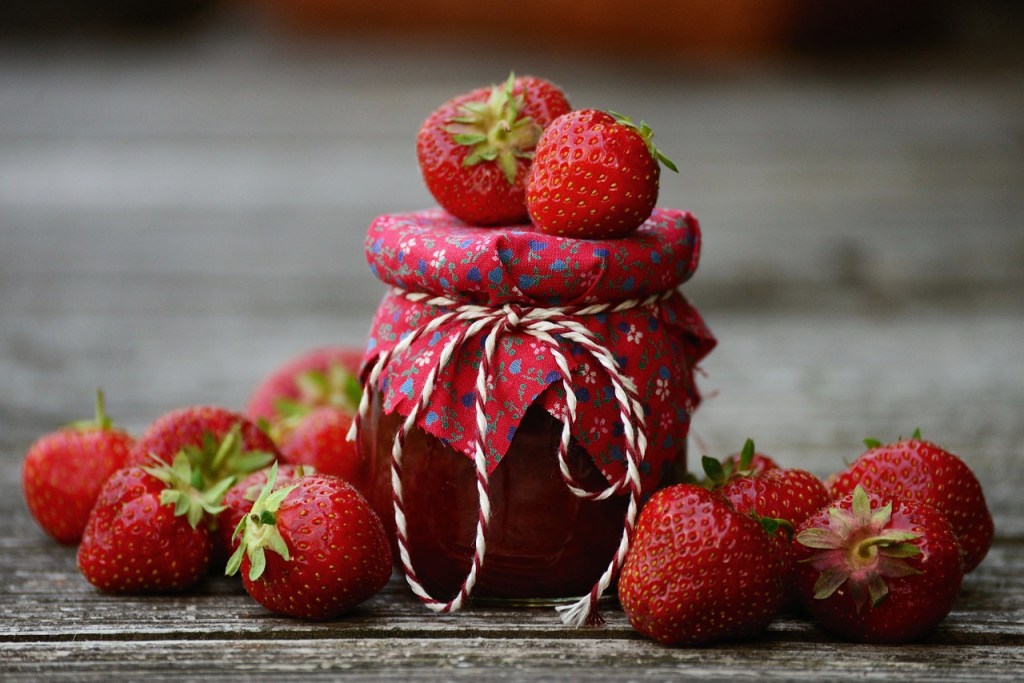
  • Great uses for frozen strawberries are smoothies, jam, ice cream, fruit topping, and strawberry sauce.

Measuring Strawberries

Although you do not always have to be exact in measuring when using strawberries in a recipe, it is nice to know how many cups are in that container you pick up in the store. The Spruce Eats has put together some conversion figures to make your life easier.

1 cup whole strawberries is equivalent to:

  • 8 large strawberries
  • 5 ounces by weight
  • ½ cup strawberry puree

1# strawberries is equivalent to:

  • 2¾ cup sliced strawberries
  • 3¾ cup whole strawberries

1 pint of strawberries is equivalent to:

  • 12 large strawberries
  • 24 medium strawberries
  • 36 small strawberries
  • ¾# by weight
  • 1¼ cups puree
  • 2½ cups whole small strawberries
  • 1½ to 2 cups sliced strawberries

Now that you know how to pick ripe strawberries, clean them, store them and use them, there is one last important tidbit. Do you know what the fear of strawberries is called? It is “Fragariaphobia.” That is bound to be helpful in your kitchen!