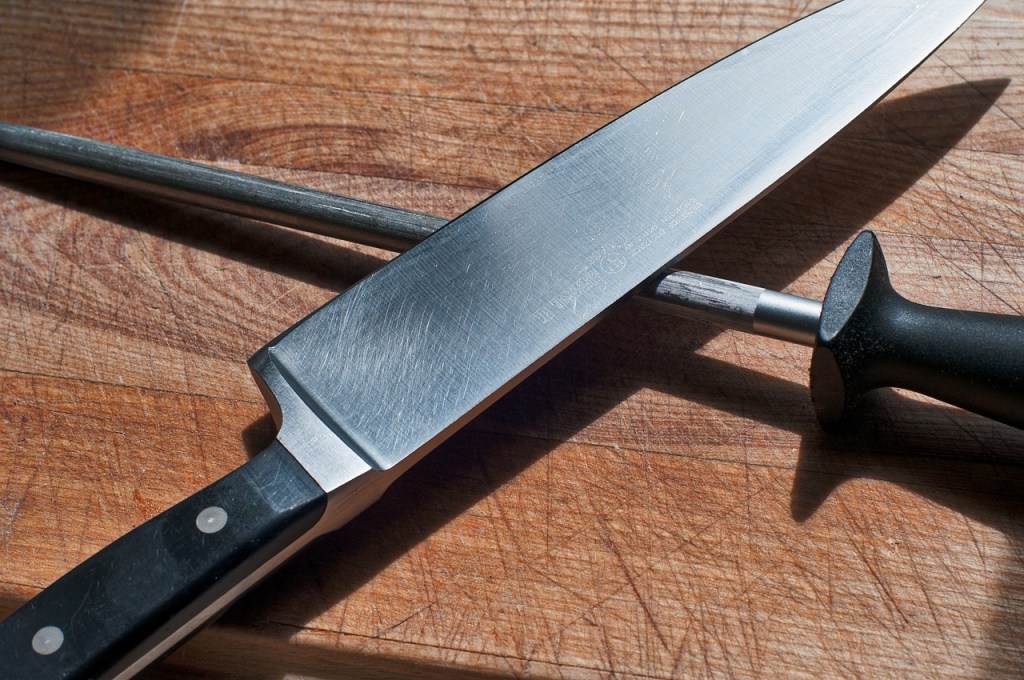
What in the world is a honing rod? Is that something that belongs in the garage or the toolbox rather than the kitchen? This Cooking Tip will explain what these are, other names for them, and why you need one in your kitchen.
We all know that knives (preferably good ones) are essential in your kitchen. I have written a prior Tip on the kinds of knives and which ones you need in your kitchen. Having great knives is important, but you also need to take care of those knives. That is where a honing rod comes into the picture.
Keeping your knives sharp not only increases the enjoyment of using the knives but also increases the safety of using them. One of the easiest ways to have a knife accident is by trying to use a dull knife, having to use more and more force, and slipping and cutting yourself.
As you use your knives, the edges will start to roll, and they will feel dull. By realigning these edges, the knives will feel sharper. This is where a honing rod (also called a honing steel) comes into the picture. They work by realigning these edges. They help your knives stay sharp longer, so you don’t need to sharpen them as often. Although you will see chefs and manufacturers call these items “sharpening rods” or “sharpening steels,” they do not sharpen your knife. The latter involves removing steel from the blade, exposing new steel, followed by polishing and refining. Honing just realigns the edges.
I like how Travis from House of Knives explains the use of a honing rod. He states, “They are meant to keep your knife sharp, not make your knife sharp.”
These honing rods are long rods of steel attached to a handle. The surface can vary from smooth to one with ridges to one with a diamond coating. Let’s look at the pros and cons of each.
Types of Honing Rods
Steel Rods

- Most steel rods will have some sort of ridging on them, although how much will vary by brand. Some will even have different amounts of ridging on different sides. The ridges help users control the angle and speed of the knife when moving from top to bottom.
- The rods can restore the edge of the knife without taking off much metal and damaging the knife.
- They are relatively inexpensive.
- They are easy to use.
- Many do not recommend using these for Japanese knives as the Japanese steel is much harder and more brittle than the Western or German steel. They feel that a regular honing steel could do damage. Go with what the knife manufacturer recommends.
Ceramic Rods

- These look smooth, although there are different grit levels.
- Ceramic is four times harder than the majority of knife steels, and therefore, can be used for almost any knife.
- Ceramic rods can break if dropped.
- They do an excellent job of restoring the edge as well as polishing the blade.
- They do possess a small amount of sharpening ability, but since they only remove a minimal amount of metal, they can be used daily.
Diamond Coated Rods

- Some are more finely textured, and others are coarser and rougher.
- Users find they make a horrible, scraping noise while using them.
- They do take off pieces of the metal blade, and therefore, can be considered a sharpening aid. However, they can damage your knife if you do not know what you are doing.
- They are not meant for daily use.
Besides the type of material, there are other considerations when purchasing a honing rod.
- Testers liked longer rods of 10-12 inches as it made it easier to keep the knife angle consistent while running the entire blade from top to bottom.
- Testers like thicker rods as they felt they had more control in using them.
- Handles also made a difference. Ones that flared out were difficult to use and get the correct angle.
One can look at recommendations, but as usual, different opinions reigned. Here are some similarities in recommended brands.
Steel
- Bob Kramer Double Cut Sharpening Steel
- Wusthof Classic Ikon Honing Steel
- Zwilling Professional Oval Sharpening Steel
- Shun Classic Combination Honing Steel
Ceramic
- Idahone Fine Ceramic Sharpening Rod
- Green Elephant Ceramic Sharpening Rod
- Noble Home & Chef Ceramic Honing Rod
Once you have purchased your honing rod, how do you use it?
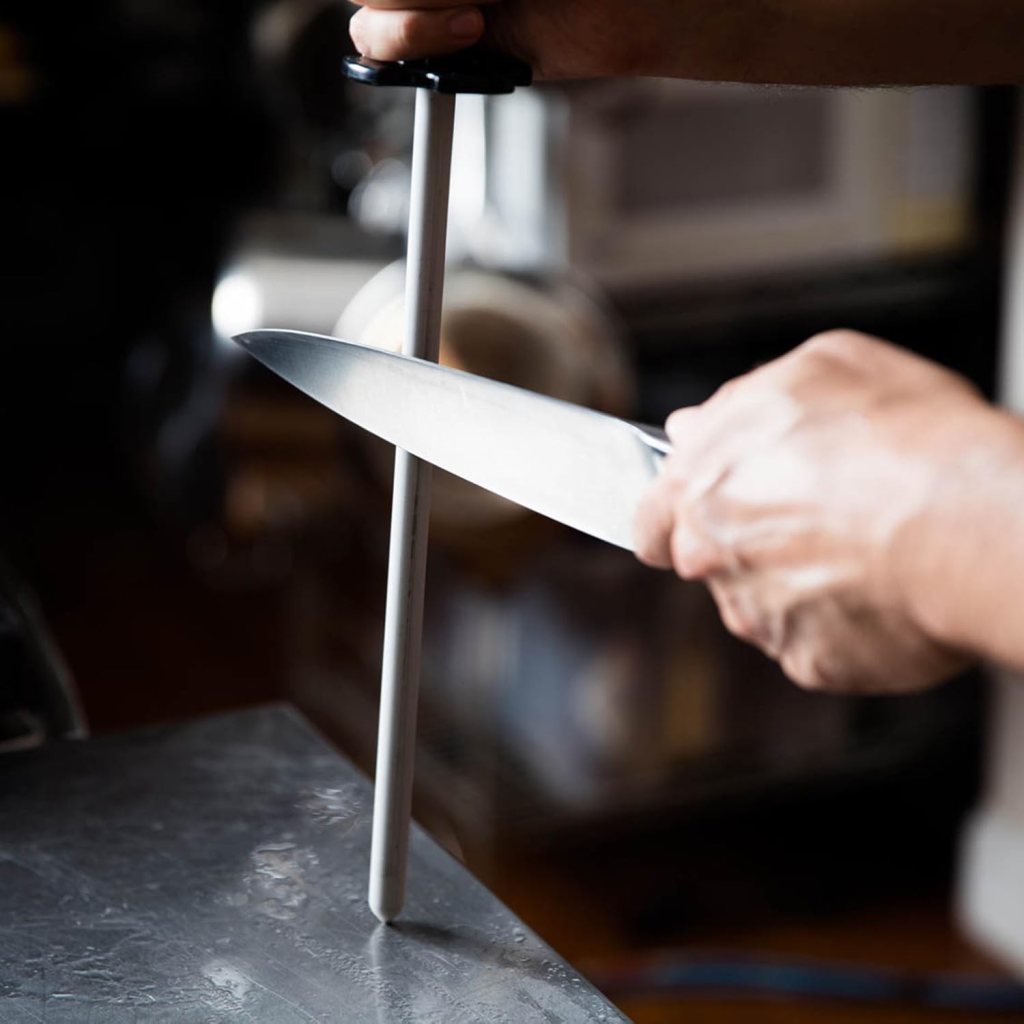
- Place the honing rod vertically on your counter on a towel or something that will keep it from slipping.
- Place the blade of the knife at a 15-20° angle on the rod. If you are like me and say, “What is a 20° angle?”, try this. Hold your knife against the upright rod at a 90° angle. Move it in halfway and you have a 45° angle. Halfway again would be a 22½° angle. Just a bit further would be 20°, and a bit more would be 15°.
- Start with the heel of the knife at the top of the rod and draw lightly and smoothly down the rod. As it descends, you will be going from heel to tip.
- Repeat on the opposite side.
Testing sharpness
It is good to test the sharpness of your knife before and after honing so you can see the difference. Here are some different ways to do this.
- Thumb test – Put your thumb lightly on the edge and pull across the blade, never along the blade. If dull, it will feel smooth and round and slide without resistance. Once properly honed, it will feel sharp. Although this is a good test, you must be careful to avoid cutting yourself.
- Paper test – Hold a piece of thin paper and slice through at a 45° angle. A sharp knife will easily and cleanly slice through the paper. Dull knives will catch and not make a clean slice.
- Pen test – Hold your knife at a 45° angle and slide over the plastic of the pen. If it bites in, it is sharp. If it slides off, it is not.
- Tomato test – This is probably the least reliable test for sharpness. Those who recommend it say that dull knives will squash and mash tomatoes rather than making a clean cut as with a sharp knife.
If you have a honing rod, I hope you are using it regularly to maintain your knives. If you do not have one, you should go out and purchase one. One last point, since honing is not sharpening, your knives will need to be sharpened at some point. There are many different at-home sharpening tools, or you can take it to a professional knife sharpener.

 Culinary Journeys, LLC