
A mandoline is one of those kitchen tools that is not absolutely necessary in your kitchen. However, it is the best tool for specific tasks and, therefore, may be something worth considering. What they are, how to select one, and how to use them safely are topics covered in this Cooking Tip.
What is a mandoline?
- A mandoline is a manual machine for slicing fruits and vegetables.
- The user holds the food with one hand and slides it down the length of the mandoline and across the blade.
- Some models only produce thin slices, while others have blades that enable you to make julienne or waffle cuts.
- It can generally slice items more precisely, evenly, consistently and quickly than with a chef’s knife.
- It can not only speed up the preparation of produce but can also produce paper-thin slices that are even in thickness.
- It can also produce very thinly shredded cabbage for your coleslaw.
What to look for in a mandoline.
Sharp Blades
According to everyone, the most crucial aspect of a good mandoline is that it should have very sharp blades. Duller blades make it more difficult to push the food through. Users then compensate by putting more pressure as they push the food, making it more likely that they might slip and cut themselves. Some brands have blades that can be removed for sharpening. For more inexpensive models, the entire unit will need to be replaced.
Type of Blade
There are three basic models: French, Japanese, and V-shape. The French style has a straight blade that is perpendicular to the sides of the mandoline. Japanese models typically feature a blade placed at an angle. The final style has a V-shaped blade.
One is not always better than the other, as each has its advantages and disadvantages. Some users prefer the straight blades as they feel it is easier to push food through. With the V-blade, it can be harder to push the food through, necessitating more force. It can also be more challenging to cut even slices with the V-shaped blades. However, V-blades are better suited for larger items, while the angled blades are more suitable for smaller foods.
Some mandolines also come with additional blades that allow you to julienne items or make waffle cuts.
Varying Thicknesses
Better mandolines possess the ability to cut in a wide range of thicknesses, so you can slice from very thin to thicker and do so evenly. Most mandolines will have preset thickness levels, although some will have an infinite control. When using those, however, there is no setting that tells you the exact measurement you are cutting. It is more of a trial-and-error experience to achieve the desired thickness.
A wide, rigid platform
The platform of the mandoline should be large enough to accommodate larger foods, such as potatoes unless you plan to use it only on smaller produce. You also want a platform that is stable and will not sag as you slice.
Rubber feet or stand
These keep the mandoline from moving around as you slice. A more stable mandoline is a safer one.
Handheld vs Kickstand
Some mandolines are called Handheld. They are made to rest atop a bowl, or you can hold them at an angle on a countertop. They are thinner and lighter, taking up less storage space. However, cutting horizontally over a bowl is more difficult.
Kickstand models feature a built-in stand that holds them upright on the counter, typically with an adjustable angle, making it easier to perform the repetitive motion required for using a mandoline.
Handguards
Mandolines have a reputation for being dangerous, and they can be unless you are informed and careful. As you are moving the food back and forth across very sharp blades, it is easy to slip and cut yourself. That is why the use of a Handguard is highly recommended. This guard is positioned between your hand and the food, providing protection from the blades. Most mandolines will come with a guard, although not all are the most effective. With some, it is challenging to keep the food solidly on the guard. Additionally, some are considered wasteful because they do not allow you to cut all the food down to the very last piece. However, as many will tell you, a bit of waste is preferable to a severe cut and a trip to the emergency room.
Cut-Resistant Gloves
These are not a part of the mandoline but are something you should seriously consider getting. Although it is not recommended to slice food without the handguard, using these gloves should be mandatory if you do. Even if you are using the guard, the glove can give you extra protection. Realize that they are not totally puncture resistant, and they do wear out after about a year.
Dos & Don’ts
- Pay attention and do not get distracted. It is the same when you are using a knife. I recall the only times I have cut myself with my chef’s knife was when I looked away as I was chopping.
- Only use mandolines with sharp blades. Just as with knives, dull mandolines are more dangerous.
- Work on a flat, dry surface to prevent the mandoline from slipping.
- Cut foods in half, especially round items such as potatoes or apples. This gives you a flat surface that moves against the blade.
- Don’t cut too quickly. You will have more control when you cut slower.
- Position the food towards the side of the mandoline as the platform is less likely to flex. Not only will it be safer, but you will also get more evenly sliced pieces.
- Clear food from underneath the mandoline as you work. That way, it won’t obstruct the food that you are slicing.
- At times, some food may become stuck on the blade. Do not force it through the blade, as you might slip and cause injury. Instead, use the handle of a wooden spoon (or similar tool) to knock the food back off the blade.
- Just as with your knives, do not place them in the dishwasher. Handwashing helps to maintain their edge.
If you have decided to buy a mandoline, which one should you choose? Are some superior to others? Yes, but it depends on who you ask. Many excellent sites have reviewed mandolines and listed their recommendations. The problem with these lists is one person’s favorite is a no-go on another person’s list. I will attempt to provide some generalizations by consolidating these reviews.
There are certain brands that rise to the top of the reviews. However, there are often different models within those brands. These different models might have different blades, different ability to adjust, different handguards, etc. If you are reading a review, pay attention to which model was tested. I will list the different models for each company as I discuss the pros and cons of those devices. Prices listed are as of March 2025.

Benriner – This is one of the companies that consistently appears at the top of reviews by many culinary professionals, and it can be found in many professional kitchens. The model generally preferred is the Super Benriner Mandoline Slicer.
- Cost – $60-$80
- Pros
- Extremely sharp – this is the main characteristic that users like, although one review noted that it was not as sharp as they expected right out of the box.
- Wide range of thicknesses. The updated model features a dial that is significantly easier to use than the one on the older model. Although the range of thicknesses is very good, there is no measurement to tell you the exact thickness.
- Easy to set up, use, clean and store.
- Cons
- One con that is mentioned is the lack of a handguard. This is not accurate as it does come with a handguard. An older model’s guard was deemed ineffective, but an updated version comes with a significantly improved guard. Not only is it easier to use, but there is very little food waste.
- Models – these mostly vary in size.
- Benriner Super Slicer
- Benriner Vegetable Slicer
- Benriner Japanese Slicer

OXO – This company is well-known for its kitchen tools and gadgets. Its mandolines receive mixed reviews but are generally well-liked. Most of the reviews were based on the V-Blade model.
- Cost – see below with list of models.
- Pros
- Easy to use (Chef’s 2.0)
- Many different thicknesses that are easy to set using a dial. (Chef’s 2.0)
- Comfortable handle (Handheld)
- Good handguard (All models)
- A see-through slicing plane that allows you to view what you have sliced. (Handheld)
- Cons
- Some say it is not as sharp as other brands.
- Bulkier to store. (Chef’s 2.0 & V-Blade)
- The julienne blades only come in 2 preset widths and thicknesses. (Chef’s 2.0)
- Jumps between settings were too large.
- Thinnest settings didn’t work well. (Chef’s 2.0)
- Only has a straight blade. (Handheld)
- Doesn’t work well with soft items. (Handheld)
- Food can get stuck on the blade. (Chef’s 2.0)
- Models
- V-Blade Mandoline Slicer – $45
- Chef’s Mandoline Slicer 2.0 – $100
- Steel Chef’s Mandoline 2.0 – $115
- Handheld Mandoline Slicer – $20
- Large Adjustable Mandoline Slicer – $30
- Simple Mandoline Slicer – $50
Kyocera

- Cost – see below with list of models.
- Pros
- Very sharp. (Soft Grip Ceramic)
- Soft, ergonomic handle. (Soft Grip Ceramic)
- Compact, lightweight. (Soft Grip Ceramic)
- Easy to store. (Soft Grip Ceramic)
- Easy to use. (Soft Grip Ceramic)
- Inexpensive (Soft Grip Ceramic)
- Cons
- Too small to accommodate large produce. (Soft Grip Ceramic)
- Only makes slices. (Soft Grip Ceramic)
- Only four preset thicknesses. (Soft Grip Ceramic)
- Poor handguard. (Ceramic Adjustable)
- Can flex with pressure. (Ceramic Adjustable)
- Models
- Double-Edge Ceramic Mandoline Slicer – $20
- Ceramic Julienne Mandoline Slicer – $35
- Ceramic Mandoline Adjustable Slicer – $25
- Soft Grip Adjustable Mandoline Ceramic Slicer – $30
- Wide Adjustable Mandoline Slicer – $40
Mueller
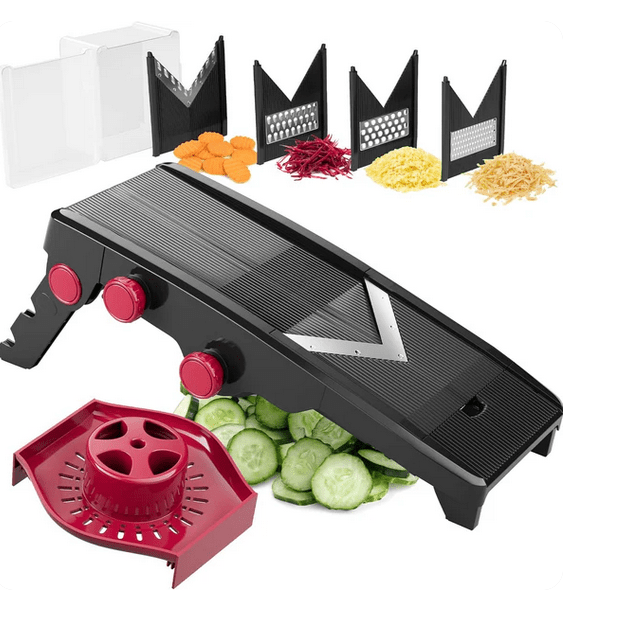
- Pros
- Five interchangeable blades give versatility.
- Sturdy.
- Good handguard.
- Cons
- Not as sharp as others.
- Doesn’t cut very thin.
- Takes some force on medium and wide settings.
- Bulky.
- Models
- MuellerLiving Mandoline – $30
- MuellerLiving Stainless Steel Mandoline – $40
Microplane – This company is well-known for its excellent zesters. Their only mandoline is the Adjustable V-Blade Mandoline Vegetable Slicer.

- Cost – $40
- Pro
- Cuts thin slices well.
- Compact.
- Easy to store.
- Has a nonslip foot.
- Cons
- Julienne blade easily dislodges from the back of the mandoline when slicing using the V-blade
- Blade tore food and food can get stuck on the blade.
- Duller than others.
- Doesn’t slice well at thicker settings.
- Too small for larger produce.
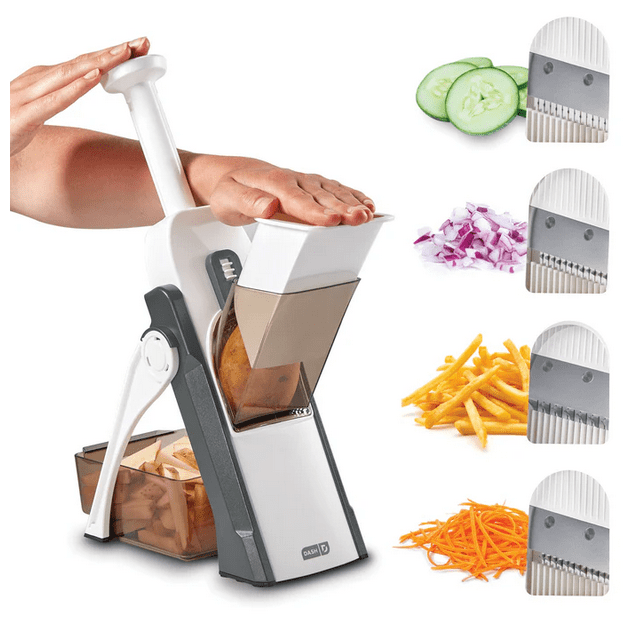
Dash Safe Slice Mandoline
I mention this mandoline because it is unique. Although there are different models of all the above mandolines, they all share the same basic shape. This one is a vertical unit that sits on your countertop. It has a chute into which you feed the food while pumping the unit up and down.
- Cost – $30-$40
- Pros
- Definitely the safest, as your hand does not get near the blade.
- Cons
- Limited utility as the items you want to cut must fit into a chute.
- Must trim larger items.
- Bulky.
Several other brands were evaluated, but none received a high rating. Do you have a mandoline, and do you use it? Is it one of the above units, or is it something not mentioned? A mandoline is a nice addition to your kitchen, provided you have the space, although it is not a necessary piece of kitchen equipment.

 Culinary Journeys, LLC