Palm sugar is a type of sugar often used in Asian cooking. This Cooking Tip, part of an ongoing series about Asian ingredients, explains what this sugar is and how it is used.
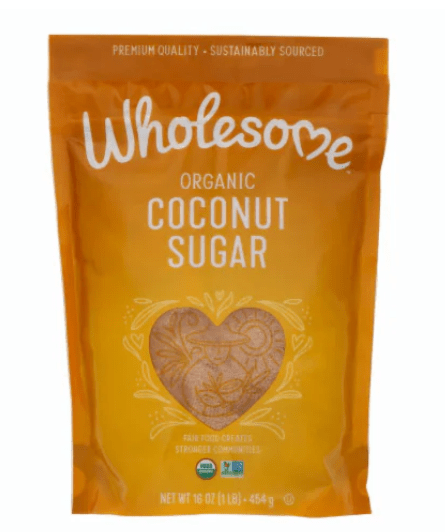
When you go to a general supermarket to purchase palm sugar, you will most likely not find true palm sugar. Instead, you will find coconut sugar. And it will almost always be in granulated form. For actual palm sugar, you will need to either frequent an Asian market or shop online. Let’s explore the differences.
Processing
Both types are considered unrefined sugars. That means they undergo minimal processing without the use of chemicals. Both are made from the sap of a palm tree. With coconut sugar, the sap is taken from the coconut tree, also known as a coconut palm tree. Palm sugar can be made from various palm trees, not just the coconut palm. Some companies have incorrectly labeled coconut sugar as coconut palm sugar, which causes confusion.
After the sap is collected, it is put into large pans and heated to evaporate the water. When a syrup-like consistency is attained, it is poured into molds, and as it cools, it starts to solidify.
Some producers will add granulated sugar to palm sugar as a filler. According to Hot Thai Kitchen, making palm sugar is labor intensive, and fewer people are choosing to learn it. This means the demand far outstrips the supply. Granulated sugar is mixed in to meet the demand. One factory in Thailand said the amount added could be anywhere between 25% and 75%, depending on the brand. Their website says that even if a package says 100% palm sugar, it is probably not true.
Appearance and texture
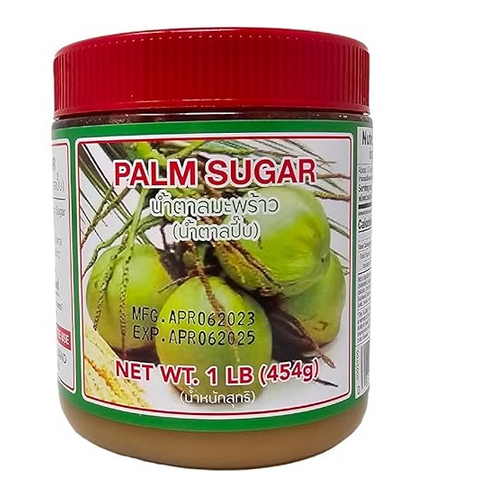
Depending on how far the reduction is allowed to go, the final moisture content will be different. Products with a higher moisture content will be softer, whereas others will be much harder. One is not necessarily of higher quality; it is just a different form.
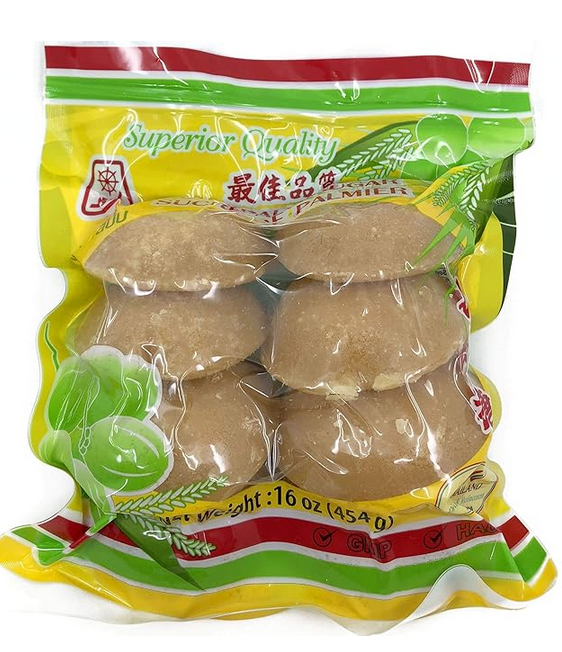
Coconut sugar is more likely to come in a granulated or powdered form. Palm sugar is available in granulated, block or a paste form.
Coconut sugar tends to be darker in color, ranging from light to dark brown, while palm sugar can vary from light golden to dark brown.
Flavor
Another difference is in the flavor. Coconut sugar delivers a rich caramel or butterscotch flavor, while palm sugar has a more complex flavor with a touch of smokiness.
Cost
Palm sugar will usually be more expensive than coconut sugar.
How to use
Since the flavors of coconut sugar and palm sugar are slightly different, try to use the one that your recipe specifies. This series of Cooking Tips is about Asian ingredients, and in that type of cooking (especially Thai), palm sugar is called for. It adds a specific flavor profile that is necessary for authentic flavor.
You may also use it in non-Asian dishes to add a caramel sweetness to the dish.
If you have a softer type of palm sugar in a tub, you can just spoon it out. However, if you do not use it up fairly quickly, it will harden, making it difficult to get out of the tub. To use it in that state, warm it gently in the microwave and spoon out what you need. Use it promptly, though, as when it cools, it will harden again.
If you have the harder variety, found in blocks or puck shapes, slice off thin pieces with your chef’s knife. Some recommend using a grater, and others like to crush it in a mortar and pestle.
The granulated form can be measured just like white sugar. However, granulated coconut sugar will have a different flavor profile than you would want in Thai dishes.
How to choose quality palm sugar.
- What you need to do is to taste the different brands side-by-side. I doubt that most (if not all) markets would allow this. If you could taste it, you would find that the more palm nectar it contains, the more flavorful and aromatic it will be. It won’t just taste sweet but more like butterscotch or caramel candy.
- Look for palm sugar with a smooth texture. You do not want it to appear crystalized, and you do not want the color to be very pale. However, experts warn that darker is not always better, as the color may be due to the addition of brown sugar.
- All other factors considered, choose the more expensive one.
Storage
With proper storage, these sugars can last indefinitely. Then, it needs to be kept in an airtight container in a cool, dark place to keep out insects, moisture and intense aromas.
If you do not use it up promptly, it will harden. If it does harden so much that you cannot slice it, try putting it in a plastic bag and breaking it up with a rolling pin. You could also try blitzing it in a coffee grinder or food processor. A final method is to sprinkle a bit of water on top and warm it in the microwave.
Substitutions
If you are making an Asian dish, seek out palm sugar. If you cannot find palm sugar, you can use coconut sugar, although the taste may not be the same. If you do not have either, the best substitute is probably light brown sugar. Dark brown sugar has a different flavor profile due to its molasses content.
Palm sugar is another Asian ingredient that you should include in your pantry if you want to make authentic-tasting Asian food. Have you tried it? If not, maybe a trip to the Asian store is in your future!

 Culinary Journeys, LLC