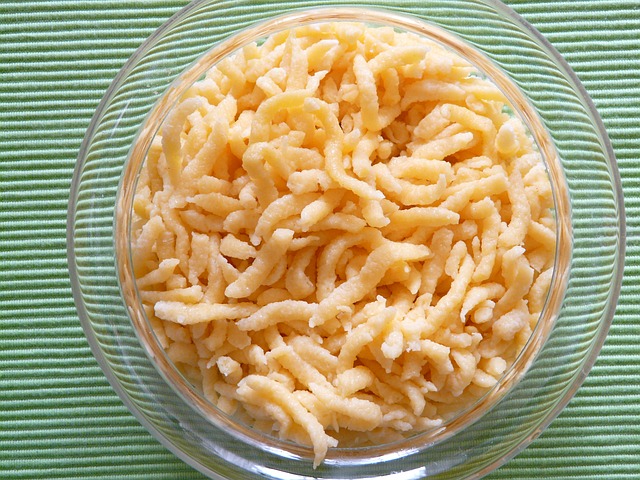
Have you ever had the German dish of Spätzle? Have you ever made it yourself? That is the subject of this Cooking Tip. What is Spätzle, and how do you make it?
Some like to call spätzle Germany’s answer to pasta. It has similar ingredients – flour, eggs, water, and salt. However, spätzle is moister and softer than pasta dough. It is far too soft to roll out or use a pasta machine. Instead, it must be made using other tools.
Although eaten all over, it is a specialty of the Swabia area of Germany. According to Brittanica, Swabia is a historic region of southwestern Germany, including what is now the southern portion of the state of Baden-Württemberg, the southwestern part of Bavaria, as well as eastern Switzerland and Alsace. This dish is so popular and so much a part of this region that there is a Spätzle museum in southern Germany.
The name means “little sparrow” in German. There is some disagreement over the origin of this name, although most attribute it to the shape when made by hand. Others say it comes from how a German cook holds the dough as they break off pieces to put into water to cook as if they are holding a sparrow. Another theory is that the word originated from the Italian word spezzato, which translates to small or broken pieces. The Swabian people then changed this into spätzle. Other German names you might see are Spätzli, Spatzen, and Knöpfle, although the latter refers more to a dumpling shape than a noodle shape.
The recipe may seem quite easy, but there is some technique involved in achieving a light and tender noodle. As I mentioned above, there are four ingredients: flour, eggs, water (or milk), and salt. Some recipes may add nutmeg or other seasonings. Generally, the flour and salt are combined, the eggs are whisked and added, followed by the water or milk. The dough is mixed to the right consistency before being formed and cooked in boiling water.
Making the dough
As with so many traditional recipes, the above general instructions have many variations and nuances.
- Flour—Most will use all-purpose flour, but others like to use semolina, 00 flour or a combination.
- Liquid–Some like water, while others think milk gives a richer result. Whether the liquid should be cold or warm is a matter of debate. You may even see quark or sour cream in some recipes. The liquid should be added gradually so it doesn’t get too thin. If it does, you will need to add more flour. Others will say you must use mineral water for the liquid. They claim that this will result in a softer and fluffier noodle.
- Eggs—The proportion of eggs to the other ingredients may vary by recipe, but the Swabian rule of thumb is to use a number of eggs equal to the number of servings plus one.
- Mixing—Traditionalists will mix by hand, but mixing can also be achieved with an electric mixer. The key is to achieve the proper consistency. The recommendation is that it should resemble a thick pancake batter.
- Consistency–This will differ depending on which method you use to form the noodles and can only be determined by practice. One piece of consistent advice is that the dough needs to start forming air bubbles before it is ready. After 10-15 minutes of beating, use a wooden spoon, scoop some of the dough, and pull to stretch. If you see bubble-like holes, the dough is ready. If not, continue mixing for another minute or two and then repeat the test. This should be followed by a rest of 10-15 minutes to allow the gluten to relax.
Forming the noodles
Each of these methods will give you different shapes/lengths of dough. It is said that to a Swabian, to be called spätzle, the noodle must have a length four times it’s diameter. If it is more of a shorter, rounder button shape, it is called knöpfle.
Here are the different tools you can use. Wetting or oiling any of them will help prevent the dough from sticking.
- Spätzlebrett (spätzle board)
- The most traditional way is to spread the dough over a wet spätzle board or wooden cutting board. The dough is then cut into thin strips with a butter knife, offset spatula, or bench scraper and dropped into the hot water.
- Spätzle Press
- This is similar to a ricer used for potatoes. It presses the dough through holes, forming it into long strips directly over the water.
- The dough will need to be a bit thicker if using a press.
- Spätzle Sieb
- This looks like a flat colander through which the dough is pressed into the water. You could also use a regular colander with ¼-inch-wide holes. The spätzle dough is pushed through the colander using a wooden spoon or rubber spatula. You can use this same method with any heat-proof tool that has ¼-inch-wide holes, such as a box grater or a slotted spoon.
- Spätzle Hobel
- This appears like a cheese grater. It is usually topped with an attachment that slides and thus presses the dough through the holes into the water.
- Spoon Method
- If you do not have any of these tools, you may just drop spoonfuls of dough into the boiling water. It is best to use a metal spoon and wet the spoon between scoops to prevent sticking.
- This will not produce the typical spätzle shape but a shape more like gnocchi or even a little pancake.
Cooking/Storing
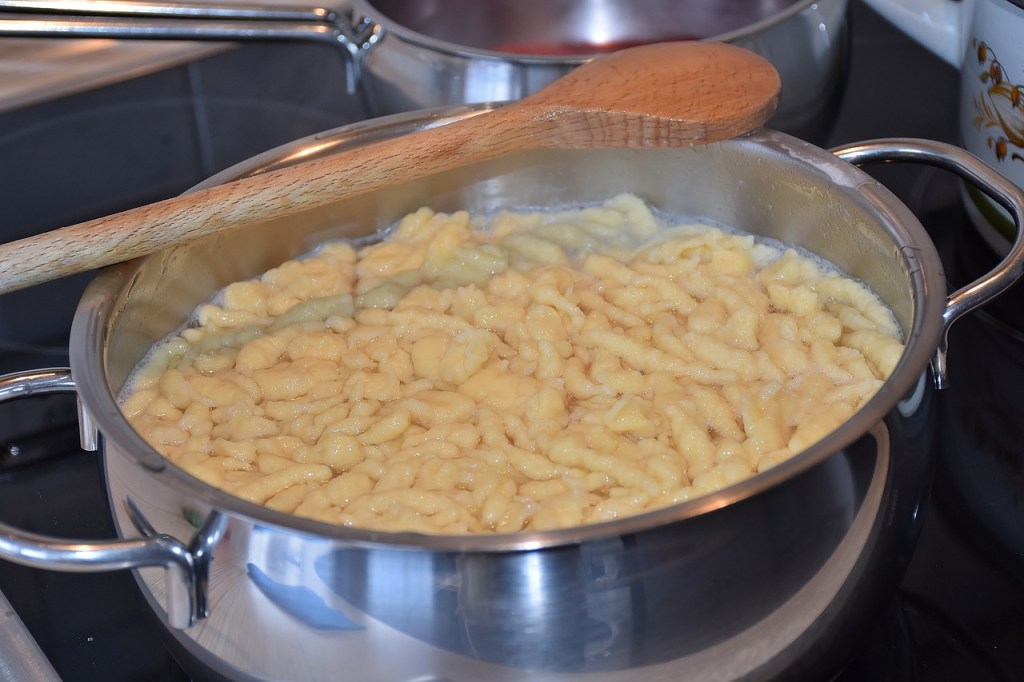
- No matter how you form the noodles, they are then dropped into boiling salted water. They are only cooked until they rise to the top, which shouldn’t be more than a couple of minutes. This might need to be done in batches as you do not want to crowd the noodles.
- Once cooked, they are generally sauteed in melted butter and garnished with fresh herbs, cheese, bacon and/or breadcrumbs.
- Spätzle can be made in advance, cooled, and stored in a covered container in the refrigerator for 3-4 days. To reheat, sauté in melted butter.
- Spätzle may also be frozen for up to 3 months. When ready to use, thaw overnight in the refrigerator.
If you have eaten spätzle, has it only been in a restaurant or when you purchased a package in the store? This dish requires very few ingredients and can be made relatively quickly once you master the technique. I hope you give it a try!

 Culinary Journeys, LLC