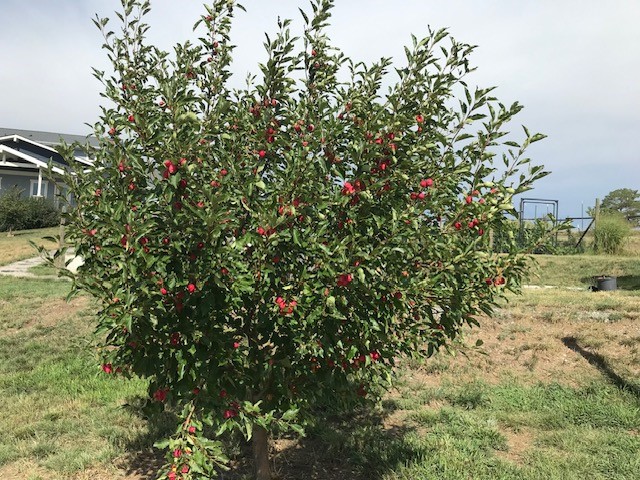
Sitting at my desk this morning, I looked out the window towards our backyard where the chickens roam, the bees buzz, the flowers bloom, and tree fruit is trying desperately to ripen in Colorado’s less-than-ideal growing conditions. As I look, I see a beautiful green tree with deep red crabapples on it. That is the subject of this Cooking Tip. Are those apples just ornamental, or are they edible? (See this Tip for a discussion on apples in general.)
According to the experts, crabapples are not a different type of fruit than other apples. However, one distinction is that they are the only apple native to North America. What determines if it is a crabapple is its size. If it is under 2 inches in diameter, it is called a crabapple. If it is larger, it is an apple.
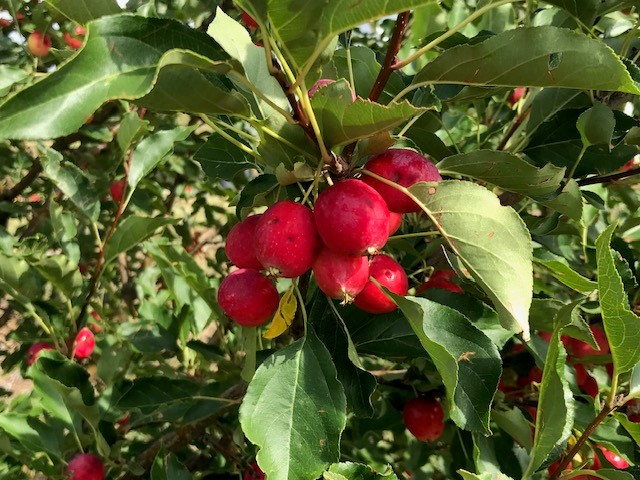
Breeding is another difference. The apples we eat for lunch have been bred to be larger and better tasting. Crabapples are bred more for ornamentation. Some varieties are purely ornamental, with no or minimal fruit. Even those crabapples with fruit have not been bred to produce particularly great tasting fruit. Although edible, they are much tarter and sourer than other apples.
Some crabapple varieties are sweeter and better for culinary uses. The two that are described as the sweetest are the Dolgo and Centennial. The Chestnut and Whitney are especially good for other culinary purposes.
Dolgo
What I see when looking into our backyard is a Dolgo crabapple. Its size is larger, and its flavor is sweeter than other varieties. Besides eating, it is commonly used to make ciders, sauces and jams.
Centennial
Some like to eat the Centennial crabapple right off the tree, while others feel it is ideal for jam, jelly, or apple butter.
Whitney
The Whitney crabapple is a smaller tree that yields larger and sweeter fruit than many other crabapples. Its great uses include preserving, canning, and pickling.
Chestnut
The flavor of a Chestnut crabapple is described as sweet and nutty. It is well-suited to jams and sauces.
Uses for crabapples
- Crabapple Jams & Jellies – the sourness of the crabapple will be offset by added sugar.
- Crabapple Butter – Apple butter made from crabapples will be pink with a more complex and sweet-tart flavor.
- Crabapple sauce
- Crabapple fruit leather
- Caramel crabapples
- Pickled crabapples
- Crabapple chutney
- Crabapple syrup
- Crabapple juice/cider
- Crabapple liqueur
- Crabapple crisp/tart/pie
Disadvantages of crabapples
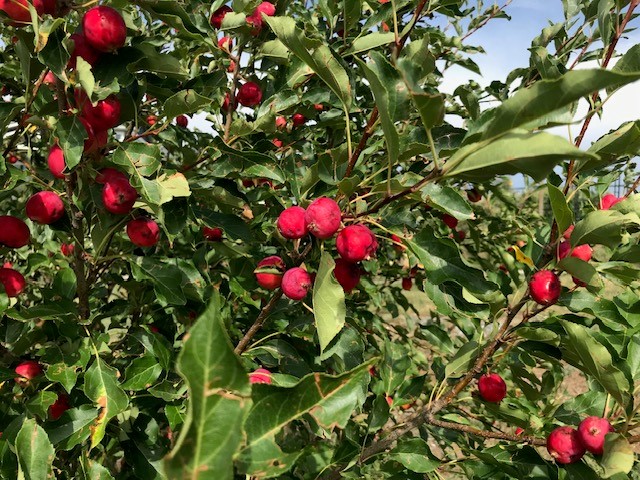
- One of the main disadvantages of using crabapples is the increased labor due to their small size. It takes more work to harvest a sufficient amount, and there is increased kitchen labor to get them ready for your desired dish.
- As noted above, their natural flavor is sour and tart. This can be adjusted by adding sweeteners and spices, although the result won’t be exactly as it would be with regular apples.
- The flesh will not get as smooth as other apples, even when cooked and pureed.
According to Robinette’s Apple Haus & Winery in Michigan, winter is the best time to pick crabapples. Although they do ripen during the fall, “freezing temperatures make the crabapples soft and sweet.” Alternatively, they recommend picking them and putting them in your freezer for a couple of days before using them.
What about the myth that you might have heard that crabapples are poisonous? The peel and flesh of the crabapple are perfectly safe to consume. Like all apples, the seeds are toxic and should not be consumed.
If you do not have a crabapple tree growing in your backyard, where do you get them? You probably won’t find them in your general supermarket, but some farmer’s markets carry them. They should be able to tell you which variety they are so you can plan accordingly.
They are also a favorite of foragers since they tend to grow in all sorts of areas. As with any foraging, care must be taken. See this Tip for guidance.
Enjoy apple season, whether it is regular apples or crabapples!

 Culinary Journeys, LLC