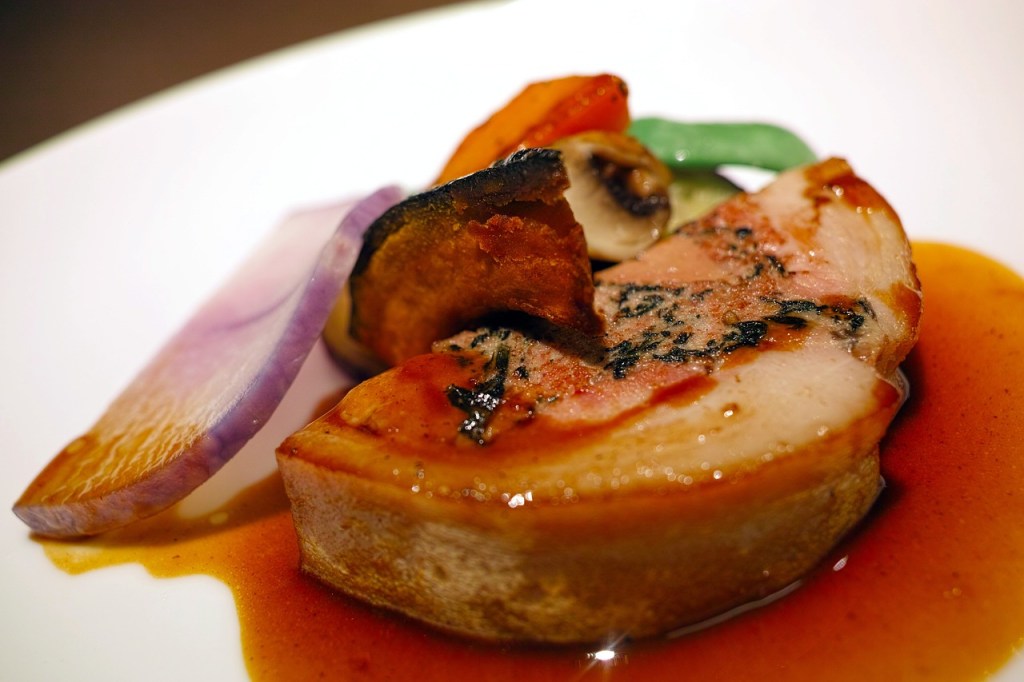
If you read much about French cooking, you will encounter the classic delicacy of foie gras. Besides being decadent and elegant, it is also controversial and polarizing. This cooking tip will explain what foie gras is and why there is this controversy. The first part of the discussion will define foie gras and its different categories. The controversy about foie gras will follow that.
Foie gras is the fattened liver of a duck or goose, but more commonly, a duck. It is produced by gavage, described as the force-feeding of ducks or geese through a tube inserted into their mouths and down the esophagus. This increased food intake leads to an elevated fat content and a distinctive flavor that is described as rich and buttery. The process is said to date from 2500 BC.
Foie gras is typically served as an appetizer or as a bread topping. Fruit flavors work very well with foie gras, particularly plums, grapes, and apples. Therefore, it might be served with bread and a fruit chutney.
There are different ways to categorize foie gras; they can be confusing and somewhat inconsistent from source to source. I will try to simplify it for you.
Foie gras entire (whole foie gras) refers to a whole liver made from one or two lobes. It may be raw or cooked with minimal seasoning, allowing the natural, rich flavors of the liver to dominate.
Foie gras is used for pieces of foie gras, not entire lobes, pressed together and seasoned.
Bloc de foie gras means reconstituted foie gras and refers to a cooked, formed block of which 98% or more is foie gras. One source likened the difference between this and “whole” foie gras to ground beef and a steak. Industrially produced Bloc de Foie Gras is actually a pâté made from minced foie gras and seasoning.
There are a few other products that contain foie gras plus other ingredients.
Pâté de foie gras: this must contain at least 50% foie gras. The liver is mixed with other meats, seasonings, and often some form of alcohol such as spirits or wine. The result is a spreadable, richly flavored paste that can be used on toast, crackers, or other dishes.
Parfait de foie gras: a parfait of foie gras is required to contain a minimum of 75% foie gras.
Mousse de foie gras must contain 50% or more foie gras. It has a creamy and airy texture due to being whipped either with just air or sometimes with dairy. Besides the lighter texture, the intense flavor is diminished somewhat.
Livers are also graded for quality.
Grade A livers are the best quality and are the largest at over a pound. They are firm, smooth, sweet smelling, consistent in color, with no blemishes. This is the type that a chef will prepare simply – seared, sautéed or in a terrine. It is also the most expensive.
Grade B foie gras will be smaller (under a pound) and somewhat softer in texture. They may have some minor surface defects and blood spots with more prominent veins. Although it has excellent flavor, chefs use Grade B in items such as pâté, mousse and terrines, where the blood content will dissolve with cooking.
Grade C is less prevalent than the other two and is generally not available on the retail market. It is often used to flavor and thicken sauces, although it can also be used in mousses and pâtés.
Now, let’s turn to a discussion of the ethics of foie gras production. According to Chowhound, the anti-foie gras movements started appearing in the 21st century, and the first country-wide ban (India) was in 2014. Since then, a few other European countries have followed suit with some level of ban. As you might expect, France is not one of those countries. Outside of Europe, bans are less common but are said to exist in Turkey, Australia, Israel, and Argentina.
Even in countries with bans, most still allow the importation of foie gras. India is one where even that is prohibited.
Different US cities and states have attempted to ban it, but these actions are usually challenged in court and are not always upheld. California has had more success in banning foie gras. In 2004, a ban on both sale and production was imposed. A court case forced the state to allow sales of out-of-state foie gras although the production is still banned. You will not see it in restaurants, as residents are still barred from ordering out-of-state foie gras and reselling it.
Why do some people and organizations seek bans? The following reasons are given.
- The living environment for the birds is overcrowded and in cages.
- The birds are force-fed more than they would naturally eat, causing their livers to grow multiple times their normal size.
- The feeding method causes esophageal inflammation.
- There is significant stress from the capture and insertion of the feeding tube.
Those who disagree with the bans give the following arguments.
- Ducks’ throats are designed for swallowing rocks and eating whole fish, including fins, so the tube insertion is not traumatic.
- The duck’s crop is made for stretching to hold food and stretching to several times its original volume.
- Ducks lack a gag reflex.
- Ducks have two pathways – one for breathing and another for eating.
- There are good farms that use very humane methods. Some say all the US-based foie gras producers fall into this category. It is argued that one should not ban a product based on bad farms. There were three leading US foie gras producers. The ban forced a California one (Sonoma Artisan Foie) out of business. The two remaining ones are both in New York State.
- Looking at Europe, there is the European Federation of Foie Gras.
- Their objectives (taken verbatim from their website) are:
- To promote foie gras, a thousand-year-old cultural and gastronomic tradition, and the profession of foie gras producer.
- To develop common reflexions and proposals at European level on the various topics of interest to the sector.
- To make European policy makers aware of the foie gras sector and, in particular, of its production methods.
- To establish a continuous exchange of experiences and know-how among member countries for a constant improvement of practices.
- The production method
- There are two stages to foie gras production. You can read more on this page, but here is a summary.
- The rearing stage—Birds are said to spend 90% of their lives outdoors during this stage.
- The fattening stage—This amounts to 10% of the animal’s lifetime. They choose only healthy adult ducks or geese, and they are fed twice every 24 hours for about 12 days for ducks and 16 days for geese. According to Hudson Valley, the feeding time is only for a few seconds each time.
- They note the “particular anatomical characteristics (possible alignment of the beak and neck thanks to the absence of cartilaginous glottis, the elasticity of the walls of the esophagus) which allow them to swallow large prey such as fish or frogs and predispose them to the fattening phase during the production of foie gras.”
- Their objectives (taken verbatim from their website) are:
The purpose of this Cooking Tip is not to take a side in this debate. It is to give you the information so you can decide if you wish to try this French delicacy and, if so, to provide you with the knowledge to know what to purchase.

 Culinary Journeys, LLC