Sauces are one of my favorite things to make. They are easy, and they elevate food from ordinary to delicious. I have written three prior Cooking Tips – Sauces Demystified, Mother Sauces I and Mother Sauces II on different types of sauces. One sauce I have not discussed is Beurre Monté. That is the subject of this Cooking Tip.
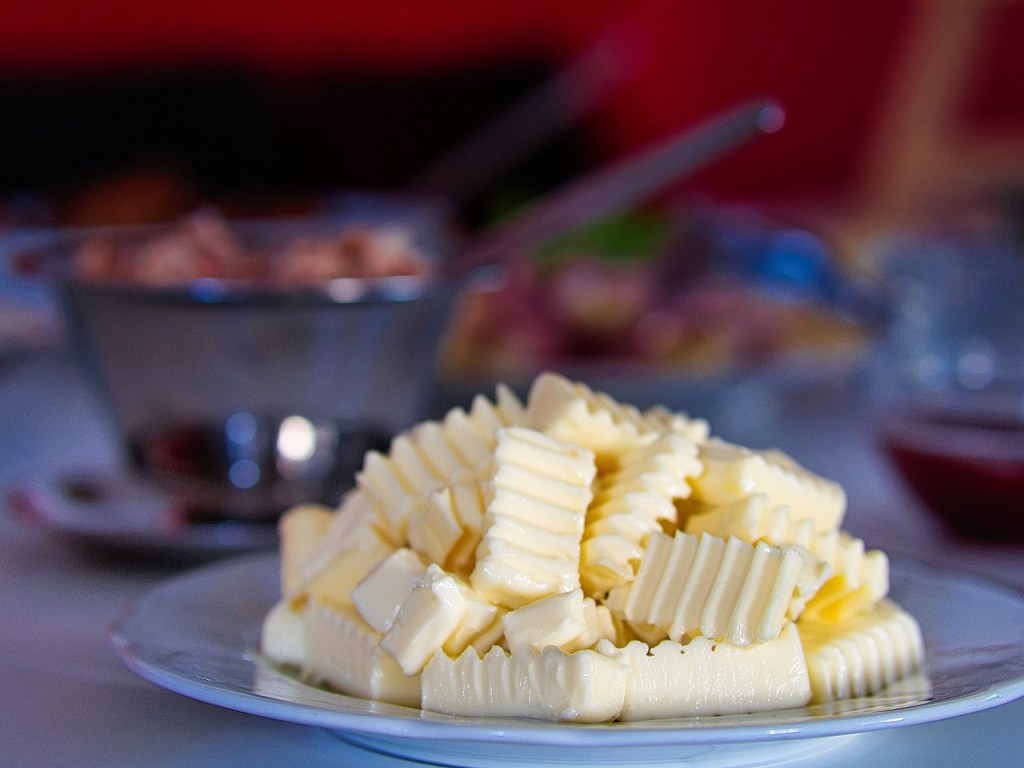
As you might suspect, beurre monté is a French invention. It is translated in various ways: “worked up butter,” “prepared butter,” “mounted butter,” or “whipped butter.” It is also a very simple and delicious sauce, as long as you don’t mind that it is made almost entirely of butter.
We all know that fat and water do not mix. We must force them to do so by the process called emulsification. This is done by slowly adding one ingredient to the other while vigorously mixing. This suspends tiny droplets of the one into the other. Vinaigrettes are one type of emulsion. The water element is typically vinegar, citrus juice, fruit juice or a combination. The fat usually is olive oil. If you pour them together, they will naturally separate. It is only by whisking the water-like ingredient while you slowly pour in the oil that you will get them to combine into an emulsion. They will often separate when setting, but you can again re-emulsify the mixture by shaking or mixing.
If you have read my Sauce Cooking Tips, you will have read that most pan sauces are finished by whisking a small amount of cold butter into the sauce. This thickens the sauce and gives it a glossiness and richness. That process is called “monter au beurre.”
Although it sounds similar, beurre monté is different. It is an emulsion, one that is made by whisking cold butter into simmering water. As one source puts it, it is the “lifeblood of many professional French kitchens.” That sounds like it would also be a good sauce for us home cooks to know.
There are only two ingredients – butter and water. Cooks Illustrated will tell you that the ratio of butter to water is crucial. You want only enough water for the fat droplets to disperse themselves without the result being too thin and watery. However, not everyone is such a stickler for that ratio.
Cooks Illustrated recommends three tablespoons of water to eight tablespoons of butter. Thomas Keller of The French Laundry uses four tablespoons of water to one pound (32 tablespoons) of butter. Masterclass agrees with Keller.
Despite your water-to-butter ratio, all agree on the method. Bring your water to a boil and reduce to a very low simmer. Start whisking the cold butter in piece by piece. You want the butter to melt and break into droplets that you emulsify in the water bit by bit. Continue this process until you have emulsified all the butter. Season to taste and you are done.
Feel free to try some variations on this basic recipe.
- Stock – substitute stock for water, but be cautious of the sodium content.
- Herbs – whisk in minced fresh herbs. Hardy ones (rosemary) can be added at the start, but more delicate ones (tarragon) should be added at the last minute.
- Preserves, liqueurs, juice – After adding the butter to the water, whisk in 1½ Tablespoons jam or jelly and 1½ teaspoons of liqueurs or juice. Cooks Illustrated recommends raspberry jam plus Chambord, apple jelly plus brandy, or plum preserves plus amaretto.
Some might ask how this is different than just melting butter by itself. The result is quite different. Melted butter will be thin and just run off the food. By contrast, beurre monté coats and clings to the food and provides a more luxurious experience.
How would you use beurre monté?
- As a sauce on its own for meat, fish, pasta or veggies.
- As a base for another sauce. Make the beurre monté and add other flavorings such as herbs, spices, lemon juice, shallots, jams, liqueurs and more.
- As a poaching liquid for veggies, delicate meat or seafood. Because of fat’s low heat conductivity as compared to water, it will allow you to cook meat and fish more gradually, giving you a tender and not overcooked result. It also infuses the meat and fish with the flavor of butter.
You may make smaller amounts to meet your immediate needs. You can also make it ahead and hold it for up to 4 hours. To do that, put a lid on the pot and keep it warm but only at a sub-simmer, 135-160°F.
The leftover sauce may be refrigerated but will not have the same texture upon reheating. Instead, upon reheating, use it as you would regular melted butter. You could also heat it to turn it into clarified butter by removing the milk solids.
I do not know about you, but I have some salmon in my freezer that is just calling out to me for it to be dressed in a beurre monté. What about you?

 Culinary Journeys, LLC