When you hear the word Meringue, what do you think of? Do you think of that soft and fluffy topping on your lemon pie? Or, do you think of the swirly, crisp cookies that melt in your mouth? What meringue is and how to make it is the subject of this Cooking Tip.

By definition, meringue is a mixture of beaten egg whites and sugar. It can be as soft as what you find on that pie or a Baked Alaska. It can also be baked into what is termed a hard meringue. Examples of these are little meringue cookies or a Pavlova. The latter is a dessert with a hard meringue base topped with fruit and whipped cream.
Since egg whites are the main ingredient, one must know how to separate the egg whites from the yolks. Eggs are easiest to separate when they are cold. However, they whip up faster and with more volume when at room temperature. Therefore, one of your first steps is to take your eggs out of the refrigerator and separate them. Put them in a bowl and allow to set at room temperature while you finish your prep for the particular recipe.
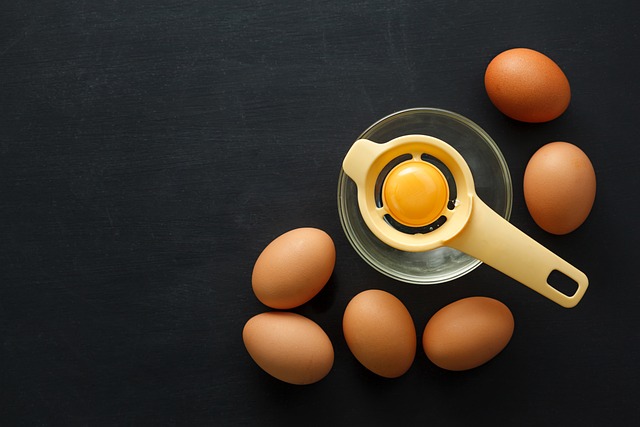
Have you ever had a time when you just couldn’t get the egg whites to whip up properly? If that happens, the main culprit is fat. The presence of fat in the egg whites prevents them from whipping up in volume and texture.
Here are tips to help you have success in whipping egg whites.
- Fat may be present if you allow some of the egg yolks to get into the whites. To prevent this, consider using the three-bowl technique for separating your eggs.
- Separate one egg putting the white into Bowl #1 and the yolk into Bowl #2.
- Separate the remaining eggs one at a time, allowing the white to drip into Bowl #3.
- After each one, put the yolk with the other ones in Bowl #2.
- If the egg white you have put into Bowl #3 looks clean of yolk, add it to Bowl #1. This way, if you accidentally get yolk into a white, you can set it aside so it doesn’t contaminate all the whites in Bowl #1.
- Always use a clean glass or metal bowl. Try not to use a plastic bowl as they will often have a coating of fat on them, inhibiting whipping.
- Ensure your beating implements (mixer blades, whisks) are clean of any fat.
- Cream of tartar – adding a small amount of this ingredient helps to stabilize the egg whites. Use ⅛ teaspoon for every egg white.
There are three basic methods of making meringue.
- French meringue is made by beating egg whites to the foamy stage (45-60 seconds), slowly adding sugar, and continuing to beat into a soft, airy, light mixture. This method can be a bit fussy as adding the sugar too early or too late can lead to disappointing results.
- Cooks Illustrated tested the timing of adding sugar to the egg whites.
- They made three batches each of meringue cookies, angel food cake and chiffon cake. They varied when they added the sugar – before whipping, after a minute of whipping and at the end.
- The best result for all the tests was adding the sugar after a minute of whipping. Adding at the beginning gave dry cakes. Adding at the end resulted in dense and crumbly cakes.
- For meringues, adding at the start gave dull cookies with a very fine crumb. Adding late resulted in an overly airy and grainy texture. They compared the taste to Styrofoam.
- It is also helpful to add the sugar a couple of tablespoons at a time until it has all been incorporated. Adding the sugar slowly ensures all the sugar is dissolved. This type of meringue is the least stable. Therefore, it is usually used when it is going to be baked – either in a cake batter, meringue cookies or a meringue shell.
- Cooks Illustrated also tested the speed of whipping the egg whites.
- They tested this with meringue cookies, meringue frosting, chocolate mousse and chiffon cakes. They tried two methods of whipping – slowly until foamy and then finishing on high and beating on high the entire time.
- The slow start produced a meringue about 10% more in volume. This gave cookies and frosting that were lighter and airier.
- With the cakes, they were indistinguishable.
- Swiss meringue is prepared by putting the egg whites and sugar into a bowl that sits above boiling water – a type of bain marie. When the mixture reaches a temperature of about 120° to 140°F, the mixture is removed from the heat and then beaten to stiff peaks. This method results in a less fluffy meringue than French and less stable than Italian. The recipe testers at Serious Eats claim to have found a technique that will make your Swiss meringue as light as a French meringue but as stable as Italian. They do this by cooking it to a higher temperature – up to 175°F. They also whip it vigorously at high speed for about 5 minutes until it is glossy, thick & stiff. This type of meringue is often used as the base for buttercream frosting. Cooks Illustrated agrees with a higher temperature. They recommend heating the whites to 160°F and increasing the amount of sugar to make pavlovas, saying it produces the result of a crisp shell with a marshmallow-like interior
- Italian meringue starts by putting the egg whites into your mixer bowl and beating to soft peaks. Then, a sugar syrup that has been heated to 240°F is slowly drizzled in while you continue to whip until the meringue is very voluminous and reaches the desired peak. Because this sugar syrup is very hot, one must be very careful when using this method to prevent burns. It is the most stable of the meringues but is also heavy and thick. It is used to make nougat and is also the best for topping meringue pies.
What are the culinary uses for meringues?

- Meringue-topped pies or Baked Alaska
- A French meringue is recommended for these recipes.
- Because the meringue is made with raw egg whites, be sure to bake it so that the internal temperature reaches 160°F.
- Because of this concern, some recommend using meringue powder as the egg whites have been pasteurized. It is made with dried, powdered egg whites and also contains sugar, silicon dioxide, corn starch, citric acid and cream of tartar. Cooks Illustrated tested this product to see if it would work in making pavlova, uncooked royal icing, and seven-minute frosting. In all the tests, they found the meringues were dense and grainy, and the frostings were extremely sweet and thin. For these reasons, they do not recommend this product.
- Meringue cookies are small, light cookies with a crunch throughout.
- A French meringue is typical.
- Pavlova is like a large meringue cookie, but whereas it has a crispy shell, the interior is more marshmallow-like with a chewy texture.
- It is generally made with a French meringue to which cornstarch and an acid (usually white vinegar) are added along with flavorings. It is then spread out on a parchment-lined baking sheet and baked in a low oven until the outside is crisp. The oven is then turned off, and the meringue is left inside the oven to finish drying out.
- Cooks illustrated tried making a pavlova with an Italian meringue. Although the usual temperature the meringue is cooked to is 140°F, the resulting meringues were coarse and had a pitted exterior. They increased the temperature that they cooked the egg whites to 160°F. This gave a smoother texture, but the exterior was too soft. They found that increasing the amount of sugar gave them the crispy shell they wanted. They recommend 1 ½ cups of sugar to ¾ cup of egg whites. Because the ratio is important, they recommend measuring or weighing these ingredients. For large eggs, this will probably be six egg whites.
- Typical pavlova recipes call for adding cornstarch and vinegar to the egg whites after whipping. They also tested this and found it solid advice. They recommend adding 1½ teaspoons of each.
A final interesting point is for those of you who would like a plant-based alternative, and that is aquafaba. Aquafaba is the liquid from a can of chickpeas. Cooks Illustrated tested this using four ounces of aquafaba and four egg whites. They heated the aquafaba and dissolved the sugar in it. After allowing the mixture to cool, they added cornstarch and whipped it with salt, vanilla and cream of tartar. They were pleasantly surprised that the result was a whipped-up mixture that was sticky and “taffy-like.” So, if you want an egg-free alternative, give it a try!
As baking season progresses, I hope you consider making meringues. A browned meringue-topped pie is beautiful on your table. A pavlova with its crisp white base and the topping of fresh fruit and cream is a showstopper. Little meringue cookies are not only wonderful to eat, but they also make very nice gifts, especially when flavored and colored.
Happy Baking!

 Culinary Journeys, LLC