Cantaloupes are my absolute favorite fruit to feast upon during the summer. Because the melons in the supermarket are often not ripe and are somewhat tasteless, I am happy that my husband grows them for me. This also allows me to enjoy different types of cantaloupes I cannot get at the stores. Some stores have sold some of these other varieties in recent years, and I encourage you to buy them if you can find them. In this Cooking Tip, I want to explore cantaloupes to help you pick the best. Of course, nothing beats the flavor of a melon picked off the vine when ripe. If you do not have the luxury of doing that, read on for some varieties to search out.
Most of the US cantaloupes are grown in California, followed by Arizona. They are, though, grown in other states in limited quantities. These states are Georgia, South Carolina, Florida, Texas, Indiana, Illinois, Pennsylvania, Colorado and Maryland.
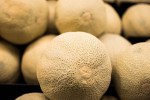
The classic cantaloupe we see in our stores is Cucumis melo Reticulatus, which refers to the net-like appearance of the skin. They can be seen in all food markets during the summer months. For some stores, that is all you will see. Many other varieties can be grown in your garden, but you will probably only see one or two other types in the store. Here are a few you might be able to find.
Tuscan melon
This melon is a cultivar from two Italian melons. In the US, Tuscan-style melons were introduced by Dulcinea Farms (now owned by Pacific Trellis Fruit) in 2004. Subsequently, the company also introduced Tuscan Style Extra Sweet, which they say is an improved version.
They look similar to our standard cantaloupe but usually have more prominent green or yellow stripes on the exterior. They have a sweeter flavor than the regular cantaloupe. Also, the flesh becomes softer and sweeter as the stripes change from dark green to lighter green to tan.
Charentais melon
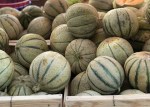
As the name implies, this is a French heirloom variety. It is said to have originated in the Charentes region of France. Being associated with the French town of Cavaillon, which holds an annual festival (Fête des Melons), it is sometimes called the Cavaillon melon. Most pure Charentais melons are grown in France and are not exported due to the fact that the soft skin and flesh mean the melons do not survive shipping. Therefore, the ones we see in the US are probably a hybrid and have been crossed with North American cantaloupes.
It is usually smaller than the standard cantaloupe, and the flesh is more orange. The exterior varies from grey-green to pale green with dark green stripes. The stripes will darken as it matures, and the exterior will develop a yellow hue.
It is one of the sweetest melons you can buy and is widely touted as the best melon in the world.
Sugar Kiss melons
A hybrid melon that originated in Taiwan, it was bred to have superior flavor and texture. The name comes from the high sugar content, creating a beautiful taste. The texture is one that melts in one’s mouth. Unlike other melons, they are only harvested when ripe.
They are part of a proprietary line of melons called Kiss melons. Other melons in this line are Golden Kiss (a hybrid of the European Charentais), Honey Kiss (a Chinese variety), Summer Kiss (a native of Israel said to be a mixture of cantaloupe and honeydew) and Kiss Limón (sweet and tart with citrus notes).
Until recently, they were easily recognizable in stores as they were packed in blue netting. This year, I found some labeled “Sugar Kiss” but not packed in the netting. The flavor was not as wonderful as the Sugar Kiss from prior years. Besides the taste, what makes me wonder about the melon I purchased is this statement from the growers about why they use the netting. They do not state that they are no longer packing the melons in this manner.
The general advice I wrote in this Cooking Tip on picking fresh fruit does apply to melons, although there are exceptions. This advice is:
- Weight – ripe fruit tends to feel heavy compared to its size. If the fruit feels light, it is either unripe or perhaps over-ripe.
- Pressure – pressing gently on the fruit should yield some give.
- Aroma – ripe fruit should be fragrant but not overpowering.
- Color – A light green color on fruit usually indicates that it is not ripe.
Some varieties, such as Sugar Kiss melons, naturally have minimal aroma even when ripe. Also, the lack of a green color may not always be accurate. According to the California Cantaloupes website, the primary type of cantaloupes once grown in California were called “Western Shippers.” Because these cantaloupes produce ethylene, a gas that speeds ripening, they tend to spoil fairly quickly. Due to this, fewer of these have been planted; as of 2022, they say only a few Western Shippers are grown.
The main type of California cantaloupe now grown is a newer variety. These do not emit ethylene, which means a longer shelf life. This also means that they do not give off the same sweet smell. Growers call these LSL (Long Shelf Life) and ESL (Extended Shelf Life), although you will not see them labeled as such in the stores.
California Cantaloupes claim they are sweeter due to a higher sugar content. They do want us to understand some differences that stray from the general advice listed above.
- Pressure – the flesh is firmer, and the exterior shell is harder. This helps to achieve a longer shelf life. If the blossom end (the end opposite the stem) begins to show a bit of cracking and gives when gently pressed, it is an indicator of ripeness.
- Aroma – they lack that prominent melon aroma. I have personally noticed that today’s cantaloupes do not have a nice aroma, and this may be why.
- Color – these new varieties may often have a somewhat green hue. The growers advise us not to be deterred by this slightly green cast.
If you love cantaloupes as much as I do, I hope this information will help you get the best melon possible. If you have never tried other varieties, I encourage you to seek them out. I have faith that they will elevate your melon-eating experience!

 Culinary Journeys, LLC