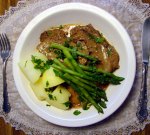
As the cooler weather approaches, what and how we cook often also changes. We gravitate towards heartier dishes and are willing to cook dishes that take a bit more time. One of the cooking skills for this type of cooking is Braising. This Cooking Tip will explain what it is and how to put it to use in your kitchen. Although braising is not limited to meat, it is the most common food item to be braised and is the one I will discuss.
According to Harold McGee in On Food and Cooking, the word braise is said to come from 18th-century French. It comes from a word for “coal” and refers to putting coals under and atop the cooking pot.
Braising is the act of slowly cooking a piece of meat in a moist environment. To add a bit more detail, the meat is browned in fat and then cooked in a small amount of liquid in a covered pan over low heat for a long time. This long slow cooking develops flavor and tenderizes the food.
Even though you do not need a recipe to produce a delicious braised meat dish, most of us will probably turn to a recipe. The problem is that most of these recipes include instructions that do not stand up to the science of making a proper braise. I will explain below and will incorporate wisdom from both Harold McGee (On Food and Cooking) and J. Kenji López-Alt (The Food Lab).
First, what cuts of meat are best for braising? The good thing is that the best cuts of meat are also the least expensive. You want to select fatty, tougher cuts of meat. Just a few examples are:
- Chuck
- Brisket
- Pork shoulder
- Boston butt
- Lamb shoulder/shanks
I will list the basic steps to braising and will follow with the elaboration of those steps.
- Brown the meat.
- Add and cook aromatics.
- Add liquid and seasonings.
- Cook in a covered pot until done and the meat is very tender.
- Use the remaining liquid to make a sauce.
Browning the meat
- Start by removing excess fat, silver-skin, etc. from the meat. Season with salt and pepper.
- Keep the meat as intact as possible so there are fewer surfaces through which juices can escape. If you must cut the meat to fit into your pot, cut it into as large of pieces as possible.
- Heat oil in a heavy pot until hot.
- Add meat and sear each side just until brown. You want to get a nice sear while at the same time minimizing the warming of the interior of the meat.
- Some chefs like to lightly dredge the food in flour that will later develop body in the sauce. Most, though, will do this later by other methods.
- Once browned, remove meat from the pan.
Start building flavor by adding aromatics
- Start with something from the onion family such as leeks, shallots, onions and/or garlic.
- Many chefs start with a classic mirepoix of carrots, celery and onion.
- The moisture that will be released from the vegetables will help to deglaze the pan and incorporate the flavorful fond into the liquid.
- Other possibilities include items such as:
- Additional vegetables (butternut squash, carrots, parsnips, celery, fennel, mushrooms, turnips, rutabaga)
- Herbs
- Fruit
- Spices
- Some recipes call for adding tomatoes, which are an acidic ingredient that helps to break down the food.
- J. Kenji López-Alt likes to add umami with anchovies, Marmite, Worcestershire sauce or soy sauce.
Add liquid
- Start by deglazing the pan with wine, vinegar, beer, stock or water.
- Add additional liquid of your choice. Common liquids are:
- Broth
- Juice – apple, cranberry, tomato
- Combination of broth and dry wine or water
- The liquid should cover the meat by ⅓ to ½. The meat should only be partially covered, not submerged.
- Bring liquid to a simmer, taste and adjust seasoning.
- Return meat to pan.
Cook mixture until done
This is the step where recipes can mislead you and give you an inferior result. The variables are the use of a lid, the cooking temperature and the cooking method.
Meats with significant amounts of tough connective tissue must be cooked to a minimum of 160-180°F to allow the collagen to dissolve. However, muscle fibers begin to lose their juices at 140-150°F. So, it can be a challenge to keep these tough meats juicy. The key is to cook slowly at or just above the temperature to dissolve the collagen. This minimizes the drying out of the meat.
Lid – Most recipes will tell you to tightly cover your pot. The truth is that you should leave the lid slightly cracked. This helps with temperature regulation. If the pot is completely sealed, the liquid gets too hot. A tightly sealed pot will allow the liquid to get to a boiling point, which you do not want as it will dry out the meat. By leaving the lid slightly ajar, the temperature of the liquid will stay around 185°F. This lower temperature allows the collagen in the meat to slowly break down while still maintaining moisture within the meat. Hotter liquid also leads to overcooking the outer part of the meat before the entire cut is done.
Cooking temperature
Once again, many recipes will give you bad advice. They will recommend an oven temperature of 300-350°F. This is much too hot to be able to keep the liquid well below the boil and around 180°F. Experts who understand this will recommend setting your oven much lower.
Here is Harold McGee’s method.
- Start the pot with the meat and liquid in a cold oven. Let the lid sit slightly ajar to allow some evaporation. Set the oven to 200°F. This should allow the contents to rise to about 120°F over two hours.
- Raise the oven temperature to 250°F so that the contents warm from 120°F to 180°F.
- After an hour, check the meat every half-hour. Stop cooking when the meat is easily penetrated with a fork.
Here is J. Kenji López-Alt’s method.
- Preheat oven to 275°F
- Return meat to the pot and put on a lid slightly cracked.
- Cook until meat is tender.
Cooking method
- Many will tell you that you can cook a braise either stovetop or in the oven. This is true but for superior results, opt for the oven.
- The difference is that:
- The stovetop maintains a constant heat output.
- An oven maintains a constant temperature.
- Cooking stovetop means that although the mixture is barely simmering when you start cooking, it will probably creep up to a boil as the heat applied to the pot from the burner is constant (unless it is monitored and adjusted.)
- In the oven, the temperature of the food stays the same. Also, the heat surrounds the pot rather than just coming from the bottom.
- No matter which method you use, you should check periodically to ensure the liquid has not evaporated.
Finishing steps
- Allow the meat to cool in the liquid. This results in reabsorption of some of the liquid, giving you a juicier result.
- It also makes the meat easier to slice.
- After removing the meat, the liquid should be turned into a delicious sauce. There are different ways to do this.
- Some will recommend reducing the liquid to a sauce consistency by boiling.
- Others will recommend thickening by using a roux, beurre manié or starch slurry.
- Another method is pureeing the mirepoix and then returning it to the sauce.
- Always finish by tasting and adjusting the seasonings.
The classic example of a braise is the all-American Pot Roast. However, this is not your only option. By following the above steps, you do not even need a recipe. If you are using a recipe, please adjust it in the above ways to ensure the best result.
Happy Braising!

 Culinary Journeys, LLC